Walter Thomas Huston was born on April 6th, that is confirmed, what is not, is the year, some say 1883, others, 1884, depending upon the source. While his agreed place of birth was Toronto, Ontario, Canada. Walter's mother was Elizabeth McGibbon, his father was a farmer turned founder and owner of a construction company, Robert Moore Huston. He was one of four children, a brother, and two sisters.
In 1902, the either 18, or 19-years-old, made his acting debut on stage. On February 22, 1904, in Denver, Colorado, Walter Huston appeared in the cast of Hal Reid's, "In Convict Stripes". That year was important to establishing the young actor. He also appeared with the distinguished German-American "Shakespearian" actor, Richard Mansfield, in a production of "Julius Caesar".
Note: In 1888, while appearing at the Lyceum Theatre, in London, starring in a play version of Robert Louis Stevenson's, "Dr. Jekyll and Mr. Hyde". Richard Mansfield came under suspicion of Scotland Yard as being "Jack the Ripper", because of his uncanny performance as "Mr. Hyde".
Walter Huston, would also tour in playwright, Wilson Barrett's religious epic, "The Sign of the Cross", and ended a busy 1904, in St. Louis, Missouri, on December 2, 1904, with his marriage to Rhea Catherine Gore. Their son, and Walter's only chid, John, would be born on August 6, 1905, or 1906, once more, depending upon the source, in Las Vegas, Missouri.

In 1909, with problems in his marriage, Walter met vaudevillian, Bayonne Whipple, actually Fanny Elmina Rose, called Mina Rose, seen below in 1908.
Huston and Whipple formed an act and started touring. While in 1912, or 1913, depending upon the source, Walter and Rhea divorced, and in December 1914, he married Mina.
According to Charles Foster's, "Once Upon a Time in Paradise: Canadians in the Golden Age of Hollywood", at:
https://books.google.com/books?id=cb49Y-xN5TcC&dq=Bayonne+Whipple&pg=PA148#v=onepage&q&f=false
Walter Huston described his vaudeville act with his wife as:
We sang, danced, did comedy skits, and managements soon found out that we could do the time on stage of three acts, so they hired us, so they wouldn't have to pay the salaries of the two acts we replaced.
Walter's son John, would spend his time split between his two parent's. With his father, as Walter toured in vaudeville, and with Rhea, at horse races and other sporting events. Then, on January 22, 1924, Walter Huston found himself at the "39th Street Theatre", on "Broadway, portraying "Marshall Pitt", in "Mr. Pitt". The course of his career had just changed dramatically.
However, this is a motion picture blog, so I turn to Walter Huston's first on-screen appearance. Released on February 23, 1929, he starred in the 15-minute SOUND short, "The Carnival Man". The short is lost and what the film was about and the name, other than the title character if there was one, are also lost.
What we do know about this short is that it co-starred Ninetta "Nan" Sunderland, seen below with Walter Huston. In 1931, Bayonne Whipple divorced Walter Huston, and he married Nan Sunderland.
Another 22-minute short, "The Bishop's Candlesticks", followed "The Carnival Man", and Walter Huston found himself in his first, and forgotten, feature length motion picture.
GENTLEMEN OF THE PRESS released on May 4, 1929
The story is based upon a 1928 Broadway Play, from playwright Ward Morehouse. The story is about a driven newspaper man. Who doesn't realize that he is missing out on the joys and sorrows of ordinary life.
Above standing second from left is Walter Huston portraying "Wicknell Snell". To his right, the actor in the first chair seated is Brian Donlevy, in the uncredited role of "Kelly".
Walter Huston followed "Gentlemen of the Press" with:
THE LADY LIES released September 21, 1929
Walter Huston portrayed widower
"Robert Rossiter". Claudette Colbert portrayed salesgirl, "Joyce Roamer". This was only Colbert's third on-screen appearance. In 1932, she would co-star with Fredric March, in Cecil B. DeMille's, "The Sign of the Cross". That pre-Motion Picture Code feature is famous (?) for her milk bath, in which the audience knew, without a doubt, that Claudette Colbert was totally naked. Two-years later, she would be DeMille's, "Cleopatra".
This story has widower "Robert", having an affair with salesgirl, "Joyce". While, his grown children attempt to stop it, until the salesgirl wins them over.
Walter Huston's next film, moved him up to a major motion picture actor. With both the studios and the box office audience, and did the same with his co-star, Gary Cooper. The following is modified from my article, "GARY COOPER: 20 Selected Feature Films", found at:
https://www.bewaretheblog.com/2025/12/gary-cooper-20-selected-feature-films.html
THE VIRGINIAN released on November 9, 1929
The motion picture was directed by Victor Fleming. Who, ten-years later, would have his name as the only director of 1939's, "Gone with the Wind". Between this feature and that feature, among Fleming's work is 1934's, "Treasure Island", that starred Wallace Beery and Jackie Cooper. Along with, 1937's, "Captains Courageous", that starred Spencer Tracy and Freddie Bartholomew, and 1939's, "The Wizard of Oz", starring Judy Garland.
The second unit director was Henry Hathaway, who would be associated with Western's starring John Wayne, and Randolph Scott. Along with Adventure films starring Gary Cooper, and Gregory Peck. More about him later.
The screenplay was based upon author Owen Wister's, 1902, Western novel. However, there was another filmed version of the novel, 1914's, "The Virginian", produced and directed by Cecil B. DeMille. Which, itself, was a version of the 1903 stage play by Kirk La Shelle.
The novel, La Shelle's stage play, DeMille's movie screenplay, were all combined into a new scenario for a new screenplay by two other writers. The first was Grover Jones, who was an uncredited writer on Cecil B. DeMille's, 1936, "The Plainsman", and DeMille's, 1938, "The Buccaneer". The second adaptor was Keene Thompson, who between 1920 and 1925, wrote 28-shorts.
Howard Estabrook wrote the actual screenplay. He was one of the co-writers on the Richard Arlen, Fay Wray, 1929, "The Four Feathers", and the Howard Hughes, James Whale, 1930, "Hell's Angels", starring Hughes's girlfriend, Jean Harlow.
Gary Cooper portrayed the cowboy only known as "The Virginian". He would follow this feature film with the First World War drama, 1930's, "Seven Days Leave". Which was based upon author J. M. Barrie's, the playwright author of the 1902 play "Peter Pan", other play, "The Old Lady Shows Her Medals".
Walter Huston portrayed "Trampas".
Richard Arlen portrayed "Steve". As mentioned, had co-starred in producer Merian C. Cooper's, 1929, "The Four Feathers". Arlen would next, co-star in the race car movie, 1930's, "Burning Up", with Mary Brian.
Mary Brian portrayed "Molly Stark Wood". Brian had portrayed "Wendy Moria Angela Darling", in the 1924 film version of J. M. Barrie's "Peter Pan". Brian followed this feature film with 1929's, "The Marriage Playground", co-starring Fredric March.
The Basic Classic Western:
A man known only as "The Virginian", is the foreman of the "Box H Ranch", near Medicine Bow, Wyoming. In an opening sequence, he vies for the attention of a barmaid, but has competition is the known cattle rustler, "Trampas".
"Trampas", insults"The Virginian" over the barmaid, and "The Virginian" pulls out his pistol, and says the classic Western line:
If you wanna call me that - smile
To the town of "Medicine Bow" comes "Molly", a new school teacher from Vermont. Both "The Virginian" and a drifter named "Steve" now complete for her.
"Steve" was a childhood friend of "The Virginian", who gives him a job at the "Box H Ranch". "Molly" is not interested in "The Virginian", because of his violent nature. Next, things switch, as "Steve" joins "Trampas's" gang, even after being warned by "The Virginian" of what "Trampas" really is like.
"Trampas" is very clever, and plans to steal cattle from the "Box H", but smartly lets everyone else in his gang, including "Steve", do the stealing. They are caught, and this forces "The Virginian" to hang everyone including "Steve", and now it's revenge that's on the mind of the "Box H" foreman.
"Molly" is even more disgusted with "The Virginian's" seemingly callous nature to what he did to "Steve" and the others. However, "Trampas" comes back to town and shoots the ranch foreman in the back. "Molly" realizes her mistake, and starts to nurse "The Virginian" back to health, as the two fall in love. On their wedding day, "Trampas" returns, and "Molly" attempts to stop the man she loves from seeking revenge, but it is the other way around.
"Trampas" challenges "The Virginian" to a shoot-out, they meet, but "The Virginian's" holster carries "Steve's" pistol, and "Trampas" lies dead.
The feature ends with "Molly" and "The Virginian's" wedding.
Walter Huston's very next motion picture was by a still very controversial director.
ABRAHAM LINCOLN premiered in New York City, on August 24, 1930
Very noticeable, is that the film's
Director, and
co-producer, was
David Wark "D. W." Griffith. Whose,
1915, Civil War epic
, "The Birth of a Nation", was the source of the controversy. English film historian,
Anthony Slide, in his
2004, "American Racist: The Life and Films of Thomas Dixon". Who was the author of the slanted toward the South, pro-Klu Klux Klan,
1905, "The Clansman". Which that
1915 screenplay was based upon, refers, as a result of its source, to
D. W. Griffith's motion picture as:
The most controversial film ever made in the United States.
My article, with a brief look at this motion picture, is "D. W. GRIFFITH: 'The Birth of a Nation' (1915) and 'Abraham Lincoln' (1930): The Odyssey of a Kentucky Born Motion Picture Innovator" to be read at:
https://www.bewaretheblog.com/2019/12/dw-griffth-birth-of-nation-1915-and.html
David Wark Griffith's co-producer was Joseph M. Schenck. Between 1917 and 1936, Russian born Schenck, produced 78-motion pictures, including Buster Keaton classics like "The General" and "Sherlock, Jr". He also produced a series of Walt Disney Mickey Mouse cartoons between 1932 and 1935, and the Walter Huston and Joan Crawford's, 1932, "Rain"..
The episodic screen play for "Abraham Lincoln" was co-written by three writers, starting with:.
American Poet and Short Story writer, Stephen Vincent Benet. Benet is known for his long 1928 poem, "John Brown's Body". For which he won the Pulitzer Prize. Benet is also known for the 1936 short story, "The Devil and Daniel Webster".
John W. Considine, Jr. co-wrote the screenplay, but was the producer for Peter Lorre's, 1935, "Mad Love", 1940's, "Young Tom Edison", starring Mickey Rooney, and its sequel, "Edison the Man", starring Spencer Tracy.
Gerrit J. Lloyd wrote additional dialogue for this picture, and 4 other D.W. Griffith films.
The Main Cast of Part One: Storekeeper and Rail-Splitter
Walter Huston portrayed "Abraham Lincoln".

Una Merkel portrayed "Ann Rutledge". This was the actresses first sound feature film, Merkel originated "Sam Spade's" secretary, Effie Perine", in the original 1931, "The Maltese Falcon". Una Merkel would eventually become a musical comedy star, in such classics as 1933's, "42nd Street", teaming with Ruby Keeler, and Ginger Rodgers, and 1933's, "Bombshell", starring Jean Harlow. Along with director Ernst Lubitsh's, 1934, "The Merry Widow", starring Maurice Chevalier and Jeanette MacDonald.

This section dealt with the alleged relationship between the young "Lincoln" and "Ann Rutledge". She passed away on August 25, 1835. This relationship, if it actually happened, is still debated by historians as I write this article. Along with Lincoln's depression and suicide tendencies after her death as shown in the screenplay.
Part Two: The Civil War and Presidency
Walter Huston portrayed "Abraham Lincoln".
Kay Hammond portrayed "Mary Todd Lincoln". Hammond was a stage actress prior to her first on-screen appearance, at 4th-billing, in the Ann Harding, 1929, crime drama "Her Private Affair". Hammond's final on-screen appearances of 11, was an uncredited, role unknown, in 1965's, "The Greatest Story Ever Told".
Ian Keith portrayed "John Wilkes Booth". Among his feature films are five for Cecil B. DeMille, 1932's, "The Sign of the Cross", 1934's, "Cleopatra", as previously mentioned, with Claudette Colbert in the title role, 1935's, "The Crusades", 1938's, "The Buccaneer", and 1956's, "The Ten Commandments".
This section covers "Lincoln's" romance with "Mary Todd", his campaign to become President, the Civl War, and his assassination. It starts just past a third of the total 94-minute running time.
Above the recreation of the assassination of "President Lincoln".
In a review at the film's release, on August 26, 1930, the movie critic for the "New York Times", Mordaunt Hall, wrote that contrary to his "The Birth of a Nation", D. W. Griffith's "Abraham Lincoln" was:
quite a worthy pictorial offering with a genuinely fine and inspiring performance by Walter Huston in the role of the martyred President
After 1930's, "Abraham Lincoln", Walter Huston still had 49-roles on-screen in his motion picture career to appear in. I will not be mentioning all 49, and will now speak to a select group of films.
THE RULING VOICE premiered in London, England, on September 10, 1931
Two of the three Lee brothers, Roland V. Lee, and Donald W. Lee, wrote the original gangster storyline screenplay. Their third brother, Robert N. Lee, was one of the writers on the motion picture that made Edgar G. Robinson a star, 1931's, "Little Caesar".
Roland was the director on this picture, some of his directing included the classic, 1934 version of Alexander Dumas's, "The Count of Monte Cristo", starring Robert Donat, the same authors, 1935, "Three Musketeers", 1939's, "The Son of Frankenstein", and 1939's, "Tower of London".
Walter Huston portrayed "Jack Bannister". Huston had just been seen in the forgotten gangster picture, 1931's, "Star Witness", and he would follow this film with director William Wyler's, 1931, "A House Divided", co-starring Helen Chandler.
Loretta Young portrayed "Gloria Bannister". Young had just co-starred with Frank Albertson, and Ricardo Cortez, in the1931 screwball comedy, "Big Business Girl". She would follow this motion picture by co-starring with Jean Harlow in the 1931 screwball comedy, "Platinum Blonde".
David Manners portrayed "Dick Cheney". Manners had just been seen co-starring with Richard Barthelmess, and Johnny Mack Brown, in 1931's, "Last Flight", and would follow this feature film with the screwball comedy, 1932's, "The Greeks Had a Word for Them". Of course most people just know him for Tod Browning's, 1931, "Dracula".
Above David Manners, Loretta Young, and Doris Kenyon portraying Mary Stanton.
Compared to the same years Edgar G. Robinson's, "Little Caesar", and James Cagney's, "Public Enemy". Walter Huston's gangster is a more of a real person. As seen on-screen, Huston's, "Jack Bannister", is a wealthy, well respected, corporate business head, to everyone who knows, or meets him. He is also a widower that had to raise his daughter, "Gloria'.
However, in reality, "Jack Bannister" is a hardened gangster leader. Who has built up his wealth through a protection racket on major businesses within the city. When his daughter, who has always believed her father is a successful businessman, returns from Europe engaged to be married to "Dick Cheney". "Jack" is faced with either continuing his criminal racket, that "Gloria" has now found out about, or give it up for the love of his daughter.
One of his most effective touches in The Ruling Voice is the use of newspaper headlines to frame the story. Warner Bros. always advertised its crime films as being "torn from the headlines." In this case, it literally happened on screen as the headlines told a desperate tale of rising food prices eventually traced to Huston's protection racket. At the end, the film's climax inspires another headline on a paper that ultimately serves as the wrapper for a fresh fish, a fitting commentary on the true value of a criminal life.
Back in March 2015, I wrote an article that begins:
Hollywood had turned 30 seconds of reality into as much as 30 minutes of gunfighting action. The date was Wednesday, October 26, 1881, the location was Tombstone, Arizona. When at 3 PM local time, Eight Men met in what became the most famous gunfight of the old West.
That article is "The Gunfight at the O.K. Corral' as Reinvented by Hollywood" and can be read in its entirety at:
The following motion picture is part of that article and is expanded here.
LAW AND ORDER premiered in Poughkeepsie, New York on January 22, 1932
This was the first motion picture about the "Gunfight". Even though there isn't one real name, or event in the screenplay. The screenplay was based upon the novel, "Saint Johnson", by W. R. Burnett. Burnett was a screenplay writer and novelist, and had written the 1929 novel, "Little Caesar".
The novel was adapted by Walter's son, John Huston. Who had also provided "Additional Dialogue" for his father's, 1931, "A House Divided", that co-starred Helen Chandler, like David Manners, is mostly remembered for the 1931, "Dracula". This was only John Huston's second work in the motion picture industry.
The screenplay was written by Tom Reed, who wrote the title cards for 1925's, "Phantom of the Opera", and other silent "Universal Pictures" films. He co-wrote director James Whale's, classic First World War drama, 1931, "Waterloo Bridge', and with writer, John Huston, Bela Lugosi's, 1932, Edgar Alan Poe based, "Murders in the Rue Morgue".
According to the above poster, "Universal Pictures BIG CAST", included two major "B" Cowboy actors appearing with Walter Huston.
Walter Huston portrayed "Frame 'Saint' Johnson", W. R. Burnett's substitute for Wyatt Earp. Huston had just co-starred with German major actress, Lil Dagover, who had portrayed"Jane Olsen, in 1920's, The Cabinet of Dr. Caligari", in 1932's, "The Woman from Monte Carlo". He followed this movie with the film-noir, 1932's, "The Beast of the City", co-starring Jean Harlow and Wallace Ford.
Harry Carey portrayed "Ed Brandt". Carey was a major silent and 1930's Cowboy actor. He was a close friend of director John Ford, the father of actor Harry Carey, Jr, and one of the mentor's of an actor now named John Wayne. Harry Carey had just been seen in the 1932 Western, "Without Honor", and followed this picture with the 1932 Western, "Border Devils".
Raymond Hattan portrayed "Deadwood". Hatton started on-screen acting in 1909, but some sites state the year as 1911. In 1939, he joined the "B" Western series "The Three Mesquiteers", portraying "Rusty Joslin" into 1940, opposite John Wayne, or Duncan Renaldo, and Bob Livingston. After which he appeared as a side-kick to "B" Cowboys, Johnny Mack Brown and James Ellison, until 1950. When he switched to television in Ralph Byrd's, "DICK TRACY" series, and in 1955, Hatton portrayed the old miner, "Pete", in Director Roger Corman's, "THE DAY THE WORLD ENDED". He also had a small role in the teenage science fiction film, 1957's, "INVASION OF THE SAUCER MEN". In all, between motion pictures and television programs, Raymond Hatton appeared in 442 different roles. My article is "An Overview of 'THE THREE MESQUITEERS': A Classic 'B' Western Series" to read at:
Russell Hopton portrayed "Luther Johnson". Hopton just had an uncredited role in the 1932 comedy, "Dance Team", and followed this feature with another uncredited role in 1932's, "The Man Who Played God".
Above left, Raymond Hatton, and Russelll Hopton
Andy Devine portrayed "Johnny Kinsman". Devine had just been seen in the Jean Harlow and Mae Clarke comedy drama, 1931's, "Three Wise Girls". He followed this feature with 1932's, "The Impatient Maiden", starring Lew Ayres, Mae Clarke, and Una Merkel. My article is "ANDY DEVINE: 'Hey, Wild Bill, Wait for Me" found at:
Walter Brennan portrayed the uncredited role of "Lankey Smith, spittoon cleaner". Brennan just had the uncredited role of a "musician", in 1931's, "A House Divided". He would follow this picture with his 9th credited role, in the "Colonel Tim McCoy" Western, 1932's, "Texas Cyclone". The 4th credited role went to an actor named John Wayne, and an uncredited role went to an actor named Glenn Strange.
Based upon the screenplay, I can understand why Wyatt Earp's widow was upset with W. R. Burnett and attempted to stop the publication of his novel.
After cleaning up and bringing order to Dodge City, Kansas, Wyatt, oops, "Saint Johnson", and the Earp Brother's, oops again, "Ed Brandt", "Deadwood", and "Luther Johnson", come to Tombstone, Arizona, and take on the "Clanton's", triple oops, the "Northrup Brother's", Ralph Ince portraying "Poe Northrup", Harry Woods portraying "Walt Northrup", and Richard Alexander portraying "Kurt Northrup".
All leading to a recreation of the "Gunfight at the O. K. Corral", at least in location. The movie has it in a narrow lot next to the photography studio. The actual location of the 30-second gunfight was at the "O. K. Corral", located at the end of an alley next to the Tombstone photography studio.
KONGO premiered in both Washington, District of Columbia and Baltimore, Maryland on September 30, 1932
In 1926, playwrights, Chester M. De Vonde, and Kilbourn Gordon wrote "Kongo". Their play opened on Broadway at the Biltmore Theatre. It starred Walter Huston in the same role he appeared in this movie.
The play was the basis for the 1928, Tod Browning, "West of Zanzibar", starring Lon Chaney. This screenplay was a remake of that motion picture, not the play.
The screenplay was by Leon Gordon, Tod Browning's, 1932, "Freaks". Gordon was also a contributing writer for 1933's, "King Kong", and an uncredited contributor for Peter Lorre's, 1935, "Mad Love".
The motion picture was directed by William J. Cowen, who previously directed 1929's, "Half Marriage", and followed this picture with the 1933 version of British author Charles Dickens, "Oliver Twist".
This is a psychological horror drama.
Walter Huston portrayed "Deadlegs Flint". Huston had just been seen in the mystery, 1932, "American Madness", co-starring Pat O'Brien and Kay Johnson. He followed this feature film with the next motion picture I will be mentioning.
Lupe Velez portrayed "Tula". Maria Guadalupe "Lupe" Villalobos Vélez was born in San Luis Postosi City, Mexico. She would appear in a series of 8-RKO comedies billed as "The Mexican Spitfire", with the character of "Carmelita Fuentes". Velez had just starred in 1932's, "The Broken Wing". Her co-stars were 2nd-billed, Leo Carrillo, and 3rd-billed Melvyn Douglas, and would follow this feature film with the 1932 romantic comedy, "The Half-Naked Truth", co-starring with Lee Tracy.
Conrad Nagel portrayed "Dr. Kingsland". Nagel co-starred with Jackie Cooper, and Lewis Stone, in 1932's, "Divorce in the Family". He followed this film with the 1932 romantic comedy, "Fast Life".
Virginia Bruce portrayed "Ann Whitehall". Bruce had just been seen in the 1932 drama, "Downstairs", co-starring with John Gilbert and Paul Lukas. She followed this motion picture with a terrible 1934 version of Charlotte Bronte's, "Jane Eyre", co-starring a wasted Colin Clive. In 1940, Virginia Bruce was in a classic comic parody of an H. G. Wells story as "The Invisible Woman", co-starring John Barrymore, and written, tongue-in-cheek, by Curt Siodmak.
Above Conrad Nagel and Virginia Bruce
"Deadlegs Flint" is an embittered paraplegic living in a wheelchair on a sugar plantation in the Congo "Deadlegs" is assisted by his fiancee, Tula", two "Thugs", "Hogan", portrayed by Mitchell Lewis, and "Cookie Harris", portrayed by Forrester Harvey, and a loyal native, "Fuzzy", portrayed by Curtis Nero. "Flint" has established an 80-mile circle around his compound. No one can enter the circle, or leave without the consent of "Deadlegs".
He controls the local natives in several ways, one is using their superstitions into thinking he is a supernatural being come into their land. This is done by performing simple magic tricks that astonish the native workers. One trick has "Flint" dress as a witchdoctor, who literally slithers down from above "Tula", cutting off her head. Then have the severed head speak to the native workers, and watch as "Tula's" head is replaced upon her body as if nothing has transpired.
Another way of control was to provide the worker's with some of the sugar they collected for him to sell and liquor. However, he tricks them by substituting kerosene for the real liquor.
18-years before this story takes place, in a fight, a man named "Gregg", portrayed by C. Henry Gordon, broke "Flint's" spine and ran away with "Flint's" wife. For all that time he has been plotting his revenge against the other.
Now, the time is ripe for that revenge.
"Hogan" is sent, disguised as a missionary, to a convent in Cape Town, and told to bring back "Ann Whitehall". She was sent there as an infant, and is the daughter of "Gregg" and "Flint's" wife. "Ann" and the nuns are told, "Hogan" is to bring "Ann" to her father. However, he has another assignment from "Deadlegs".
For several months, "Ann Whitehall" found herself in a Zanzibar brothel, working as a prostitute. Next, the alcoholic "Ann", is taken to "Flint's" compound, and forced to do his bidding for a little brandy. While "Flint" takes delight in physically abusing the daughter of "Gregg" and controlling her life.
Time is passing and into the compound comes a drug addicted doctor and one-time surgeon, "Dr. Kingsland". "Flint" lets things progress, as the drug addicted doctor and the alcoholic daughter of his enemy fall in love. To "Flint", this can only make the doctor more conscious of his addiction, and wanting to be cured of it, because he wants "Kingsland" to perform surgery on his spine.
Next, able to walk, the second part of "Flint's" revenge is to take place. He has summoned "Gregg Whitehall" to his camp and the other has come. Gloating, "Flint" first reveals that he has been stealing shipments of ivory from "Gregg".
No more
"Flint Deadleggs", the walking "Flint", plans to introduce "Gregg" to his daughter, "Ann Whitehall", followed by having him killed, and "Ann" sacrificed as part of the cannibal natives funeral
ritual. However, "Gregg" doesn't seem to recognize "Flint", but shortly, realizes that he was "Rutledge", and is reminded of running away with "Rutledge's" wife, and kicking him in the back causing the spinal damage..
Twist time:
As "Gregg" proves to "Rutledge", that "Ann Whitehall" is actually "Rutledge's" own daughter. The stunned "Flint, or Rutledge", begs "Gregg" not to leave the compound, because "Fuzzy" is patrolling the area with orders to kill him on sight. "Gregg" ignores his enemies warning, leaves, and "Fuzzy" kills him.
Now desperate to keep his own daughter alive. "Rutledge" has "Fuzzy" guide "Ann", "Kingsland", "Tula", and "Cookie" to safety along an escape tunnel. Meanwhile, he will keep the natives at bey. The others escape to freedom and "Rutledge aka: Flint" sacrifices his own life to save them. This fact is shown to the audience, by having "Flint's" pet monkey going through the ashes of a fire, and finding the necklace he always wore.
As for "Ann" and 'Dr. Kingsland", they are safely on board a riverboat waiting for the captain to marry them.
Walter Houston was not competition to the newly established horror king, Boris Karloff, but his role of "Flint" brought many comparisons at the time of the film's release. One example is the following from Abel Green, writing in the "Hollywood Trade Paper", "Variety", November 22, 1932:
Another of those tropical, horror films, made more so by unnecessary gruesomeness and general lack of sympathy ... Huston is shown with a Karloff makeup as the crippled tyrant who rules the natives with voodoo buncombe - - -The general bitterness of this thesis of hate and revenge almost wholly nullifies its entertainment value. And while it has its gripping moments of tense drama, there is much that is ridiculous, recurring every so often to the detriment of the sum total. Huston's histrionic assignment must necessarily be tense and dominating, with the result it reflects negatively so far as the rest of the support is concerned. So much so that one can hardly work up sympathy for the others. Nagel tries hard to keep his difficult assignment lucid and balanced, but it becomes silly. Same goes for Virginia Bruce as the victim of this hatred between her pseudo and actual father. Lupe Velez has little opportunity. The rest on a same par.
Immediately following "Kongo", came another one word title in a motion picture that should have been great, because of all the talent involved, but failed even with the public at the box office.
RAIN released October 12, 1932
In 1921, English writer W. Somerset Maugham published a short story, "Miss Thompson", that later would have the title changed to "Rain". In 1922, playwrights John Colton and Clemence Randolph turned the short story into a successful play, with that title of "Rain". The leading role, of "Miss Thompson" on Broadway, was portrayed by legendary stage and film actress. Jeanne Eagles. In 1928, Gloria Swanson starred in a silent film version of the play entitled "Miss Thompson".
Now, American playwright, author, poet, journalist, and screenplay writer, Maxwell Anderson turned the Colton and Randolph play, once again into a screenplay.
The motion picture was produced and directed by Lewis Milestone. He would be nominated four times by the "Academy of Motion Picture Arts and Sciences" for "Best Director", and won twice, for 1927's, "Two Arabian Knights", starring the future "Hopalong Cassidy", William Boyd, and Mary Astor, and, 1930's, "All Quiet on the Western Front", starring Lew Ayres. His other two nominations were for 1931's, "The Front Page", starring Adolphe Menjoyu and Pat O'Brien, and the 1939 version of author John Steinbeck's, "Of Mice and Men", starring Lon Chaney, Jr. and Burgess Meredith. My article is "Lewis Milestone: Three Wars, Three Decades, Three Movies" at:
Joan Crawford portrayed "Sadie Thompson". In 1927, Crawford had co-starred with Lon Chaney, in "The Unknown". She had just co-starred with Robert Montgomery, in 1932's, "Letty Lynton", and followed this feature film by co-starring with Gary Cooper, in 1933's, "Today We Live". My article is "Joan Crawford: 7 Decades of Film Work" to be read at:
Joan Crawford was under contract with "Metro-Goldwyn-Mayer", but she really wanted this role and was able to convince "MGM" to loan her to "United Artists".
Walter Huston portrayed "Alfred Davidson". Huston followed this motion picture with the next one I will mention.
William Gargan portrayed "Marine Sergeant O'Hara". Gargan had just been seen in the Claudette Colbert comedy, 1932's, "The Misleading Lady". He followed this production, by co-starring with Joel McCrea in 1932's, "The Sport Parade".
The Basic Plot Outline:
A west bond ship for the capital city of Samoa, Apia, has to put in at Pago Pago, the future capital of American Samoa, due to an outbreak of cholera on board. The passengers are told to go ashore until the cholera outbreak is over. The on shore medical staff is informed of the situation and will monitor the passengers. Two of the ship's passengers that went ashore, are a missionary, "Alfred Davidson", and his unnamed wife, portrayed by character actress Beulah Bondi, in only her third film.
A third passenger decides to come ashore, her name is "Sadie Thompson", and by profession, is a prostitute. "Sadie" immediately heads for a bar and starts drinking. There she begins to "party" with the local American business men, the ship's crew, and the Marine's stationed in Pago Pago.
Above left to right, Guy Kibbee portraying "Joe Horn", Joan Crawford, and Matt Moore portraying "Dr. Robert MacPhail".
One of the Marines is "Sergeant O'Hara", who over the days that follow, has fallen in love with "Sadie".
However, "Sadie's" wild behavior, in the eyes of both the self-righteous missionary,"Alfred Davidson" and his wife has come to a head. "Davison" decides, that it is up to him to save "Sadie Thompson's Soul!"
After "Davidson" has spoken with "Miss Thompson" about saving her soul through God. The missionary is faced with the fact, that soul saving is against all that's "Sadie Thompson" stands for.
Being convinced that she is the devil's tool, "Davidson" speaks to the island's governor about having "Sadie Thompson" deported. "Alfred Davidson" believes he has discovered a crime committed by "Miss Thompson" in San Francisco, and uses it against her with the governor. A crime, "Sadie" denies having committed, but was framed for. That doesn't stop the righteous missionary. "Sadie", now begs "Alfred Davidson" to let her remain on Pago Pago for a few more days until a particular ship departs. Her plan is to go to Sydney, Australia, but this turns into a heated conversation with "Davidson",
During their argument, "Sadie" experiences a religious conversion, and agrees to return to San Francisco and the jail sentence awaiting her there.
The Climax and Ending:
The evening before "Sadie Thompson" is to leave for Australia, "Sergeant O'Hara" comes to her, and asks "Sadie" to marry him. He offers to hide her until it's time for the Sydney ship to depart Pago Pago, but she refuses. Later, as native drums beat an uninhibited dance. "Alfred Davidson", his lust for "Sadie" finally coming out, enters "Sadie Thompson's" room and, (Off screen), rapes her.
The following morning, the body of "Alfred Davidson" is found on the beach with his throat slit, and the inquest rules his death a suicide. "Mrs. Davidson" gives "Sadie Thompson" a "Hollow Apology" for her husband's action and is told by the other. That she is:
Sorry for the whole world, I guess!
The film ends with "Sadie Thompson", returning to her cynical self, and Marine Sergeant O'Hara, deserting the Marine corps, together, on the boat for Sydney, Australia.
A little Political Commentary on the current "President of the United States", courtesy of a 93-year-old, Walter Huston, motion picture. The motion picture was financially backed by newspaper magnate, and yellow journalist, William Randolph Hearst. Whose influence is seen in the characters and storyline. For those unfamiliar with the publisher, one of his finest achievements, along with Joseph Pulitzer, is the subject of my article "Hearst, Pulitzer, Theodore Roosevelt, Hollywood and the Spanish American War" to read at:
GABRIEL OVER THE WHITE HOUSE premiered March 31, 1933
The novel was written by British Lieutenant-Colonel Thomas F. Tweed, under the original 1933. British title of "Rinehard". The novel came to the United States as "Gabriel Over the White House".
Carey Wilson turned the novel into a screenplay. Wilson was a co-author of 1933's, "What No Beer?", starring Buster Keaton,and Jimmy Durante. He followed this feature film with 1934's, "Bolero", that starred actual "Dancer", George Raft, and Carole Lombard. Wilson also co-wrote, 1935's, "Mutiny on the Bounty", and as an uncredited writer, co-wrote the entire Mickey Rooney, "Andy Hardy"movie series.
The feature's director was Gregory LaCava, who directed Lupe Velez's, 1932, "The Half-Naked Truth", just prior to this picture. After which he directed Constance Bennett, and Joel McCrea, in the romantic comedy, 1933's, "Bed of Roses".
Walter Huston portrayed the "Honorable Judson 'Jud' Hammond - The President of the United States". Huston followed this feature with the First World War Naval submarine drama, 1933's, "Hell Below" aka: "Pigboats", co-starring Robert Montgomery.
Karen Morley portrayed "Pendola 'Pendie' Molly". Morley had 3rd-billing in director Howard Hawks's, 1932 crime classic, "Scarface". She had 3rd-billing in Boris Karloff's, 1932, "The Mask of Fu Manchu", and would follow this feature film with 11th-billing, in "MGM's", All-Star, 1933, "Dinner at Eight".
Franchot Tone portrayed "Hartley 'Beek" Beekman". This was only the actor's third motion picture. Tone had 3rd-billing in the Gary Cooper and Joan Crawford, 1933, "Today We Live". He followed this movie, co-starring with Loretta Young, in 1933's, "Midnight Mary".
An Overview of an Depression Era Fantasy:
The friendly and cheerful, everyone likes, new "President of the United States", "Judson 'Jud' Hammond", is in reality a corrupt politician looking out for ways he can enrich himself.
After being sworn in, "Jud" instructs his secretary, "Hartley 'Beek" Beekman", that only two people may be admitted to his office at any time. They are his young nephew, "Jimmy Vetter", portrayed by Dickie Moore, and "Pendola 'Pendie' Molly", "Hammond's mistress", who for show, becomes "Beek's" assistant.
At a press conference, "President Hammond" informs the reporters that he will not meet with "John Bronson", portrayed by David Landau, the leader of the "Army of the Unemployed". Which represents one-million-unemployed-men, at that moment, marching to Washington D.C.. The reason the "President of the United States" gives for not meeting with "Bronson". Is that he considers "John Bronson" an anarchist, adding that he considers unemployment a State and City, "Local Issue", and therefore, not his responsibility.
At the press conference, he is asked by a reporter:
How he will respond to the dire straight of the country during, what is now being called, "The Great Depression"? The "President of the United States" responds with platitudes and many promises of what he going to do to improve the life of every American. He next signs, showing no real interest, or enthusiasm, several "Executive Orders", to supposedly improve every American's life, while playing with his nephew, instead of listening to "John Bronson" on the radio. The "Secretary of State, Jasper Brooks", portrayed by Arthur Byron, calls upon the "President" to use the United States Army against the unemployed American workers.
What follows is that "President Judson Hammond" is driving his car, crashes, and is taken to a hospital. The audience sees him in a hospital bed in what resembles a coma, and the doctor's tell "Pendie" and "Beek" that they believe "The President":
The fantasy of the title now kicks in, as a breeze ruffles the curtain around "President Hammond's" bed. Suddenly, "Judson Hammond" opens his eyes. Next, "Dr. H. L. Eastman", portrayed by Samuel S. Hinds, confides in "Beek" and "Pendie", that the "President" is physically well as if nothing happened, but changed in that he now reads and thinks silently to himself. The two come into his room, and find that he is now very formal, calling the two, "Miss Molly" and "Mr. Beekman".
"President Hammond" asks for an update on "John Bronson" and the marchers? Next, he orders an immediate cabinet meeting. His first business is to fire the "Secretary of State" for wanting him to use the United States Army against the marchers.
Meanwhile, "John Bronson" is approached by gangster "Nick Diamond", portrayed by C. Henry Gordon, below. "Diamond" threatens "Bronson", if he doesn't keep the marchers in their camps as a distraction to law enforcement. "Diamond" is "Al Capone", exploiting prohibition laws to fuel organized crime.
"John Bronson" is now killed in a drive-by shooting, but the unemployed marchers continue on to Baltimore, Maryland. The new "President Hammond" goes to the marchers camp and tells the assembled, that "John Bronson" was a martyr, and promises them. The he will create a "Construction Army" to provide work for all.
That night, "Pendie", is worried, after "Jud" doesn't recognize his manuscript for a speech he wants to give to Congress. That changes, after she witnesses a strange light and experiences a slight breeze. "Pendie" goes to "Beek" and wonders out loud, if:
God might have sent the ANGEL GABRIEL to do for Judd Hammond what he did for DANIEL?"—that is, to be a messenger.
When "President Judson Hammond" fires his entire cabinet, they had met to discuss impeachment? "The President" now appears at the Capital and forces Congress to adjourn until normal conditions are restored. He states to all assembled that if he is a "Dictator":
it is a dictatorship based on Jefferson's definition of democracy: a government for the greatest good of the greatest number.
In a radio broadcast to the nation, "President Hammond" proposes a temporary halt to foreclosures, a "National Banking Law", aid for agriculture workers, and an attack on racketeering.
Next, in the screenplay is a prediction of what actually came 9-months after this picture's release.
"Prohibition is Repealed!"
In the movie, there are now plans for the Government to open and run liquor stores, but the first such store is bombed. Followed by a drive-by machine gun attack on the "White House", in which "Pendie" is wounded,
Knowing that "Beek" and "Perdie" have fallen in love, "President Judson Hammond" makes "Beekman" the head of the newly formed, "Federal Police Force". Knowing that for revenge over "Pendie", "Beekman" won't stop until they get the crime boss behind the attack, "Nick Diamond". "Diamond" is captured, and with his associates. they are publically executed by order of a Federal Court-Martial.
At a conference to discuss the debts, from the First World War, owed the United States by Foreign Countries. "President Hammond" threatens a massive expansion of the American military to ensure global peace, unless the other countries cut their military spending, and pay their debts.
The countries agree, come to Washington to sign the agreement, and just as "President Hammond" signs, he collapses.
"Hammond" is carried away and "Pendie" is the only one with him. She notices the light on his face changes, and he calls her 'Pendie", once more. Holding his hand, she calls him one of the greatest men that ever lived. The curtain stirs once more and "Judson 'Jud' Hammond" dies.
Holding hands together, ""Pendola Molly" and "Hartley Beekman" come out of the President's bedroom and announce his death. Flags are lowered throughout the United States.
Seven feature films followed before I come to my next main film I want to speak about. I've mentioned the first of the seven, the end of the First World War submarine thriller, 1933's, "Hell Below". However, the 6th and 7th need to be mentioned, because of their story lines.
On October 25, 1935, in Pittsburgh, Pennsylvania, a co-production of the United Kingdom and the United States premiered. This was an overlooked piece of speculative science fiction based upon an April 1913 novel, by German writer Bernard Kellerman, "Der Tunnel". The novel was about building a tunnel between London and New York under the Atlantic Ocean. By October 1913, the novel had sold 100,000 copies worldwide. In 1915, a German silent movie version had been released, and in 1933, both a sound German feature, and separate sound French version of the novel had been filmed and also released.
By 1935, rumbling's of a possible new European War were being heard in political and military circles around the globe.
Sir Malcolm Balcon was a motion picture producer and decided to produce a British version of
Kellerman's novel. He hired German/American screenplay writer
Kurt (Curt) Siodmak, 1941's "The Wolf Man", to write a new screenplay designed to show the unity between England and the United States. When released, in the United Kingdom, the movie kept the title of
"The Tunnel", but in the United States the title became the
"Transatlantic Tunnel". The international cast was headed by American
Richard Dix, and British actor,
Leslie Banks. While,
at 12th-billing, Walter Huston, once again portrayed the "President of the United States", in a small role. The movie is well worth my reader seeing it for its futuristic ideas.

The 7th-feature film was the British biographical production, "Rhodes of Africa", released in February 1936, with Walter Huston portraying the real life Cecil John Rhodes. Who became a South African diamond magnate, politician, and founded Rhodesia, today divided into Zimbabwe and Zambia.
I am not going into detail about this movie, other than to mention its opening crawl, that reads:
The life of Cecil Rhodes is a drama of the man who set out single-handed to unite a continent. In the pursuit of this task, he spared neither himself nor others. By some he was hailed as an inspired leader, by others he was reviled as an ambitious adventurer. But to the Matabele---the very people he had conquered--he was a Royal Warrior, who tempered conquest with the gift of ruling. At his death, they gave to him, alone of white men before or since, their Royal Salute Bayete! Perhaps these children of Africa came closest to understanding the heart of this extraordinary man.
The motion picture, like many during this period, is racist in content and the depiction of the "Matabele Tribe" strongly reflects the superiority of White over Black, but this small scale epic is worth viewing.
Above, Walter Huston as "Cecil Rhodes", and Peggy Ashcroft, as the fictional, "Ann Carpenter".
The following motion picture comes from a novel by a major American author, and the play version by an American playwright.
DODSWORTH released on September 23, 1936
The 1929 satirical novel was written by Sinclair Lewis. In 1930, Lewis became the first American writer to receive the "Nobel Prize in Literature". In 1934, playwright, Sidney Howard, turned Sinclair Lewis's novel into a very successful play. In 1925, Howard received the "Nobel Prize in Drama". In 1936, he turned his play into this screenplay and would be nominated by the "Academy of Motion Picture Arts and Science", for the "Best Writing, Oscar".
The motion picture was directed by William Wyler, who would be nominated. by the "Academy of Motion Picture Arts and Sciences" for "Best Director". He had just directed the very controversial 1936, "These Three", starring Merle Oberon, Joel McCrea, and Miriam Hopkins. My article is "Director WILLIAM WYLER--Director BILLY WILDER: Clearing Some of the Confusion Among Classic Movie Lovers" to clarify at:
Nine Actors - Nine Roles:
Walter Huston portrayed "Samuel 'Sam' Dodsworth". Huston would be nominated by the "Academy of Motion Picture Arts and Sciences" for "Best Actor".
Ruth Chatterton portrayed "Fran Dodsworth". Chatterton had just co-starred with Herbert Marshall and Simone Simon, in 1936's, "Girl's Dormitory". She followed this feature film with the 1937 crime drama, "The Rat", with co-star Anton Walbrook.
Paul Lukas portrayed "Arnold Iselin". His film's include Katherine Hepburn's, 1933, "Little Women", Alfred Hitchcock's, 1938, "The Lady Vanishes", 1940's, "The Ghost Breakers", starring Bob Hope and Paulette Goddard, co-starring with Bette Davis, in 1943's, "The Watch on the Rhine", and Walt Disney's, 1954, classic version of Jules Verne's, "20,000 Leagues Under the Sea".
Mary Astor portrayed "Edith Cortright". Astor had just been seen in the 1936 comedy, "Trapped by Television", and followed this picture with the 1936, crime drama, "Lady from Nowhere".
David Niven portrayed "Captain Lockert". Niven was just seen in the 1936 comedy, "Palm Springs". He would follow this picture with the British comedy, 1936's, "Thank You, Jeeves!".
Gregory Gaye portrayed "Kurt Von Obersdorf". Gaye had just been seen in the 1936, romance, "Hollywood Boulevard". He would follow this movie with the musical comedy, 1936's, "Under Your Spell".
Maria Ouspenskaya portrayed the "Baroness Von Obersdorf". The "Academy of Motion Picture Arts and Sciences" nominated her for "Best Supporting Actress". Ouspenskaya is known for "Universal Pictures", 1941, "The Wolf Man", portraying the Gypsy, "Maleva", a role she repeated in screenplay writer Curt Siodmak's, other feature film, 1943's, "Frankenstein Meets the Wolf Man". However, her other roles also include the Greta Garbo and Charles Boyer, 1937, "Conquest", 1940's, "Dr. Ehrlich's Magic Bullet", starring Edgar G. Robinson, and the Vivian Leigh, Robert Taylor, 1940, "Waterloo Bridge".
Above left to right, Ruth Chatterton, Gregory Gaye, and Maria Ouspenskaya
The Basic Screenplay:
The story opens in a small midwestern town, with "Samuel 'Sam' Dodsworth", finalizing the sale of the car dealership he founded 20-years earlier. He has other major assets, but now, "Sam" is talking to his close friend, banker, "Tubby Pearson", portrayed by Harlan Biggs, about the extended trip to Europe he and his wife will be taking. "Tubby" warns "Sam", that men like him, are only happy when working. However, "Sam's" wife "Fran", feels trapped in the dull social life of the town they live in, and is looking for escape.
The two are on-board the "RMS Queen Mary", and each meet congenial companions. "Sam" meets American divorcee, "Edith Cortright", who lives in Italy, and is sympathetic to his desire to expand his horizons. While, "Fran" meets a young Englishman, "Captain Lockert", whom she starts to flirt with and kisses. "Lockert" misreads "Fran", and attempts to become more intimate with her. This ends when he apologizes for offending her, but clearly tells "Fran Dodsworth" that she should stop pretending to be adventurous and sophisticated. "Fran", without telling him why, asks "Sam" to skip England, and go directly to Paris, France.
"Lockert" proves right about "Fran Dodsworth", as once in Paris, she is passing herself off as a much younger woman and a very sophisticated world traveler. While, "Sam" notes that those who would associate with "Hicks", like "Fran" and himself, are really not "High Class". As time passes, "Fran" sees her husband as boring and unimaginative, because all he wants to do is see the "Usual Tourist Attractions". "Fran" now meets cultured playboy "Arnold Iselin", and becomes infatuated with him. "Arnold" invites "Fran" to accompany him to Montreux and Biarritz. While, "Sam" is ready to go home, but she convinces her husband to let her stay for a while longer in Europe, he agrees, and not knowing, "Fran" goes off with "Iselin".
Back at home, his friends greet "Sam" warmly, and he finds his daughter, "Emily", portrayed by Kathryn Marlowe, and his new son-in-law, "Harry", portrayed by John Payne, billed as John Howard Payne, having taken up residence in his mansion. "Sam" realizes he has changed, and wonders, if the same had occurred to "Fran"? When a "Dodsworth" manager in Europe confirms "Sam's" suspicions about his wife and "Iselin".
"Sam" books passage on board the "RMS Aquitania", and when he finally confronts his wife, she denies his suggestion, but "Iselin" confirms everything. "Fran" breaks down and begs for forgiveness, initiating a reconciliation with her husband.
While "Sam" still loves "Fran", it is obvious that they are growing apart, and in Vienna, their relationship becomes more strained. The two receive news that their first grandchild has been born, but "Fran's" reaction to the good news is anything but normal. "Fran" realizes she has become a "Grandmother", and that plays upon her desire to still be young. In fact, "Fran" gets "Sam" to agree not to tell their European friends that they've become grandparents.
That night. "Fran" goes dancing with the charming, young, "Baron Kurt Von Obersdorf". Who tells "Fran" he would marry her, if she were free. Later, "Fran" asks "Sam" for a divorce, and he reluctantly agrees.
While the divorce is being arranged, "Sam" wanders across Europe on different sightseeing tours. At an "American Express Office" in Italy, he again meets "Edith Cortright", and she invites him to her villa in Naples. There the two fall in love, and he asks her to marry him after the divorce becomes final. She accepts his proposal and the two continue their travels together.
Meanwhile, "Fran" is told that "Kurt's" mother, the "Baroness Von Obersdorf", has denied her son's request to marry her. "Kurt" will need children to carry on their line and "Fran" would be an:
OLD Wife, with a YOUNG Husband!
Additionally, DIVORCE is against their religion. "Kurt" tells "Fran" they'll just postpone their wedding until he can get his mother's approval, but she knows that is HOPELESS!
"Fran" calls "Sam" and wants him to sail back to the United States with her. "Edith" cautions "Sam" that "Fran" will never make him happy, but he leaves "Edith". While "Fran" and "Sam" are returning on the "SS Rex", however, as "Edith" predicted. In "Fran's" critical and demanding company, "Sam Dodsworth", reaches the realization of what "Edith" told him. He tells "Fran" that:
LOVE HAS TO STOP SOMEWHERE SHORT OF SUICIDE!
He departs the ship at it the next port, and returns to "Edith" at her Naples Villa.

I move ahead three motion pictures, to a picture written, and directed, by Walter Huston's son.
THE MALTESE FALCON premiering in New York City on October 3, 1941
The original novel was written by Dashiell Hammett, as a serial published in "Black Mask" magazine, starting with the September 1929 issue. My article about the author, how the story came about, the history he used for "The Black Bird", the overlooked, and excellent, original 1931 film version, and this production, can be found in my article "The Stuff That Dreams Are Made Of':The Maltese Falcon in Writing and on the Motion Picture Screen" at:
According to the film's credit, the screenplay was solely by John Huston. This was his first directing assignment and he put together a CLASSIC CAST:
Humphrey Bogart portrayed "Sam Spade". Two pictures earlier, he was 2nd-billed, gangster, "Roy Earle", in the John Huston written, and "One-Eyed", Raoul Walsh, directed, 1941 crime film-noir, "High Sierra", starring Ida Lupino. While on the other hand, as a "Warner Brothers", contract player, Bogart, had found himself cast as a dead mad scientist brought back to life, in 1939's, "The Return of Dr. X". A movie that was more like a typical gangster picture than horror movie. My article, "HUMPHREY BOGART: Horror Movie Actor", can be read at:
Mary Astor portrayed "Ruth Wonderly/Brigid O'Shaughnessy". Astor just had 3rd-billing, in the Bette Davis, 1941, "The Great Lie". She followed this feature film with another 3rd-billing, in the Claudette Colbert and Joel McCrea, 1942, "The Palm Beach Story". My article is "MARY ASTOR co-starring John Barrymore, Douglas Fairbanks Sr., Clark Gable, Edward G. Robinson, William Powell, and of course, Humphrey Bogart", at:
Sydney Greenstreet portrayed "The Fat Man, Kasper Gutman". Greenstreet's name never appears on the film's posters. The British actor was born Sydney Hughes Greenstreet and this was the stage actor's first motion picture. He would appear with both Bogart and Peter Lorre in, 1942's, "Casablanca" and, 1944's, "Passage to Marseille".
Lee Patrick portrayed "Secretary Effie Perine". Patrick would reprise her role in the 1975 comedy, "The Black Bird", starring George Segal as "Sam Spade, Jr.".
Peter Lorre portrayed "Joel Cario". Director John Huston and Peter Lorre, were able to get the homosexual aspect of "Cairo" into the picture without the "Hayes Censorship Office's" interference. Huston never really used any obvious references, which in 1941, would have been removed. He just let the audience make up their own minds about "Joe", through Lorre's performance. My article is "PETER LORRE: Overlooked, or Forgotten Performances" at:
http://www.bewaretheblog.com/2017/11/peter-lorre-overlooked-or-forgotten.html 
Elisha Cook Jr. portrayed "Wilmer Cook". The actor started out in 1930, and over his 60-year career , he had an amazing, 219-roles. Including William Castle's, original, 1959, "House on Haunted Hill". My article is "Elisha Cook, Jr: Film-Noirs, Westerns, Horror, Science Fiction and a Judy Garland Musical" found at:

Should my reader be unfamiliar with the novel, this motion picture, or the 1931 film version. My article on "The Stuff That Dreams Are Made Of" will explain it all.
Above, I have given my reader the major acting role's, from John Huston's, 1941 motion picture. However, there's also one small, but critical, uncredited role in the film. In which, acting Father, and directing Son, worked for the first time, together.
Walter Huston had the role of "Captain Jacoby", of the "Freighter, La Palma". At that point in the story, "Sam Spade" goes to the docks, planning to search the "La Palma" for the "Black Bird", but finds the ship on fire. He leaves, and goes back to his office. Shortly, after "Sam Spade" has settled back in, and is thinking what to do next? In staggers "Captain Jacoby", having been shot multiple times, and carrying a package. As he staggers further into "Spade's" office, the package drops to the floor.
"Sam" helps the Freighter's Captain to the couch, where he dies.
Walter Huston's critical cameo role, occurs at approximately 70-minutes into the 101-minute feature film. "Private Detective Samuel Spade" believes he now possesses the statue of a falcon, dating back to the "Knight's Templars". That a series of murders and deceptions, beginning with his partner "Miles Archer", portrayed by Jerome Cowan, have occurred. "Sam" will take the package, that everyone I have mentioned has been searching for, during those previous 70-minutes, and place it into a storage locker at the bus station.
All leading to the climax of a still outstanding film-noir, detective thriller.
The following motion picture is as interesting as its director, Jean Renoir. The French director made one of the great prisoner of war motion pictures, 1937's, "La Grande Illusion (The Grand Ilusion)". The picture starred French singer and actor, Jean Gabin, and Austrian-Hungarian actor and director, Erich Von Stroheim. The feature film won the "Best Artistic Ensemble Award", at the Venice, Italy, Film Festival, and became, the first Foreign Language motion picture nominated for "Best Picture", by the "Academy of Motion Picture Arts and Sciences". However, the picture's theme was brotherhood, and in 1938, it ran afoul of the Nazi's, and would eventually be banned both in Germany and by Mussolini, in Italy.
Released in 1938, was Renoir's, "La Bete Humaine (The Human Beast)", starring Gabin, and Simone Simon, the star of producer Val Lewton's, 1942, "Cat People". Two-years-later, with the invasion of France by Adolph Hitler, Jean Renoir, a known pacifist and supporter of the French Communist Party, came to "Hollywood".
In July 1941, Jean Renoir started the filming of his first American motion picture.
SWAMP WATER premiered in Waycross, Georgia, on October 23, 1941
Note: The motion picture was shot in Waycross's, "Okefenokee Swamp".
The motion picture was produced by Irving Pichel. Pichel was also an actor, and one of his most known appearances was as "Sandor", in "Universal Pictures", 1935, "Dracula's Daughter". As a director, he directed the excellent, 1932,, "The Most Dangerous Game", starring Joel McCrea, and Fay Wray. Irving Pichel helped Jean Renoir direct this feature film, because the French director was having a hard time adjusting to the "Hollywood System".
The story is based upon the 1940 novel, "Swamp Water", originally published in serial form in the "Saturday Evening Post", by Vereen Bell. During the Second World War, he served as a Navy Lieutenant in Intelligence. On October 25, 1944, his ship, the escort carrier, "USS Gambier Bay", was sunk in "The battle off Samar", a part of the "Battle of Leyte Gulf". Lieutenant Vereen Bell died the following day from wounds suffered during the Japanese attack on his ship.
The screenplay was written by Dudley Nichols. Nichol's writing is mostly associated with director John Ford. These include both, 1934's, "The Lost Patrol", and "Judge Priest". The 1935, "Oscar Winning", "The Informer", 1936's, "Mary of Scotland", 1937's, "The Hurricane", 1939's, "Stagecoach", and 1940's, "The Long Voyage Home". However, Dudley Nichols's immediate screenplay was for German-American director, Fritz Lang's, 1941, "Man Hunt", and he would follow this screenplay with director Howard Hawks's, 1943, "Air Force".
The Cast:
Walter Brennan portrayed "Tom Keefer", Brennan had just been seen in 1941's, "This Woman Is Mine", and followed this feature with the musical comedy, 1941's, "Rise and Shine".
Walter Huston portrayed "Thursday Ragan". Huston had just portrayed "Mr. Scratch", in 1941's, "The Devil and Daniel Webster", and followed this feature with 1941's, "The Shanghai Gesture".
Anne Baxter portrayed "Annie". Baxter was just in the Jack Benny, 1941 comedy, "Charlie's Aunt". She followed this motion picture with Orson Welles's, 1942, "The Magnificent Ambersons". The role was original cast with Linda Darnell, but she was fired for misconduct by Darryl F. Zanuck.
Dana Andrews portrayed "Ben". Andrews had just co-starred with Randolph Scott and Gene Tierney in 1941's, "Belle Star". He followed this feature film with the Gary Cooper and Barbara Stanwyk's, 1941, "Ball of Fire".
Virginia Gilmore portrayed "Mabel MacKenzie". Gilmore co-starred in director Fritz Lang's, 1941, "Western Union". She would follow this film with "Mr. District Attorney in the Carter Case".
John Carradine portrayed "Jesse Wick". Carradine had just been in Fritz Lang's, 1941, "Man Hunt", and followed this feature film with the Tyrone Power starring vehicle, 1942's, "Son of Fury: The Story of Benjamin Blake".
Ward Bond portrayed "Tim Dorson". Bond had just appeared in 1941's, "The Maltese Falcon", and followed this movie with 1942's, "Wild Bill Hickok Rides". My article is "Ward Bond of Director John Ford's Stock Company" at:
This is a character driven motion picture in the hands of Jean Renoir. Renoir brought to the American motion picture screen, a film, that was more European in construction and is consider by many film historian to be the First Film-Noir. Renoir concentrated on characters over excepted action, and worked closely with the two cinematographers, Peverell Marley and Lucien Ballard, on the black and white imagery he wanted. Probably, only Orson Welles, might have understood what Renoir wanted his audience to see on-screen.
The Very Basic Plot:
"Thursday Ragan" is a Georgia farmer living on the edge of the Okefenokee Swamp. He is very harsh to people, and seeks complete control of his son "Ben". Yet, in his own way, he loves his son. Then there is his young wife, "Hannah", portrayed by 27-years-old, Mary Howard, Walter Huston was 57, 30-years her elder. "Thursday" would rather spend his time with her than anyone else, including "Ben".
"Ben's" girlfriend is "Mabel MacKenzie", but she is a jealous, conniving, and very shallow person, and uses her sexual charms to manipulate "Ben" and the other men of the small community, including "Thursday".
The real story starts when "Ben's" dog disappears into the swamp and he goes after it.
"Ben" enters the swamp looking for his dog and will find more than he bargained for.
"Ben" is attacked by a man who turns out to be the murderer, "Tom Keefer".
However, after "Tom" regains consciousness after a short fight between him and "Ben". "Tom" says he was framed for the murder of "Sheriff Deputy Shep Collins", and "Ben" believes his story, but who did the actual killing?
The two form a partnership, "Ben" will sell the animals trapped by both men. Adding to his promise, is that "Ben" will help clean up the sheltered, and swamp raised. "Julie", "Tom's" daughter.
"Ben" will bring "Julie" to "Hannah", as a love starts to bloom and he finally stands up to his father over what he has been doing.
Meanwhile, "Ben" starts to believe that "Jesse Wicks" is involved in the "Deputy Sheriff's" murder. He goes to him, forcing a confession from "Wicks", that is told to the towns people.
"Ben" next goes to the swamp to tell "Tom" he's a free man, but the real killers, the "Dorson Brothers", "Tim", and "Bud", portrayed by Guinn "Big Boy" Williams, shoot at them.
Meanwhile, several men from the town are now, also chasing the brothers for the murder, and enter the Okefenokee Swamp with "Julie Keefer".
As "Ben" confronts "Bud Dorson", and the two start to fight. "Bud" steps into quick sand and the fight ends with his screams.
"Tom Keefer" next confronts "Tim Dorson", and tells the other all he wants is a normal life. A moment later, "Tim Dorson" turns away from "Tom", and walks into the swamp, never to be seen again. The townspeople find "Tom" and "Ben", and the movie cuts to a dance. Where "Thursday" and "Hannah" are one dancing couple, "Ben" and "Julie" are another, and a clean cut "Tom Keefer" smiles and looks on.
Returning to 1909, my reader will remember that Walter Huston became a "Vaudeville Singer". Now the vaudevillian came back to life, if only for four song and dance routines in:
YANKEE DOODLE DANDY premiered in New York City on May 29, 1942
This was "Warner Brothers" home front morale booster, and musical tribute to composer "George M. Cohan".
Between directing, James Cagney, Dennis Morgan, and Brenda Marshall, in 1942's, "Captains of the Clouds", and directing, Humphrey Bogart, Ingrid Bergman, and Paul Henreid, in 1942's, "Casablanca". Michael Curtiz directed James Cagney, Joan Leslie, Walter Huston, and Richard Whorf, in 1942's, "Yankee Doodle Dandy".
The Four Cohan's Vaudeville Family:
James Cagney portrayed "George M. Cohan".
Walter Huston portrayed "Jerry Cohan". In actuality George's father's name was "Jeremiah "Jere" (Keohane) Cohan.
Rosemary DeCamp portrayed "Nellie Cohan". In actuality George's mother's name was Helen "Nellie" Costigan Cohan.
Jeanne Cagney (James's sister) portrayed "Josie Cohan". In actuality George's sister's married name was Josephine "Josie" Cohan Niblo.
Walter Huston sang and danced in the following four songs:
1. "Keep Your Eyes On Me (The Dancing Master)", just the actor.
2. "At a Georgia Camp Meeting", danced by Walter Huston, James Cagney, Rosemary DeCamp, and Jeanne Cagney as "The Four Cohan's".
3. "I Was Born in Virginia", sung and danced by "The Four Cohan's".
4. "Oh You Wonderful Girl/Blue Skies, Grey Skies/The Bell of the Barber's Ball", sung by the "Four Cohan's".
Above center left to right,James Cagney, Jeanne Cagney, Walter Huston, and Rosemary DeCamp
Below, Walter Huston, nominated by the "Academy of Motion Picture Arts and Sciences" for "Best Supporting Actor".
One can debate which "Hollywood" version of the life of "Billy the Kid" is the most accurate, but only one was "Produced" and "Directed", by Howard Hughes. My article is "HOWARD ROBARD HUGHES, JR: The Motion Pictures" at:
THE OUTLAW initially premiered in San Francisco on February 5, 1943
His birth name was Henry McCarty, but he's known as either "William H. Bonney", or "Billy the Kid".
Howard Hughes, Jr. decided to make his own version of the myth that was "Billy the Kid", from a screenplay by Jules Furthman. Furthman co-wrote Jean Harlow's, the one time girlfriend of Howard Hughes, Jr., 1933, "Bombshell", 1935's, "Mutiny on the Bounty", and followed this feature film with director Howard Hawks's, 1944, "To Have and Have Not".
The filming of "The Outlaw" was completed on March 31, 1941, and was immediately blocked by Joseph Breen, of the "Hayes Censorship Office". The stated reason was 20 year old actress Jane Russell's bust size.
Jane Russell, Howard Hughes, Jr's, current girlfriend, was the star of the picture as "Rio McDonald". Hughes had been dissatisfied with Jane's 38D, bust size. As he wanted to "Accent her bust"on film. So, he went to the engineers of his "Hughes Aircraft Company" to see what they could do to emphasis that area. They came up with an underwire bra, but according to Jane Russell in her 1985 autobiography. She secretly didn't wear the Hughes bra, as it was very uncomfortable, and just stuffed bathroom tissue in her own bra and tightened the bra's straps. 
Russell was both the star, and the lure, as the above United Kingdom poster, and the above photo illustrate.
The other three main roles were:Jack Buetel portrayed "Billy the Kid", and as with Jane Russell, neither had been in motion pictures previously. Buetel had signed a seven year contract with Hughes. Who promised to make him a major star. However, novice film actor Jack Buetel received lack luster reviews and Howard Hughes, contract in hand, would not cast him in any other role. Howard Hughes refused Howard Hawks's request to cast Jack Buetel in 1948's, "Red River". As a result, that role went to Montgomery Clift. It wouldn't be until 1951, that Buetel appeared in his second feature film, portraying "Bob Younger", in "Best of the Badmen", starring Robert Ryan and Claire Trevor.
The role of "Pat Garrett" was portrayed by Thomas Mitchell. Mitchell was the first male actor to win the triple crown: an "Oscar", a "Tony", and a "Emmy". In 1939, he was in both "Gone With the Wind", and director, John Ford's, "Stagecoach". For his role in "Stagecoach", Mitchell won the "Academy of Motion Picture Arts and Sciences, Best Supporting Actor", "Oscar", for the role of "Doc Boone".
The role of
"Doc Holliday" was portrayed by
Walter Huston. Huston, followed this piece of fiction, with
3rd-billing in the
Errol Flynn and
Ann Sheridan, Second World War drama,
1943's, "Edge of Darkness.
The screenplay is obvious
pure "Hollywood Fiction", and plays off the myth rather than truth.
The only reason "Doc Holliday" was in this screenplay, is that Howard Hughes didn't much care for facts, but did, for both box office and a good yarn. A classic example was in 1956, Hughes turned John Wayne into "Genghis Khan", in "The Conqueror", opposite Susan Hayward, as his "Tartar Women".
This story opens with "Pat Garrett's" friend, "Doc Holliday", arriving in the town of Lincoln, New Mexico, looking for his stolen horse.
 The horse thief turns out to be "Billy the Kid". That at first worries "Garrett", but the two gunmen take a liking to each other, which worries "Garrett" even more.
Add into the mix, that famous scene of Jane Russell in the barn, and you actually have a very good "B" Western, but done by an "A" cast. 
The next night, "Doc" steals his horse back. The following day a stranger offers to shoot "Garrett" in the back, if "Billy' will distract him. The suspicious "Billy" guns the man down, and is shot himself. "Pat" attempts to arrest "The Kid" for murder, but "Doc" sides with him. As the two start to leave town, "Pat Garrett" shoots "Billy", and "Doc" shoots the gun out of the other man's hand, and kills two of "Garrett's" deputies.
"Doc" and "Billy" flee to "Rio's" aunt's house with a posse after them. Instead of killing the unconscious "Kid", "Holliday leaves. For the next month, "Rio" nurses "Billy" back to health.
"Rio", who was supposed to have been "Doc's" girlfriend, has fallen in love with "Billy". "Doc" returns to discover the state of things. "Rio" is claiming she secretly married "Billy". "Doc Holliday" is furious the "Billy" first stole his horse, and now his girlfriend. "Billy" tells "Holliday" to simmer down, and gives him a choice to settle the situation. He can either have "His Horse", or "Rio". To "Billy's" surprise, "Doc", chooses the horse, and this angers "Rio".
Shortly, the two men are forced to ride off, as they are now being pursued by "Pat", and a posse. After pitching camp for the night, talking the situation over, both outlaws think the angry "Rio" told "Pat" how to find them.
When "Doc Holliday" awakes the following morning, he finds not "Billy", but"Pat Garrett" standing over him with a pair of handcuffs. "Pat" figures "Billy" will go back to "Rio's" aunt's house, because "The Kid" hasn't figured it out that he loves the girl. "Pat' is able to capture "Billy", and the three men head back towards town.
The three spot Apaches trailing them and "Pat' reluctantly unlocks the handcuffs and gives his prisoners back their guns, but not before he makes "Doc" promise to help make "Billy' give back his guns after the Indians are driven off. They are able to allude the Apaches, but "Doc" is the one who refuses to honor his word.
It is "Billy", who attempts to stop him, and "Pat" is pleased that the two are going to "Duel It Out", because he believes "Doc" will kill "The Kid". Even though "Doc" shoots "Billy" in the hand and ears to provoke him. The young Outlaw keeps his hands away from his guns. "Billy" has realized that "Doc" is a true friend. In anger "Pat' calls out "Doc", but "Holliday" will not shoot him, and is instead killed by "Garrett".
After they bury "Doc Holliday", "Garrett" offers to trade "Billy's" guns for "Holliday's". That way "Pat" can claim the grave belongs to "Billy the Kid". Whom everyone in Lincoln knows he was going after. After looking at "Holliday's" guns, "Billy" does a switch, and hands an empty one back to "Pat". Then, "Billy" gets the drop of "Pat", and handcuffs "Garrett", leaving him at the grave site. "Billy the Kid" rides away, with the knowledge that "Pat Garrett" will claim the grave is that of "THE OUTLAW"! "Billy" though, is even more happy, that he now has "Doc Holliday's" fine horse as his own.
Every "Hollywood Movie Studio", the "Department of the Navy", the "Department of the Army", and even the "Office of Strategic Services. (O. S. S.)", that after the Second World War had its name changed to the "Central Intelligence Agency (C.I.A.)", contributed to keeping high the morale of those on "The Home Front". Some of the shorts, and feature movies, were made either with "Hollywood Stars", or newsreel footage with narration. Walter Huston was involved with the production of two of these morale boosters.
The first motion picture about the Japanese attack on "Pearl Harbor, Hawaii", came from Japan itself. That 1942 piece of propaganda was made for the Japanese Home Front. As a morale booster about the might of the Japanese Navy. The picture was "Hawai Mare Okikaisen (The War at Sea from Hawaii to Malaya)".

Propaganda film making can work from both sides of a war. Walter Huston's first such film was Directed by Naval Commander, John Ford, working for the "Department of the Navy". Along with his Co-Director and Cinematographer, Naval Lieutenant, Gregg Toland.
December 7th the edited, censored, short subject version, was released on March 1, 1943
The Ford and Toland film won the "Academy of Motion Picture Arts and Sciences, Best Documentary Short Subject, Oscar", at a running time of 32 minutes. The problem here was the film that the two men had originally made, from a screenplay written by Budd Schulberg, ran 82 minutes in length.
A little bit of information on each of these three men.
Commander John Ford, prior to the attack on Pearl Harbor, in 1939, made three Ford classics, "Stagecoach", "Drums Along the Mohawk" and "Young Mr. Lincoln". Followed, in 1940, by author John Steinbeck's look at the Great Depression,"The Grapes of Wrath", and three months prior to the attack, released "How Green Was My Valley".
Now, he was in charge of one of the main "Office of Strategic Service's, Photographic Intelligence Units", and later, would be wounded filming remarkable footage of the Japanese attack on Midway Island.
 Naval Lieutenant Gregg Toland was the Cinematographer, on such films as, 1935's "Les Miserables", 1938's "Kidnapped", 1939's "Wuthering Heights", and, 1941's "Citizen Kane". Now he turned to John Ford's feature on the Pearl Harbor attack.
Novelist, Playwrighnt, and Screenplay writer, Bud Schulberg, would reach his peak during the 1950's, but right after "Victory in Europe (VE) Day". He would be part of the first American troops to liberate Nazi concentration camps and wrote about the horrors he saw. Schulberg was also part of the team that arrested German film maker Leni Riefensthal. Riefensthal filmed the 1932, "Berlin Olympics", and made the Nazi propaganda film ,"Triumph of the Will". You can read her story, as well as that of German film maker, Fritz Lang, 1927's, "Metropolis", in my blog article at this link:http://www.bewaretheblog.com/2015/03/fritz-lang-and-leni-riefensthal-their.html
Walter Huston was the narrator, while portraying "Uncle Sam", seen below.
The above still is described on the website for "The National Archives", in "It's No Citizen Kane: Legendary Cinematographer Greg Toland Directed December 7th" at:
Toland’s December 7th includes long sequences of Uncle Sam (played by the legendary Walter Huston) being admonished by his “conscience” (played by character actor Harry Davenport) for vacationing too much and not taking seriously the “hyphenated” threat of Japanese-Americans. The overt racism far surpasses even the propaganda films that were shown only to the troops and intended to instill scorn for the enemy (that would be our actual enemy, the Japanese nationals that the US military was fighting in the Pacific). The film depicts everyday Japanese-Americans as lying in wait to collect information from unsuspecting tongue-flappers. Viewers are reminded over and over that there are 150,000 Japanese-Americans in Hawaii. By the logic of the film, that would equal 150,000 spies and saboteurs. Even the children.
The film concludes with the ghost of an American soldier strolling through a military cemetery and explicating an extremely unwieldy baseball metaphor to demonstrate his belief in the American cause. On the positive side, since this is Gregg Toland’s film, it’s all very beautifully shot.
So, why would an American propaganda film made by so distinguished a group of film makers be cut by 50 minutes? The answer was one word "CENSORSHIP", by order of both the "Department of the Navy", and the "Administration of President Franklin Delano Roosevelt".
This "Censorship" was based upon questions posed by Ford, Toland and Schulberg in their film. Questions that are still being asked today.
Warnings concerning a possible attack by the Japanese were acknowledged as received by Army Lieutenant General Walter Campbell Short, in charge of the defense of all military installations in Hawaii - - - -
- - - -and, Four Star Admiral Husband Edward Kimmel, the Commander-in-chief of the U.S. Pacific Fleet.
Their Lack of Action In Response to the Warnings. Has Led to Two Main Questions:
Why there were no long range Navy patrols, and short range Army Air Corps patrols, on the days after the acknowledged receipts of the warnings?
Why were the Army aircraft still arranged in tight groupings after the receipt of the warnings? Making them easy targets for total destruction by the Japanese pilots?
Two Problems Created By John Ford for the Censor's:
John Ford's original cut of "December 7th", spent a large portion of the feature recreating the lives of the 160,000 Japanese-American's living in Hawaii, prior to, and after, December 7th? His "Fictional" depiction of Japanese life was thought to be pro-Japanese.
A further problem, not for the Censors, but the Filmmakers. There was only, approximately, four minutes of actual film footage of the Pearl Harbor air attack, So, Ford, had to recreate it with miniature battleships on the 20th Century Fox back lot. After which, John Ford, passed off his recreations as actual captured combat footage. Problem here ,were the very visible wires on the miniature Japanese aircraft, and the fact, that Ford was using recognizable American planes for Japanese Zero's.
In comparison, look at the special effects work, by Eiji Tsuburaya. Who made 1954's "Gojira (Godzilla)", found in the Japanese propaganda picture, "Hawai Mare Okikaisen (The War at Sea from Hawaii to Malaya)". The following comes from my article, "I BOMBED PEARL HARBOR: December 7, 1941 in Motion Pictures", at:
However, it was Tsuburaya's commitment to the smallest detail, as the above photograph indicates, that would actually fool "The Office of Strategic Services (OSS)", and Photographic Intelligence Officer, Commander JOHN FORD. As Eiji Tsuburaya was not a member of any espionage ring, but was a dedicated film maker.
According to Ford and members of his Unit. The picture was initially discovered on a downed aircraft, probably on its way to a carrier, or Naval base. John Ford reviewed the movie, and determined that the motion picture was USING ACTUAL COMBAT FOOTAGE of the attack on Battleship Row. Being such a revered Hollywood Director, it was presumed he knew what he was talking about. After the war, according to Ford biographers, this became a touchy subject with the director.
The complete uncut version of "John Ford's December 7th" was kept from view for decades and only released in 1991, but is now available on line at many sites.
When the following movie first came out, like "December 7th", it was at the height of the Second World War. This "Warner Brothers" motion picture, was one example of the propaganda means of solidifying American audiences to the fact, that now, Communist Russia, and Democratic America, stood together, against Nazi Germany, Fascist Italy, and Imperial Japan.
MISSON TO MOSCOW premiered in Washington, D. C., on April 28, 1943
The screenplay was based upon the non-fiction work, "Mission to Moscow", by Joseph E. Davies. Which was about his first trip, in 1938, to the Soviet Union as the "United States Ambassador".
In 1915, President Woodrow Wilson had appointed him as the "First Head of the Federal Trade Commission". Between 1936 and 1938, Davies was the Second United States Ambassador to the Soviet Union. After which he was appointed Ambassador to both Belgium and Luxembourg. In 1939 through 1941, Joseph E. Davies was "Special Assistant" to "United States Secretary of State", Cordell Hull. He was placed in charge of war emergency problems and policies. Between 1942 and 1946, he was the "Chairman" of the "President's War Relief Control Board". Joseph E. Davies also served as "Special Advisor" to President Harry Truman, and "Secretary of State", James F. Byrnes, at the 1945, "Potsdam Conference".
The original screenplay was written by Erskine Caldwell, author of, among other works, 1932's, "Tobacco Road", 1933's, "God's Little Acre", and 1941's, "Say, is this the USA?". Caldwell's draft was considered by the studio as too sensationalist, and overly pro-Soviet in the studio's mind.
Howard Koch was brought in to rewrite the screenplay, and Caldwell's name was dropped from the credits. Koch had started by writing for Orson Welles's "Mercury Theatre of the Air", the radio play of Bram Stoker's, "Dracula". He co-wrote both, 1941's, "Sergeant York", and, 1942's, "Casablanca. Which was Koch's previous screenplay to this motion picture. He followed this feature, by co-writing, 1944's, "In Our Time", that starred Ida Lupino, and Paul Henreid.
The final screenplay was also very pro-Soviet Union, but with the approval of Joseph E. Davies. Whom "Warner Brothers" let oversee the writing, as he had the backing of President Franklin Delano Roosevelt.
Walter Huston portrayed "Ambassador Joseph E. Davies". Huston had just been billed third after Ann Baxter, and Dana Andrews, in the film version of playwright Lillian Hellman's, 1943, "The North Star". Which had to do with Ukrainians fighting the German invasion of June 1941.
Ann Harding portrayed "Mrs. Majorie Davies". Harding had just co-starred with Edgar G. Robinson in 1942's, "Eyes in the Night", and followed this film with 5th-billing, behind Walter Brennan, in 1943's, "The North Star".
Eleanor Parker portrayed "Emlen Davies". Parker had just been seen in the forgotten horror entry, 1943's, "The Mysterious Doctor", and she followed this motion picture with 1943's, "Destination Tokyo", starring Cary Grant, and John Garfield. Eleanor Parker's role in that feature was just a woman's voice on a record (Mike's Wife).
Above left to right, Eleanor Parker, Ann Harding, and Walter Huston
The following description of this faux-documentary is from the "Turner Classic Movie" website at:
Among the many films produced by Hollywood for the wartime effort, Mission to Moscow (1943) stands out for the boldness and controversial nature of its message, as well as its unique attempt to recreate recent history in fictionalized form. The book, which was compiled from diary entries, letters and official reports, became a surprise bestseller upon its initial publication. Easily the most controversial aspect of it--carried over in the film--remains its defense of the infamous 1936-38 Moscow show trials, during which a number of highly placed officials within the Soviet government were accused of collaborating with the exiled political figure Leon Trotsky to undermine the Soviet regime through acts of treason and sabotage, including the 1934 assassination of Stalin’s potential rival Sergei Kirov. Although he expressed reservations about the trials, Davies stated that the confessions appeared genuine, concluding: “To have assumed that this proceeding was invented and staged as a project of dramatic political fiction would be to presuppose the creative genius of a Shakespeare and the genius of a Belasco in stage production.” Nonetheless, many commentators at the time argued that the trials were staged and still do so today. It is widely believed, for instance, that Stalin himself was behind the assassination of Kirov.
When the "House Committee on Un-American Activities" resumed its work after the Second World War was officially ended. The actors, the writer, and even crew members on "Mission to Moscow", along with the also mentioned, 1943, "The North Star", found themselves called before the committee. This was the time of naming names of the members of the "Communist Party USA (CPUSA)" in the motion picture industry, and "Blacklisting" by the studio's themselves.
My article is "MCCARTHYISM: LIGHTS, CAMERA, COMMUNISTS IN THE MOTION PICTURE INDUSTRY" at:
https://www.bewaretheblog.com/2025/08/mccarthyism-lights-camera-communists-in.html
Walter Huston moved from a Pro-Communist Motion Picture and potential "Blacklisting". To an American Western that earned the nickname of "LUST IN THE DUST"!
DUEL IN THE SUN premiered in Van Nuys, California, in a "Veteran's Only Showing", on December29, 1946
The following is modified with more details from my article, "Gregory Peck: Five Westerns-Five Different Characters" at:
This was a personal project of producer David O. Selznick. His last feature film release was Alfred Hitchcock's, 1945, "Spellbound", co-starring Ingrid Bergman and Gregory Peck. Selznick would follow this picture with Alfred Hitchcock's, 1947, "The Paradine Case", co-starring Gregory Peck, Ann Todd, and Charles Laughton.
Let's talk director, on the motion picture screen the audience saw the name King Vidor. It had been two-years since his last motion picture, 1944's "An American Romance" co-starring Brian Donlevy and Ann Richards had been released. Vidor would follow this picture with a comedy musical romance, 1948's "On Our Merry Way" co-starring Paulette Goddard, Burgess Meredith, and James Stewart.
On the face of things, everything seemed normal. However, King Vidor became upset with what he believed was producer David O. Selznick's constant interference, as it pertained to leading lady Jennifer Jones. Who happened to be the producer's mistress, and the added fact that Selznick had visions of creating another film epic to equal his earlier 1939 "Gone with the Wind". So, King Vidor walked off the unfinished motion picture!
As with director ,Victor Fleming on "GWTW", David O. Selznick brought in a team of six other directors to finish shooting the motion picture!
The six were, Otto Brower, who had been directing since 1928, and this was his last motion picture.
William Dieterle, had directed Jennifer Jones in 1945's ,"Love Letters", while, Sidney Franklin, had directed 1937's, "The Good Earth", and had been nominated for an "Academy Award", William Cameron Menzies, was the production designer on "GWTW", and directed the burning of Atlanta sequence without directing credit. Josef von Sternberg, directed Marlene Dietrich in the original German language, 1930, "The Blue Angel", and that sixth director was David O. Selznick, himself.
Some film sites also add Unit Managers Glenn Cook and William McGarry to the uncredited director's list. Bringing the total director for "Duel in the Sun" to NINE!
The screenplay was suggested by the 1944, Southwestern novel, "Duel in the Sun", by Niven Busch.
Above the cover of the reissued motion picture tie-in version, and below, the end papers for that edition.
Oliver H.P. Garrett adapted the novel. In 1932, he had adapted Ernest Hemmingway's, "A Farewell to Arms", for the Helen Hayes and Cary Cooper motion picture. Garrett also adapted the Charles Nordoff and James Norman Hall novel, "The Hurricane", for director John Ford's, 1937, motion picture, and of course he worked without credit on 1939's, "GWTW".
The actual screenplay is credited to David O. Selznick. As a screenplay writer, just before this motion picture, Selznick wrote, 1944's, "Since You Went Away", that co-starred Claudette Colbert, Jennifer Jones, and Joseph Cotton. He followed this feature by writing the screenplay for Hitch's, 1947, "The Paradine Case".
Trivia: using the name "Oliver Jeffries", David O. Selznick suggested to "Universal Pictures", the story for the studios sequel to Todd Browning's, 1931 "Dracula", the 1936, Lesbian vampire story, "Dracula's Daughter".
However, Ben Hecht, is an uncredited writer on the screenplay for "Duel in the Sun". Hecht had just written the screenplay for Alfred Hitchcock's, 1946,"Notorious", co-starring Cary Grant and Ingrid Bergman. After this motion picture, Hecht wrote screenplay for 1947's, "Kiss of Death", that co-starred, Victor Mature, Brian Donlevy, and Coleen Gray. That Film-Noir contained a cold-blooded killer portrayed by the unknown, Richard Widmark, in his first on-screen appearance.
Jennifer Jones portrayed "Pearl Chavez". Jones's previous motion picture was produced and directed by Ernst Lubitsch, the 1946 comedy romance "Cluny Brown", co-starring Charles Boyer and Peter Lawford. The actress followed this film with director William Dieterle's mystery fantasy, 1948's "Portrait of Jennie", co-starring Joseph Cotton and Ethel Barrymore.
Gregory Peck portrayed "Lewton 'Lewt' McCanles". Peck's previous film was based upon the Pulitzer Prize Winning novel by Marjorie Kinnan Rawlings, 1946's, "The Yearling", co-starring Jane Wyman and Claude Jarman, Jr. He would follow this picture with 1947's, "The Macomber Affair", based upon an Ernest Hemmingway short story, and co-starring, Joan Bennett and Robert Preston.
Joseph Cotton portrayed "Jesse McCanles". Cotton had just appeared opposite Jennifer Jones in director William Dieterle's, 1945, "Love Letters". He would follow this feature with the comedy romance, 1947's, "The Farmer's Daughter", co-starring with Loretta Young and Ethel Barrymmore. Joseph Cotton was a founding member of Orson Welles's, "The Mercury Theatre", and appeared on screen in both 1941's, "Citizen Kane", and 1942's, "The Magnificent Ambersons".
Lionel Barrymore portrayed
"Senator Jackson McCanles". Barrymore had a supporting role in
1946's "The Secret Heart", starring
Claudette Colbert, Walter Pidgeon, and
June Allyson. Back in
1929, he portrayed French author
Jules Verne's, "Captain Nemo", but using the character's actual last name of
"Dakkar", in the part silent, part talking,
"The Mysterious Island". He was
"Rasputin", in
1932's, "Rasputin and the Empress", co-starring with his brother
John, and sister,
Ethel.
Herbert Marshall portrayed
"Scott Chavez". He was one of six co-stars with
Tyrone Power, Gene Tierney, John Payne, Anne Baxter and
Clifton Webb, in the
1946 version of author
W. Somerset Maugham's novel,
"The Razor's Edge". Marshall followed this film co-starring with
Joan Fontaine and
Patric Knowles in
1947's "Ivy". For science fiction fans,
Herbert Marshall was in producer
Ivan Tor's, 1954, 3-D, "GOG", and in
1958, he co-starred with
Vincent Price, in the original,
"The Fly". Lilian Gish portrayed
"Laura Belle McCanles". Miss Gish was just seen in
1946's "Miss Susie Slagle's" starring
Veronica Lake, Sonny Tufts, and
Joan Caulfield. She would follow this picture with
1948's "Portrait of Jennie". Back in
1915, the actress had first billing in
D. W. Griffith's, "Birth of a Nation", and with her sister,
Dorothy, the
Gish Sister's, co-starred in
Griffith's, 1921, "Orphans of the Storm".
Walter Huston portrayed
"Mr. Jubal Crabbe, The Sinkiller". Huston had just co-starred with G
ene Tierney, Vincent Price, and
Glenn Langan in the
1946, period piece,
"Dragonwyck".
I want to point out five members of the supporting cast.Charles Bickford portrayed
"Sam Pierce". Bickford was an excellent character actor, and was just featured in the
Alice Faye, Dana Andrews, and
Linda Darnell,
1945's,"Fallen Angel". He followed this motion picture with
1947's "The Farmer's Daughter", starring
Loretta Young.
Harry Carey portrayed "Lem Smoot". Carey had just co-starred with Paul Kelly, in one of the last American propaganda films during the Second World War, 1945's "China's Little Devils". He would next be seen in director Elia Kazan's,, 1947, Western, "Sea of Grass", starring Spencer Tracy, Katharine Hepburn, Robert Walker, and Melvyn Douglas.
Above,
Harry Carey is on the lower right, to his left is
Otto Kruger portraying
"Mr. Langford. Kruger's career included co-starring with
Gloria Holden, in the classic
1936, "Dracula's Daughter", and
co-starring with
Edward G. Robinson and
Ruth Gordon, in
1940's, "Dr. Ehrlich's Magic Bullet". Kruger had roles in
Alfred Hitchcock's, 1942, "Saboteur", and
1944's, "Murder My Sweet", starring
Dick Powell portraying
Raymond Chandler's "Philip Marlowe", and co-starring
Claire Trevor and
Anne Shirley.
Joan Tetzel portrayed
"Helen Langford". Tetzel was a stage actress, and her on-screen career between this, her first motion picture, and her last, an episode of
Angie Dickinson's, 1976, television series
Police Woman", totaled
24.
Butterfly McQueen portrayed
"Vashti". African American actress
McQueen, is mostly remembered for her overly stereotyped supporting role of
"Prissy", in
1939's, "Gone with the Wind". The actress was anything but "Prissy", She was just seen in
an uncredited role, in
1945's, "Mildred Pierce", starring
Joan Crawford, Jack Carson, and
Zachary Scott. She followed this picture with the African American,
1948, musical comedy,
"Killer Diller".
Also found on the list of
"Uncredited Role's", was the narrator,
Orson Welles. He was between films,
1946's "The Stranger", co-starring with
Loretta Young and
Edward G. Robinson, and
1947's, "The Lady from Shanghai", co-starring with
Rita Hayworth and
Everett Sloane.The Basic Screenplay:As originally shot, the motion picture couldn't pass the
"Motion Picture Production Code". Which was being monitored by
Joseph Breen, of the
"Hays Office", and designed to protect American morality.
"The Catholic League of Decency", added their concerns, and the motion picture was heavily edited to meet both party's demands.
Even after those edits, the remaining film still had a running time of two-hours-and-twenty-five minutes. In some State's, that edited version was re-edited further by local censor boards. After the film's run ended in these additional edited States, the edited sections were restored, and the print sent on its way.
The film opens with
the murder of "Pearl Chavez's" mother, portrayed by
Tilly Losch, by her father
"Scott Chavez", because he caught her with a lover. Prior to his execution, "Chavez" is able to arrange for his daughter to go and live with his cousin, and old sweetheart,
"Laura Belle McCanles" in Texas.
"Pearl" arrives by stagecoach, and is met by the older and gentlemanly "McCanles" son,
"Jessie". He takes her to
"Spanish Bit", the extremely large "McCanles" family ranch.
At "Spanish Bit", "Pearl" is welcomed by "Laura Belle", but her husband, wheelchair bound, "Senator Jackson McCanles" is anything but pleased to meet her. He out-right calls "Pearl", a "half-breed", and sets the racist undertone of the story.
I would mention that the character of "Senator McCanles" was not in a wheelchair in the novel, but was rewritten because Lionel Barrymore needed to use one.
"Pearl" finally meets the "McCanles" second son, a direct opposite of "Jesse". "Lewt" is a lady's man, gambler, says and does whatever he wants, because he is a "McCanles", no one would dare challenge him.
"Pearl" takes an immediate dislike to the brash "Lewt McCanles", who expresses in direct terms, his interest in her as a sexual partner. These lines had to be rewritten to make them acceptable to
Joseph Breen and the
"Catholic League of Decency".
Learning of "Lewt's" interest in the young woman she has promised to take care of, and raise. "Laura Belle" calls in the gun-toting itinerant preacher, "Jubal Crabbe", known as "The Sinkiller".
She hires the preacher to help teach "Pearl" how to remain "a good girl", like she claims to be. "The Sinkiller" is the character that preaches to each member of the family about their own sins. While also showing his own temptation for "Pearl Chavez". The character comes in and out of the story, as the "Moral (?)" compass to all of the other McCanles family members toward "Lewt".
Orson Welles's narration, had told the viewer that the story takes place in
1880's Texas. Above, one of the means to help "Pearl" face her sins and remain a
true good girl, is the use of an
"Egyptian Magic Coin". A minor mistake in the screenplay, as the coins didn't start to be sold until
1905.
However, "Laura Belle" is shocked to find "Pearl" naked, under a blanket in the room with the "Sinkiller". Which Walter Huston's "Sinkiller" states is a part of his anti-sin teaching.
By this point in the story, both "McCanles" sons have become interested in "Pearl"!
However, one night "Pearl" gives into "Lewt's" aggressive advances, but regrets it the following morning.
Against his father's interests, "Jesse McCanles", looking to the future of Texas, has sided with the railroad representative "Mr. Langford". The Senator now tells his son that he is no longer part of the family, and has no right to be at "Spanish Bit".
"Jesse" leaves for Austin to pursue a political career. Where he meets and marries "Langford's" daughter, "Helen".
"Lewt" is still trying anything to get "Pearl" to cave-in to him, but she maintains the she's a good girl.
Finally, "Lewt" promises "Pearl" that the two will soon be married.
However, "Lewt" reneges on the promise of marriage, and the offended "Pearl Chavez", seeks a way to get even with him. There is a local rancher named
"Sam Pierce", who can't get "Pearl" out of his mind, and she plans to use him as her means of revenge. "Pearl" doesn't love "Sam", but says yes to his proposal of marriage.
Before "Pearl Chavez" and "Sam Pierce" can be married,"Lewt" enters the local saloon, goads him into a fight, and very expertly guns "Sam" down!
Going to "Pearl", "Lewt" insists that she can only belong to him, and leaves "Spanish Bit" a wanted man. Even on the run from the law, on several late nights, "Lewt" returns, and enters "Pearl's" room, and she cannot hide her desire for him. The sheriff comes looking for "Lewt", and asks "Pearl" if she knows his whereabouts? She lies to him, the Senator, and "Laura Belle", while hiding "Lewt" in her room.

After "Pearl" has protected him from both the law and his own family. "Lewt McCanles" calmly walks out on "Pearl Chavez", as she pleads her undying love for him.
Age and health have caught up with "Laura Belle McCanles", and she is dying. After all their years together, the Senator admits he has always loved her, as his wife passes away.
"Jesse" and his wife arrive for a visit, and find out that his mother has passed away. His father, and his brother, who are on "Spanish Bite", still will have nothing to do with him. This family feud now results in the inevitable showdown between "Jesse" and "Lewt".
"Lewt" tosses "Jesse" a handgun, but his brother refuses to pick it up, and stands his ground. "Jesse" gives his brother a warning that he will eventually be caught and hanged as a murderer. In response, "Lewt" shoots "Jesse", and leaves.
The "Senator's" close friend, "Lem Smoot", tells him that the wound to "Jesse" is not mortal. Now, reconsidering his life, "Senator Jackson McCanles" softens up, and his feud with his son ends. "Pearl" is glad that "Jesse" will survive the shooting by "Lewt". "Helen McCanles", now arrives by train, and befriends "Pearl", whom she invites to leave "Spanish Bit" forever, and come with her, and "Jesse" to Austin.
One of the ranch hands tips off "Pearl" that "Lewt" plans to come after "Jesse" again. The screenplay has reached the point that turned the title from
"Duel in the Sun" into
"Lust in the Dust"."Pearl Chavez" arms herself, takes a horse, and goes after "Lewton 'Lewt' McCanles" in the desert.
"Pearl" finds "Lewt", and begins a shoot-out with the man she really loves.
In the end, "Pearl Chavez" and "Lewt McCanles", will die in each other's arms.
My last look at Walter Huston, brings the actor, once more, under his son, John Huston.
THE TREASURE OF THE SIERRA MADRE initially opened in Canada, on January 7, 1948
The screenplay was based upon the 1927 novel, "The Treasure of the Sierra Madre", by B. Tavern (Bruno Tavern). Whose life is an adventure in itself. Many believe that he may have been German, and it is confirmed that he lived in Germany under the name of Reit Marut, from 1909 until 1923. Anything prior to 1909 is unknown. He appears to be have been an actor, anarchist, and pamphleteer. In 1923, the author was arrested in London, England, as an unregistered alien. At that time, he gave his name as Albert Otto Maximillian Feige. Below, is his London mug shot:
In 1924, the author B. Tavern came to Mexico, where this novel was written. He would marry Mexican actress, Rosa Elena Luján, on May 16, 1957. In 1966, he gave a rare interview to the Mexican political magazine, "Siempre!". In it, whomever this author really was, claimed to actually have been born in the United States to Scandinavian parents. That he lived for a time in 1930's Germany, but that the Third Reich, banned his books, and confiscated his German earnings. Telling the interviewer. that his "Business Name" was Hal Groves, and to add to the confusion about who he really was, that he also used the name of Traven Torsvan.
The screenplay was written, solely, by John Huston. Just prior to this movie, Huston and future director, Richard Brooks, were the uncredited screenplay writers on 1946's, "The Killers", which introduced Burt Lancaster. As a screenplay writer, John Huston followed this motion picture with co-writing the screenplay for his 1948, "Key Largo".
The motion picture was directed by John Huston. He had previously directed the 1945 documentary short, about the Second World War, "1943, Battle of San Pietro", and followed this feature film by directing one of three stories within the 1948, comedy, musical, romance, "On Our Merry Way". My article is "JOHN HUSTON: 'Moby Dick' 1956, 'The Barbarian and the Geisha' 1958, 'Freud: The Secret Passion' 1962 and "The List of Adrian Messenger' 1963"to enjoy at:
For this picture, John Huston, had the "Triple Play" of writer, director, and actor, portraying "The American in Tampico in White Suit". John Huston won the "Academy of Motion Picture Arts and Sciences, Oscar's", for both his writing and directing.
The Treasure Hunters:
Humphrey Bogart portrayed "Fred C. Dobbs". Bogart had just seen with his wife, Lauren Bacall, in the 1947 film-noir, "Dark Passage". He followed this picture with director John Huston's, 1948, "Key Largo".
Walter Huston portrayed "Howard". Walter Huston won the "Academy of Motion Picture Arts and Sciences, Best Supporting Actor, Oscar", for this motion picture. He had just been seen in 1946's, "Duel in the Sun", and followed this feature with the Mickey Rooney, and Gloria DeHaven, 1948, "Summer Holiday".
Tim Holt portrayed "Bob Curtin". Holt was in the middle of series of "B" Cowboy feature films that had started in 1940. He had been in John Ford's, 1939, "Stagecoach", and took a break from Westerns with Orson Welles's, 1942's, "The Magnificent Ambersons". Tim Holt starred in the cult science fiction film, 1957's, "The Monster That Challenged the World". My article is "TIM HOLT: Directors John Ford, Orson Welles, John Huston, and a Prehistoric Snail" at:
Three Interesting Characters:
Bruce Benett portrayed "James Cody". Bennett had just been seen in 1947's, "Dark Passage", but Bennett started his film career with his birth name of Herman Brix, a 1928 Olympic Shot Put, Silver Medalist. He was to have starred in "Metro-Goldyn-Mayers", 1932's, "Tarzan the Ape Man", but a shoulder injury put him out of the role. However, he portrayed Edgar Rice Burroughs character in 1935's, "The New Adventures of Tarzan", a 12-Chapter-Serial, that first portrayed "Tarzan" as the educated "Lord Greystoke". In 1943, Bennett co-starred with Bogart in the Second World War tank movie, "Sahara", and in 1959, the actor found himself in two science fiction movies, "The Cosmic Man", and "The Alligator People".

Barton MacLane portrayed "Pat McCormick". The normally tough guy/gangster role actor portrayed, boyfriend, "Detective Steve McBride", opposite Glenda Farrell's, wisecracking reporter, "Touchy Blane", in a series of 9-comedy, mystery films. Right before this picture, MacLane was the bad guy, in the 1947 Western, "Cheyenne", and followed this film with another bad guy, in another Western, 1948's, "Relentless".
Alfonso Bedoya portrayed "Gold Hat". The Mexican character actor had just been seen in the Pedro Armendariz 1947, "La Perla (The Pearl)", based upon a novel by John Steinbeck. He followed this feature film with the Mexican production, 1948's, "El ultimo chinaco (The Last Chinaco)", starring Katy Jurado.
The Screenplay:
The year is 1925, the setting is the Mexican town of Tampico. "Fred Dobbs" is in a restaurant and a "Boy", portrayed by Robert Blake, approaches him to buy a lottery ticket, but "Fred" has spent his last dollar.
Outside of the restaurant, "Fred" first meets the wealthy man in white, and begs for a handout to buy that lottery ticket.
Next, "Fred" meets labor contractor "Pat McCormick". "McCormick" recruits "Fred" and another broke American drifter, "Bob Curtin", as roughnecks to build oil derricks away from Tampico. He'll pay them $8 per day (as of this writing, equal to $147).
When the derricks are built, "McCormick" skips without paying "Fred" and "Bob", and the two return to Tampico. All but penniless, the two enter a flop house to spend the night. It is there that they meet an old prospector, name of "Howard".
It is the old man's talking of mining for gold that starts "Bob" and "Fred" thinking about their future. "Fred" and "Bob" go to the cantina, run into "McCormick", and "Fred" and "Bob" demand their money.
"McCormick" makes the mistake of refusing them, a bar fight takes place, and when it's over, the two gold hunters have their wages.
Next, "Fred Dobb's" lottery ticket comes in, and the three men have just enough money to buy supplies to prospect within the interior of Mexico. They board a train and help drive off an attack of Mexican banditos led by "Gold Hat".
Having purchased burrows, just north of Durango, the three head into the Sierra Madre mountains. Where the old man, "Howard", proves he's the toughest and hardiest of the three. After several days, it is "Howard", the old knowledgeble prospector, who has spotted the gold, that "Bob" and "Fred" have missed.
After many weeks of harsh working using plancer mining (the mining of stream beds), the three have accumulated a small fortune, and the first signs of greed appears. As "Fred Dobbs" is leery of the other two, and the three men agree to divide their digging's, and each will hide their share somewhere known only to themselves.
"Bob Curtin" goes into Durango to get supplies and is spotted by a curious Texan named "James Cody". After watching "Bob" for a while, "Cody" decides to follow him and discovers the other two.
"Cody" boldly walks into the encampment and confronts the other three about what they're doing? They lie to him, but he isn't a fool and can tell by what he sees that they're looking for gold. "Cody" says he'll only take a share of their future mining.
However, "Howard", "Fred", and "Bob" vote to just kill "Cody". They pull out their pistols, but suddenly "Gold Hat" and his men appear, claiming to be "Federales (Mexican Federal Police)".
After a tense stand-off, a gunfight takes place and during it, "James Cody", is killed. Real "Federales", appear and chase off "Gold Hat" and his men. Going through "Cody's" personal things, a love letter from this wife is discovered. It show's how he was trying to provide for his family, and both "Howard" and "Curtin" agree to give a small portion of their gold to "Cody's" family, but "Fred Dobb's" will have nothing to do with such a ridiculous thing.
The next day, "Howard" is called away to help a group of "Indios (native Mexican's who can trace their history to before any Europeans arrived in Mexico) with a very sick boy. The following morning, the boy recovers, "Howard" goes back to the encampment accompanied by some of the "Indios". Who now insist that "Howard" return with them to be honored. He leaves his "Goods" with "Dobbs" and "Curtin", sayin he will meet them later, and goes with the "Indios".
In the encampment, "Fred Dobbs" starts arguing with "Bob Curtin", until one night, "Dobbs" shoots "Curtin", and takes all the gold to the burrows. What "Dobbs" doesn't know, is that "Curtin" is alive and crawls away in the night and hides. "Fred" returns and finds "Bob" gone, in panic, "Fred Dobbs" now flees, but, at a water hole, will run into "Gold Hat" and the remainder of his men.
"Gold Hat" kills "Dobbs", after which, "Gold Hat" and his men mistake the gold dust as sand, and dump the bags to lighten the burrows load. As a wind comes up and blows the gold away across the Sierra Madre.
"Indios", next discover a weaken "Curtin", whom they take to their village and "Howard". "Bob" will recover under the old man's care.
In Durango, "Gold Hat" and his men want to sell the burrows, but a child recognizes the brand on the burrows and the "Federales" arrest "Gold Hat" and his men.
"Howard" and "Curtin" go to Durango to recover their property, find only the empty bags with the burrows. At first, the two are shaken over their loss, but then burst into laughter. "Howard" will return to the "Indio" village and a place on honor with an invitation to remain among them. "Bob Curtin" will sell everything, return to the United States and Texas, to seek out "James Cody's" wife, and tell her how he died, heroically, fighting off bandits.
On April 7, 1950, Walter Huston died from an aortic aneurysm, one day after his 67th birthday.


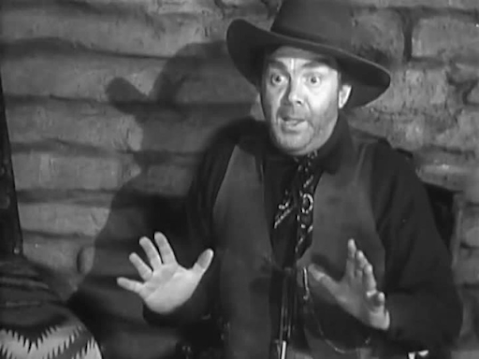


No comments:
Post a Comment