I feel impelled to speak today in a language that in a sense is new—one which I, who have spent so much of my life in the military profession, would have preferred never to use. That new language is the language of atomic warfare.

Above, President Dwight David Eisenhower at the "United Nations", below is a link to "Our Friend the Atom":
https://www.youtube.com/watch?v=pkwadgJORFM

I'm sorry, "Uncle Walt", but the Atom was not our friend in 1957. Should you have crossed the Pacific Ocean to the Island of Japan. Even during the year your television program was first aired. You would have been shocked at what American scientist's still didn't know about the effects of a Nuclear Blast, but even the Japanese civilian knew..
Atomic Warfare first was mentioned not by Julius "J." Robert Oppenheimer and His Research Team, but by British author Herbert George "H. G." Wells, in the 1914 novel, "The World Set Free". Technically, Wells was the real "Father of the Atomic Bomb". For those of my readers interested in the true story of the creation of the Atomic Bomb, the "Castle Bravo Test", and its real effect on the Japanese fishing trawler, "The Lucky Dragon #5". That complete story, in three parts, makes up my article, "H. G. Wells - J. Robert Oppenheimer - ゴジラGOJIRA", to be read at:
https://www.bewaretheblog.com/2024/03/h-g-wells-j-robert-oppenheimer-gojira.html
In the United States during the 1950's, the "House Committee on Un-American Activities" was busy finding Communists, or Communist sympathizers in the Motion Picture Industry. Seemingly, forgetting, that during the Second World War, both the Soviet Union, and the Chinese were our allies, and Japan and Germany, our enemies. For those interested in the "HUAC's" work to protect the United States, my article is "MCCARTHYISM: LIGHTS, CAMERA, COMMUNISTS IN THE MOTION PICTURE INDUSTRY" to be read at:
https://www.bewaretheblog.com/2025/08/mccarthyism-lights-camera-communists-in.html
While the "HUAC" was grilling members of the film industry. The three major studios, Metro-Goldwyn-Mayer", "Warner Brothers", and "20th Century Fox", banded together to start "Blacklisting" anyone that committee "Claimed" was either a past member, or a current member, of the "CPUSA (Communist Party United States of America)". These major motion picture studios started to turn out what they knew where "SAFE" from the eyes of the "HUAC" feature films. These "Safe Film Genres" included "Biblical" stories, such as in 1951, "Quo Vadis", "The Robe", and "David and Bathsheba". Musicals, such as the 1951, George Gershwin, "An American in Paris", the 1955, Rodgers and Hammerstein, "Oklahoma" and the two's, 1956, "The King and I", Westerns, like the cross over musical, Doris Day's, 1953, "Calamity Jane", and straight films like director John Ford's, 1950, "Wagon Master", Anthony Mann's, 1952, "Bend in the River", and Robert Aldrich's, 1954, "Vera Cruz". Not to forget, Fred Zinnemann's, 1952, "High Noon", with the alleged anti-McCarthy screenplay, and with a major "Blacklisted" screenplay writer. Which is part of my article on "McCarthyism".
While the three major's, along with the semi-major studio, "RKO Pictures", concentrated on staying out of harms way. The non-major studios, such as,"Lippert Pictures", the independent's that combined to form "American International Pictures", and even, "United Artists", "Universal International" and "Columbia Pictures", moved into the new world of Science Fiction.
At the same time in the United Kingdom, "Hammer Films", "Danziger Productions", and "Anglo Guild Productions", also discovered this new and lucrative genre.
While in Japan, "Toho" and "Daiei Film" studios, moved into Science Fiction in a completely different perspective. Which I have gone into detail in my first linked article.
The following are the 1950's, Atom Bomb related, Science Fiction motion pictures from the United States, the United Kingdom, and Japan, with my comments. In one case. science fiction became science fact effecting an entire motion picture crew and the residents of a small town in Utah.
I start with a classic from "Lippert Productions", that was also the first motion picture to mention the subject of President Eisenhower's FEARS.
ROCKETSHIP X-M: EXPEDITION MOON The Premiered in New York City, on May 26, 1950

My in-depth article on this feature film, "ROCKETSHIP X-M, EXPEDITION MOON (1950): Anatomy of a Cult Science Fiction Classic", may be read in its entirety at:
https://www.bewaretheblog.com/2022/07/rocketship-x-m-expedition-moon-1950.html
The original linked article, just above, has been modified and some quotes may be out of order, or shortened.
I will identify the actors in their roles, when, or if, their character first appears in the following quotes. A more detailed description of the actors, or this story, can be found in my above linked article.
My purpose of using this feature film is found after the space craft arrives, not at its original destination, the moon of its title, but at the new destination in the following two quoted paragraphs:
"Floyd" (Portrayed by Lloyd Bridges) makes some adjustments to the flight path and is able to get out of the meteor shower without damage to the "RX-M". "Floyd" and "Harry" (Portrayed by Hugh O'Brien) now make other adjustments to bring the "RX-M" back on its original course to the moon and require the use of "Dr. Eckstrom's (Portrayed by John Emery) new fuel mixture ratio.
The moment the new fuel mixture enters the space craft's engine system, the "RX-M" accelerates at a rate of speed far beyond "Eckstrom's" calculations, sending the space craft off course, and into deep space. When the "RX-M" finely slows down, the crew discovers that they had passed out from a lower oxygen level in the cabin created by the acceleration. They next discover that they are approaching the planet Mars and "Dr. Karl Eckstrom", determines they have traveled 50 million miles from the Earth and are 50 thousand miles away from an orbit around the planet.

Below, the crew comes upon part of a buried ancient statue and speculation about its origin takes place.


From examining the ancient statue's head, the crew believes a civilization equal to the one now on Earth once lived on Mars, and the question is raised, what became of them?
The motion picture's main writer, and its director and producer was one man, Kurt Neumann.


- - - - in October, 1947, screenplay writer Dalton Trumbo, and nine others, were brought before the "House Committee on Un-American Activities", and became known as "The Hollywood Ten". The "Ten" refused to speak to their "Alleged" involvement in planting Communist views in motion picture screenplays, and refused to give the committee the names of other Communist sympathizers each knew.
As the others sleep and he stands guard, "Harry" sees human figures emerge from behind the distant rocks beyond the cave entrance. They start to move toward the cave, "Harry" wakes the others, and they observe the Martian race turned into cavemen like survivors, leading to "Dr. Karl Eckstrom" commenting:
From Atomic Age to Stone Age!
(A one sentence warning from Kurt Neumann and Dalton Trumbo, of what could happen on Earth. Should the United States and the Soviet Union actually engage in nuclear war, but this is only the lead-up to how the two men viewed the Earth after such an event!)
As, "Karl" and "Bill" (Portrayed by Noah Beery, Jr.) explore the area around the cave, they see figures on the rocks above, and one, a Martian woman, (Portrayed by Sherry Moreland), loses her balance and slides down to the two explorers. The woman stops in front of the two, sitting on the ground, and reacts in fear to the voices she hears through the oxygen masks. The most noticeable facial change is to her eyes, she is blind and has large milky white cataracts on her eyes.

"Karl" and "Bill" are now attacked by other Martian's tossing heavy rock slabs at them and using a hatchet-like weapon made from a rock.


"Bill" is killed and "Karl" is badly injured, but he will make it back to the cave.

- - - - Wyllis Cooper, seen below, had created a Tuesday, midnight horror radio program, "Lights Out". In 1936, Cooper stepped aside for the glamour of writing for "Hollywood". Which began his 13-screenplay career, with three, "20th Century Fox","Mr. Moto", detective features starring Peter Lorre. However, "Universal Pictures", did turn him loose on one motion picture. He singularly created the story and wrote the screenplay for 1939's, "Son of Frankenstein".

"NBC" offered Arch Oboler, the now vacant, "Witching Hour" program, but according to Oboler's, January 1, 1945 collection, "Oboler omnibus; Radio plays and personalities":
a weekly horror play that went on at Tuesday midnight to the somber introduction of 12 doleful chimes, was not exactly my idea of a writing Shangri-La...
Thinking it over, two things stood out in favor of taking on the program:
1. A midnight time slot gave him the freedom to write whatever he wanted.
2. There was no sponsor and that further empowered the young writer.

Above, Arch Oboler directing a live "Lights Out" program.
The above comes from my article, "ARCH OBOLER: Horror, Fascism, the End of the World, the 3rd Dimension, and a Television Set" to read at:
https://www.bewaretheblog.com/2025/03/arch-oboler-horror-fascism-end-of-world.html
6-years before English novelist, Nevil Shute, published "On the Beach". In the tightness of the radio scripts he wrote, Arch Oboler's "End of the World" motion picture was:
FIVE premiering in New York City, on April 25, 1951


Next, two more people arrive in a car, having seen smoke coming out of the house's chimney.Three, "Oliver P. Barnstable", portrayed by Earl Lee, an elderly bank clerk in denial of what has happened and mentally thinking he's only on a vacation, Four, "Charles", portrayed by Charles Lampkin, a African-American taking care of "Oliver". The audience finds out that the two survived the atomic war, because they were locked inside a bank vault. "Rosanne" reveals that she must have survived the atomic bomb, because she was in a hospital in a lead lined X-Ray room. While "Michael" says he was stuck in an elevator in New York's "Empire State Building".
"Oliver" sickens, and "Michael" suspects it's radiation poisoning, However, "Barnstable" appears to become stable and he would like to see the ocean, and the four head to the Pacific Ocean in the car.

Above left to right, Susan Douglas Rubes, Earl Lee, Charles Lampkin, and Michael Rogin.
At the Pacific, the four find a man, still alive, floating in the water. The pull him out and revive, Five, "Eric", portrayed by James Anderson.

He was a mountain climber and was up on "Mount Everest" during a blizzard when the bombs started to drop. After the blizzard stopped, he made it back to base camp to find everyone dead. Next, he started walking through Asia, and European countries, never finding another person alive. Reaching the Atlantic Ocean, he took a boat and crossed it to the United States, finally running out of fuel opposite this beach.

While "Eric" tells his story, "Oliver" dies peacefully on the beach.

The next day, "Charles" helps "Michael" on his construction project, setting up greenhouses to raise food for the group. Since bringing "Eric" to her aunt's house, "Rosanne" has been bringing the "still weak" "Eric" food, but"Michael" warns her to watch out for him. Believing he is faking how bad off he really is to get sympathy. Later, "Eric", theorizing that somehow the five of them are immune to radiation and wants the group to go into the city and search for survivors. However, cautious "Michael", believes they are safe at the house and that it is the cities, targets of the atomic bombs, that may have the highest levels of radiation. This is followed by "Eric" using racial taunts on "Charles", and Arch Oboler's screenplay is used to tackle blatant racism in Eisenhower America. "Eric" makes it clear that he cannot stand being anywhere near "Charles", adventurually leading to the two men having a fist fight. Their fight stops, when "Rosanne" goes into labor and "Michael" delivers her son.
Things come to a head with "Eric", when he takes the jeep and purposely drives it through the cultivated fields that "Charles" and "Michael" have made and are attempting to grow crops on.

"Michael" orders "Eric" to leave, but the other pulls out a pistol and states he will leave only when he is ready to go.
Later, one night, "Eric" tells "Rosanne", that he plans to go to the town of "Oak Ridge". "Rosanne" wanting to find out what happened to her husband, agrees to go with "Eric". This was just as he had planned, and "Eric" tells "Rosanne" not to let "Michael" know what they're going to do. Next, "Eric" starts stealing supplies for the trip, but "Charles" appears, pulling out a knife, "Eric" kills him.
Once "Eric" and "Rosanne", with her baby, reach "Oak Ridge", he starts looting stores, while she goes looking for her husband at his place of work.


"Rosanne" finds her husband's workplace empty and goes to the local hospital, and discovers his remains in one of the rooms. Now wanting to go back to her aunt's house and "Michael", "Rosanne" asks "Eric" to take her back, but he refuses. "Rosanne" in a rage attacks "Eric", ripping open his shirt to reveal advance signs of radiation poisoning. "Eric" runs away, knowing he is a dead man walking, leaving "Rosanne" just standing there in shock.

"Rosanne" now starts the long walk back to her aunt's house, and on the way her baby dies. All this time, "Michael" has been searching for her and together they bury her son. The two return to the house, and the film ends with "Michael" once again cultivating the soil as "Rosanne" joins him.
Atomic Bomb Tests now began at a new location, the "Nevada Proving Grounds", located 65 miles Northwest of Las Vegas, at Yucca Flats, Nevada, The first test, "Operation Buster-Jangle", on October 22, 1951.

Today, my reader may think the following is laughable, but it wasn't at the time. In Los Angeles, in my elementary school, we had weekly drop and cover drills. We were being told that getting under her desk would save us from a Russian Atomic Bomb. These were accompanied with the sounds of the weekly tests of the "Civil Defense Air Raid Sirens".
In 1951, Backyard Bomb Shelter's were selling from the fear American's had of what was known as the Second Red Scare, and promised to keep the American family safe from Nuclear Fallout coming from the Atomic Bombs "The Russkie's" would drop on your town, or city.
The following ad was from the United States Government.

Did you want to save money, build your own "Fallout Shelter".


How about a "FALLOUT/BOMB SHELTER" for a whole city, or more?
UNKNOWN WORLD released October 26, 1951


I've mentioned that the "National Security Resources Board", recommended that President Truman drop nuclear bombs on the "Soviet Union". In 1952, there were 10-Science Fiction movies released from the United States, West Germany, Austria, the United Kingdom. One of the 7 from the United States envisioned the reverse, and came from the long forgotten "American Motion Picture Corporation" and distributed by "Columbia Pictures".
INVASION USA released on December 10, 1952
IT WILL SCARE THE PANTS OFF YOU!
[the script is based on] a book written by a Commie and the screen script was written by a Commie, so don't go see it.


Above left to right, Gerald Mohr, Erik Blythe, Peggie Castle, and Wade Crosby
Tom Kennedy portrayed "Tim, the Bar Tender". Kennedy portrayed 3rd-billed, "Gahagan", in 7 "Torch Blane" films, but that was a fraction of the character actor's 404-film-roles.

The Two Lois Lane's:
Noel Neil portrayed the "Second Airline Ticket Agent". She portrayed "Lois Lane" in the 1948, Chapter Serial, "Superman". She repeated the role in the second motion picture chapter serial, 1950's, "Atom Man vs Superman", and on television's "The Adventures of Superman", from 1953 - 1958.

Phyllis Coates portrayed "Mrs. Mulfory". She portrayed "Lois Lane" in the feature length movie, 1951, "Superman and the Mole-Men". She portrayed the role, starting with the feature broken in to the first two episodes of "The Adventures of Superman", 1952 - 1953. Phyliss Coates portrayed Whit Bissell's secretary "Margaret" in 1957's, "I Was a Teenage Frankenstein", and was in 1959's, "The Incredible Petrified World".

Above left to right, Erik Blythe, Phyllis Coates, and Richard Eyer, portraying their son. Eyer would portray "Baronni - the Genie", in stop motion animator, Ray Harryhausen's, 1958's, "The 7th Voyage of Sinbad", and had played the title role of 1957's, "The Invisible Boy". My article is "Richard Eyer and Charles Herbert: Youthful Actors" at:
https://www.bewaretheblog.com/2016/06/richard-eyer-and-charles-herbert-child.html
Now, let me return to that New York City bar and the seven strangers, who represent all walks of American life, listening to a "Special News Bulletin".
The group hears that enemy paratroopers have taken the military base at Seal Point, Alaska. Then word that Nome has been taken over and there are unconfirmed reports of Atomic Bombs being dropped on Air Force Bases. As the conquest of the United States, by an unnamed enemy, (That to a 1950 American audience doesn't need to be named), starts and the group, in some panic, disbands and leaves the bar.
Newscaster "Potter" goes to his television station to start broadcasting and socialite "Sanford" starts organizing her friends into a major blood drive.
While, Rancher "Mulfory" and Industrialist "Sylvester" share a cab after flying from New York to San Francisco. The enemy starts dropping conventional bombs on the city. As their cab pulls up to the curb at "Sylvester's" business headquarters. The two men and the cab driver run inside and watch the bombing. "Sylvester" says he will remain in San Francisco and will dies there from an Atomic Bomb. "Mulfory" hires the cab to actually drive him to his ranch in Arizona.
Strategic cities are now seen as targets for the unnamed enemy's Atomic Bombs.
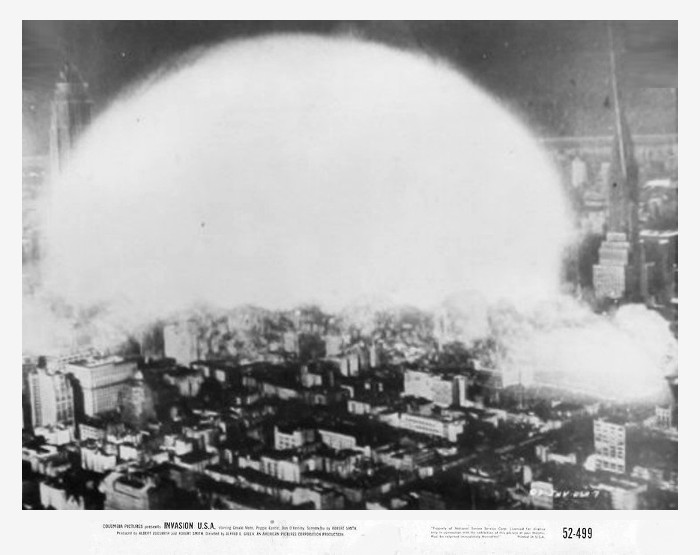
"Ed Mulfory" and the Cab Driver make it to his Arizona Ranch and pick up his wife, and their son. The cab and its occupants appear to be getting away safely. When, in Nevada, the cab is buried under tons of water as a nuclear missile hits Boulder Dam.
Soldiers dressed like American troops attack Washington, D.C. killing "Senator Harroway" and others. As one by one those in the bar are killed.
Below, enemy soldiers dressed as Americans have taken "Vince Potter" and "Carla Sanford" prisoner in her hotel room,
"Vince" is taken to his television station and told what propaganda he is now expected to report. While broadcasting, he starts to tell the truth. The enemy soldiers stop "Vince's" broadcast, he is taken outside, and is executed. Meanwhile, "Carla", alone with the soldiers starts to feel uneasy. As one starts toward her she manages to elude him, makes for the balcony, and jumps off.
As "Carla" falls to her apparent death. The picture starts to swirl and her body appears in a brandy sniffer, being held by "Mr. Ohman". Everyone is back in "Tim's" bar and alive. Each remembers hypnotist "Ohman" starting to swirl his brandy glass just before the first enemy attack was reported. "Mr. Ohman" tells them he was listening to their fears and wanted each to experience how lucky they are to be living in the United States and not an Un-American country. "Potter" and "Sanford" rekindle their romance and the others leave.
On the same double bill with "Invasion USA", was the first post-apocalyptic science fiction movie. That much is fact, but when, and under what title, the motion picture was first released isn't completely clear. The motion picture, also, wasn't distributed by "Columbia Pictures", but made and distributed by "RKO Pictures".
However, both feature films on the double bill, were produced by Albert Zugsmith. Who, when he was a "Public Relations Man", once had Al Capone as a client. Among the films, Zugsmith would produce are, 1957's, "The Incredible Shrinking Man", and Orson Welles's, 1958, "Touch of Evil" with Charlton Heston, and Janet Leigh.
Which brings me to the confusion in both the film's title and release date. On the double bill I saw, the motion picture was entitled "1000 YEARS from NOW", and like, "Invasion USA", was released on December 10, 1952.

The screenplay was by two writers, the first was Jack Pollexfen. Among the films he worked on are 1951's, "The Man from Planet X", 1951's, "The Son of Dr. Jekyll", 1953's, "The Neanderthal Man", and not to have a sibling fight, 1957's, "The Daughter of Dr. Jekyll".


However, in "The Mutates" village there are two factions. One is led by a man saved from death by the "Norm" Leader, and is attempting to overthrow the current evil Mutate leader. Battle will ensue, and friendships will overcome animosities toward each other. In the end the "Norm" woman, Ruth, marries the good "Mutate" leader Riddon, bringing hope for the entire human race and a restoring of faith in God.

The above must be a lobby card for the 1956 re-release of "1000 Years from Now", because the first "Hydrogen Bomb Test" was conducted on November 1, 1952.
There were 22-Science Fiction movies released in 1953, from a combination of the United States, the United Kingdom, and the Soviet Union. Not one of these looked at the danger that President Dwight David Eisenhower gave a speech about, "Atomic Warfare", or its consequences. Yet, at the "Nevada Test Site", the United States conducted 11-Atomic Bomb Tests. While in the Soviet Union, the Russian's, with their ex-Nazi German scientist's, were now able to conduct their own Atom Bomb tests. The "Cold War" was getting "Hot!"
The term "Cold War" was created by British author George Orwell, in his October 19, 1945 essay, "You and the Atomic Bomb". Orwell write that:
- - - - few people have yet considered its ideological implications—that is, the kind of world-view, the kind of beliefs, and the social structure that would probably prevail in a state which was at once unconquerable and in a permanent state of "cold war" with its neighbours.
There would only be two-feature-films related to Atomic Bomb Testing, in 1954, out of 10-science fiction films. Both are classic science fiction feature films showing how naive American scientists still were about the unseen dangers of their continued nuclear testing.
IF my reader has not read my linked article "H. G. Wells - J. Robert Oppenheimer - ゴジラGOJIRA", this would be a perfect time to stop and read it.
From that article:
March 1, 1954, was the date that Edward Teller's 1943 argument became reality, and he became, officially, "The Father of the Hydrogen Bomb". It took place on Bikini Atoll, when the hydrogen bomb, code name, "Castle Bravo", was tested and once again, would affect Japan, but without touching the island itself.

That effect is part of the horrendous story of a Japanese tuna fishing boat and its crew being exposed to both radiation and falling ash from the hydrogen bomb. My detailed article is "THE STORY OF THE 第五福龍丸, Daigo Fukuryū Maru, LUCKY DRAGON #5" found at:
http://www.bewaretheblog.com/2024/02/the-story-of-daigo-fukuryu-maru-5-lucky.html
One-Month Later, having decided to get into the science fiction film genre, "Warner Brothers Picture's" released the first, or the two-feature-films:
THEM in a limited engagement starting on April 26, 1954

The story for the "Warner Brothers" science fiction feature came from writer George Worthing Yates. His name isn't familiar to my reader, try the following movies, George Pal's, 1955, "The Conquest of Space", Ray Harryhausen's, 1955, "It Came from Beneath the Sea", and 1958's, "Space Master X-7" for starters. My article is "George Worthing Yates: Screenplays from 1927's LIGHTNING LARIATS to 1962's, KING KONG VS GODZILLA" at:
https://www.bewaretheblog.com/2021/01/george-worthing-yates-screenplays-from.html
Because of his subject matter, Yates investigated the science behind what he proposed. Then, using his imagination, visualized what American scientists had, as yet, not imagined in the United States. Unlike, Robert Oppenheimer's concerned for what they had unleashed. American scientist's were singularly focused on in creating more powerful weapon's. Such as Edward Tellar's "HYDROGEN BOMB"! While in Japan, the fears of both Oppenheimer and President Eisenhower seemed real!
Russell S. Hughes adapted Yates's story into a screenplay. Hughes became a television writer after this motion picture and was mainly a writer of westerns such as Randolph Scott's, 1951's, "Sugarfoot", and 1953, "Thunder Over the Plains". The Guy Madison and James Whitmore, and Joan Weldon's, 1954, "The Command", and the Glenn Ford, Ernest Borgnine, and Rod Steiger, 1956, "Jubal".
Ted Sherdeman was the screenplay writer, his films included, the excellent and overlooked, "Lost Dutchman Mine" story, 1949's, "Lust for Gold", starring Ida Lupino, Glenn Ford, and Gig Young. Along with the very good true Second World War story, 1960's, "Hell to Eternity", starring Jefferey Hunter.
The motion picture was directed by Gordon Douglas. Douglas started out directing the "Little Rascal's" shorts, and ended up as Frank Sinatra's personal film director. My article is "Gordon Douglas: The Little Rascals (Our Gang) - Giant Ants - and Francis Albert Sinatra" to enjoy at:
https://www.bewaretheblog.com/2024/07/gordon-douglas-little-rascals-our-gang.html
The Six Main Actors:
James Whitmore portrayed "New Mexico Police Sergeant Ben Peterson". Among his motion picture roles was opposite Nancy Davis, the feature Nancy Reagan, in the 1950, science fiction, "The Next Voice You Hear", being "God" speaking to them over their radio. In 1964, Whitmore starred as White reporter John Howard Griffin, under the movie's name of "John Finley Horton", in "Black Like Me". About Griffin's experiences after medically being turned into an African American in the Deep South. My article is "JAMES WHITMORE: World War 2, Film-Noir, Musicals, Science Fiction, Racial Prejudice, Westerns and President Harry Truman" to admire his work at;
https://www.bewaretheblog.com/2021/05/james-whitmore-world-war-2-film-noir.html
Edmund Gwenn portrayed "Entomologist Dr. Harold Medford, United States Department of Agriculture". Gwenn is perhaps best known for playing "Kris Kringle" in the original 1947, "Miracle of 34th Street", starring Maureen O'Hara and John Payne, and featuring 9-years-old Natalie Wood. Back in 1936, Edmund Gwenn brought Boris Karloff back to life in "The Walking Dead", and he appeared in the 1952 version of Victor Hugo's, "Les Miserables", starring Michael Rennie and Robert Newton.
Joan Weldon portrayed "Entomologist Dr, Patricia 'Pat' Medford, United States Department of Agriculture, and Harold's daughter". Although she had just appeared with Whitmore in "The Command" and would appear on different television shows through 1958. Joan Weldon was actually a member of the "San Francisco Opera Company" and returned to her real love, opera.
While most feature films of the Eisenhower Era show a woman's role was in the "Home". It was Science Fiction films that broke that mold with character's such as "Dr. Patricia Medford". My article is "Before Gloria Steinem: There Was Feminism in 1950's Science Fiction" found at:
https://www.bewaretheblog.com/2019/11/before-gloria-steinem-there-was.html
James Arness portrayed "FBI Agent Robert Graham". Arness's, 4th motion picture had been director William A. "Wild Bill" Wellman's, Second World War, 1949, "Battleground", that also featured James Whitmore. In 1950, he was one of the bad guys in Director John Ford's, "Wagon Master", that starred Ben Johnson, Harry Carey, Jr. and Joanne Dru. In 1951, before he had the title role in Howard Hawks's, "The Thing from Another World". James Arness starred in the forgotten 1951 Science Fiction, "Two Lost Worlds". While in 1952, the actor co-starred with his friend, John Wayne, in "Big Jim McLain". In which the two portrayed agents of the "House Committee on Un-American Activities", tracking down a Communist Spy Ring in Hawaii. The picture reflected both actors strong Conservative politics. My article is "JAMES ARNESS: The Intelligent Alien Carrot Marshall of Dodge City" bring law and order at:
https://www.bewaretheblog.com/2025/06/james-arness-intelligent-alien-carrot.html

Above left to right, James Arness, Joan Weldon, James Whitmore, and Edmund Gwenn
Onslow Stevens portrayed "Air Force Intelligence, Brigadier General Robert O'Brien". Among Stevens's roles was "Aramis", in the 1935 version of Alexander Dumas's, "The Three Musketeers". His other roles include, co-starring with Carol Landis and Henry Wilcoxon in 1940's, "Mystery Sea Raider". Along with three Horror entries, 1941's, "The Monster and the Girl", 1945's, "House of Dracula", portraying "Dr. Edlemann", and 1948's, "The Creeper".

Sean McClory portrayed "Air Force Intelligence, Major Kibbee". Of McClory's first 16 on-screen appearances, 7 were without credit. However, among his credited films, were the Ginger Rodgers, Ronald Reagan and Doris Day, 1951, modern KKK story, "Storm Warning". John Ford's 1952, "The Quiet Man", starring John Wayne and Maureen O'Hara. Sean McClory, also appeared as one of Wayne's downed DC-47 transport crew. In Director William A. "Wild Bill" Wellman's, 1953, production of Ernest K. Gann's, "Island in the Sky", featuring James Arness.

Note: In the above scene with Sean McClory and James Arness. Joan Weldon is using a 3-D slide camera, as an indication that the movie was shot in that process and her photo's would have been seen 3-D also. I had the same camera at one time.
Three minor roles of interest:
Sandy Descher portrayed "The Little Ellinson Girl". This was Descher's 11th on-screen appearance, of which 5 were on television, and 4 movies were without credit. At the end of her career, in 1969, Sandy Descher appeared on either the big, or small screen, in 48 different roles. 30 of which were on television series.

Fess Parker portrayed "Texas Pilot Alan Crotty". Before, "THEM!", Parker had appeared on-screen 14 times. The last 5 on different television shows and of his movies, 6 were without on-screen credit, including "Island in the Sky". However, it is what happened before this motion picture was released that is important here. Jack L. Warner invited his friend Walt Disney, who liked Science Fiction movies, to the studio for a private screening. As the story goes, Disney had Warner's projectionist rerun Fess Parker's scene multiple times. When Jack L. Warner asked Walt Disney why the reruns? Disney is supposed to have replied that he had found his "Davy Crockett" and for Fess Parker and Walt. The rest was history.

For those of my readers that might be interested. My article, "Walt Disney's 'Davy Crockett, King of the Wild Frontier" is found at:
http://www.bewaretheblog.com/2016/06/walt-disneys-davy-crockett-king-of-wild_25.html
Leonard Nimoy portrayed "Army Sergeant in Information Center". This was the uncredited Nimoy's 9th on-screen appearance. Of these, probably the most interesting was portraying "Narab" from the planet Mars. One of the title characters in the 1952, Cliff-Hanger, "Zombies of the Stratosphere". In February 1965, Nimoy first portrayed, "Mr. Spock", in the rejected, by NBC, original pilot episode of Gene Roddenberry's "Star Trek".

"Zombies of the Stratosphere" is part of my article, "Republic Pictures: THE ROCKET MAN CLIFF HANGERS", at:
http://www.bewaretheblog.com/2019/09/republic-pictures-rocket-man-cliff.html
The George Worthing Yates story opens with a search for a little girl walking alone in the New Mexico desert. It concerns a Police Search Aircraft piloted by "Johnny", portrayed by John Close, and a New Mexico Police Car with two Officers, "Sergeant Ben Peterson" and "Trooper Ed Blackburn", portrayed by Christian "Chris" Drake.

"Johnny" is about to end his search, but sees the little girl walking carrying a doll. "Ben" and "Ed" spot the girl, stop the car, and "Ben Peterson" goes out to her. He determines she's in a state of shock.

"Ben" brings the girl back to their squad car. As "Johnny" comes on the air to inform "Ben" and "Ed" that there's a trailer up the road.


The two police officers pull up by the trailer and "Ed Blackburn" goes to investigate and calls for "Ben Peterson" to join them. Leaving the little girl sleeping, "Ben" approaches "Ed, and sees that the trailer has been somehow pushed out.


There are no bodies and money has not been taken. "Ed" makes a comment about finding some sugar and then discovers a odd looking print. Both men agree it wasn't made by a mountain lion and may be nothing at all.
"Ed" is told to call in for an ambulance and a crime crew. The story now seems to be a murder mystery and the scene switches to a man making a plaster mold of the strange print and the girl in the ambulance.

As "Ben" speaks to one of the ambulance attendants, played by William Schallert, they hear a strange sound and the two do not notice the girl, with a frightened look on her face, sit up on the stretcher.

The sound stops and the girl goes back down still in shock. A comment is made about winds in that part of the desert.
Next, "Ben" and "Ed" go out to "Gramps Johnson's", played by Matthew McCue, store, but find the place ransacked and the walls pulled out like the trailer. No money has been taken. sugar is found, a shotgun that seems to have been broken apart by something is found by the cash register, and "Gramp's" body is in the cellar.

"Ed Blackburn" is told to stay at the store until the crime lab can arrive and "Ben" heads back to town. Moments after "Ben" leaves, "Ed" hears the sound from before, turns off the lights, goes outside and exists the scene. As his scream is heard and the sound becomes louder.


Back at the police station it has been determined that the owner of the trailer was an "FBI Agent, named Ellinson" on vacation with his family. Cut, to "Ben Peterson" and "Robert Graham" returning from the desert after looking at the scene. Graham asks to send either original, or a copy of the print to "FBI Headquarters". The local coroner arrives and tells the group that "Gramps Johnson" had enough formic acid in his body to kill several people.


"Ben" and "Bob" are at a military airfield waiting the arrival of two doctors named "Medford". They speculate that somebody has identified the print, but the doctors are from the "Department of Agriculture". The plane lands and they meet "Dr. Harold Medford" and his daughter, "Dr. Patricia Medford". To the surprise of both men, the elder "Medford" wants to immediately read all the investigative reports.


The two Doctor "Medford's" agree that the idea this was a fake report is wrong. Irritated, because they seem to be ignored by the doctor. Both "Bob" and "Ben" want answers. "Medford", tells them he's not being coy about this and understands they're concerned about what appears to be a local incident.
The elder "Dr. Medford" wants to know when the first Atomic Bomb was set off. The answer from "Bob Graham" is at White Sands, in 1945. To be exact, July 16, 1945.
However, the mounting evidence points elsewhere and they wouldn't want to risk a Nationwide panic!
"Harold Medford" tells him he wants to see the "Ellinson Girl" and then the original scene "Ben's" report speaks too.
The elder "Dr. Medford" tells the doctor taking care of the girl that he has a means of possibly bringing her of shock.

He uses some formic acid and the girl awakes, runs to the side of the hospital room screaming over and over again, one word:


THEM!

"Dr. Harold Medford" wants to go to the location of the "Ellinson" trailer. "Bob" mentions its getting late, but "Medford replies:
It Might Be Later Than You Think!
The winds are blowing hard as they arrive and the doctor needs assistance with his goggles. Then, he goes with "Ben" to the location and a little more of the irritation surfaces as "Bob" and "Dr. Patricia Medford" speak to each other. Then her father calls them over to see another print.

It is at this point that the murder mystery, becomes pure Science Fiction. As "Pat" leaves the group, the sound begins again, and above her on a hill, a giant ant appears.

"Pat's" father yells at "Bob" to shoot the other antenna to confuse it and then it's killed by more gun fire.

"Dr. Harold Medford" now tells "Ben" and "Bob" they are looking at an ant and explains how the stinger injected "Gramps" with formic acid.

Meeting with "Brigadier General O'Brien" and "Major Kibbee", "Dr. Harold Medford" explains he theory that the ants are mutations from the first Atomic Bomb test, nine years earlier in, 1945. An air search takes place to find the nest and it, along with the bones of the missing people, will be found.


After an argument between "Bob" and "Pat", "Dr. Patricia Medford", "FBI Agent Robert Graham" and "New Mexico Police Sergeant Ben Peterson" enter the nest.


It is discovered that two Queen Ants and their mates have left the nest. Which is now burned under the orders of "Pat Medford".
What follows is a search for the two Queen's and their new nests. One Queen entered an open hatch on a merchant ship. The ship is ordered sunk by a Navy destroyer that will be kept at sea to keep word of the ants from getting out.

The search for the other Queen will lead to Los Angeles by way of a Texas pilot in a hospital.

Then interviews at a Los Angeles Police Station, being told a women's, "Mrs. Lodge", played by Mary Ann Hokanson, husband was killed, possibly by the ants, but her two boys are missing.


The search for the ants continues and will end in a hospital alcoholic ward.


Above, "Jensen", played by Olin Howard, tells "Bob" and "Ben" he's been seeing ants in the L.A. River for months. "Bob" looks at the river bed and notices the entries into the sewer system.

A toy airplane is found and it's verified that "Mrs. Lodge's" husband would take their boys there to fly a model airplane.

"Brigadier General O'Brien" places Los Angeles under martial law.


Above, the immenseness of the sewer system is revealed to "Brigadier General O'Brien" and "Dr. Medford". I can vouch for that, because I used to play in them. Now the word is given and the military, along with "Pat", "Bob", "Ben" and "Major Kibbee", enter the sewers to find the boys and the nest.

"Ben Peterson" hears something and everyone stops the search as he investigates. He locates the boys alive, but they're trapped within the nest. "Ben" now enters, as everyone else converges on the location, "Ben" is able to get the boys to safety, but a giant ant attacks him.


As "Bob" and the army break into the chamber, but "Ben" dies in "Bob's" arms. The soldiers move off and start shooting the ants in very close quarters.


"Dr. Medford" orders the shooting to stop, but a cave-in occurs trapping "Bob" on the other side. He is rescued and the nest is found to contain new Queens, but they have not left and "Dr. Harold Medford" orders the nest burnt.


The story ends with a warning about the testing of Atomic Bomb's having created undetected residual radiation pockets. such as the one which caused the desert ants to mutate into the eight foot long giants, as:
"Robert Graham" asks "Dr. Harold Medford", what about all the other atomic tests?
To Which, "Dr. Harold Medford" replies:
No. We haven't seen the end of THEM!. We've only had a close view of the beginning of what may be the end of us.
The approximate distance between Los Angeles, California, where the sewers were located in the above motion picture, to Tokyo, Japan, is a distance of 5,488 miles. My reader now travels that distance for the second-feature-film related to Atomic Bomb Testing, coming from Japan's, "Toho Company, Limited".
The following comes from my linked article, above, about the real, "Daigo Fukuryū Maru, LUCKY DRAGON #5", incident. In which a Japanese tuna trawler was way outside the safe "Fallout" zone for the "Castle Bravo, H-Bomb Test". A zone, given and assured safe, by American scientist's. Who had their mathametical figures wrong by miles:
Japanese biophysicist Nishiwaki Yasushi, below, was in Osaka, with his American wife, Jane Fischer Nishiwaki, when the "Daigo Fukuryu Maru #5" returned to port.
According to a November 2015, article in the:
中國新間可heGhuugolu§himbum: https://www.hiroshimapeacemedia.jp/?p=53448
Reading about the incident in a newspaper on March 16, Dr. Nishiwaki took a night train from Osaka to Yaizu, Shizuoka Prefecture. The following day, he began collecting substances from the boat and the crew members and measuring their radiation levels.

After examining the tuna boat, he ordered that the "Lucky Dragon #5" be relocated it an isolated area.

Nishiwaki went to see the seven crew members. He discovered high levels of radiation in the men's hair and ordered the hair be cut off. These crew members were ordered by Nishiwaki Yasushi, to be quarantined in "Yazizu North Hospital", and their clothes buried on the hospital property.

Next, Nishiwaki Yasushi wrote a detailed letter, to the current head of the "United States Atomic Energy Commission" about the "Daigo Fukuryū Maru #5" incident, stating the seven crew members he examined, suffered from acute radiation sickness. He wanted to know how to treat them and the other members of the crew in Tokyo? Additionally, other Japanese scientists had sent letters asking the same.
Not one letter writerreceived notification of the receipt of their letters from the "AEC". However, two American medical students were sent to Japan.
The above incident and its reminder of August 1945, completed the thinking of Japan's "Toho Studio's" producer ,Tomoyuki Tanaka's thinking for his next motion picture.
I now give my reader the allegorical "Hiroshima" and "Nagasaki" Atomic Bombs, turned into a living creature. As a result of Hungarian-American Theoretical Physicist and Chemical Engineer, Edward Teller's, quest to make a "Hydrogen Bomb".
There were only two-tests, first was "Mike", back on November 1, 1952, that disintegrated an entire small Pacific Island. The second, was "Castle Bravo", that was detonated only two-months before the start of production on this second feature film.

This is not "Godzilla", a re-edited "Monster-on-the-Loose" creature, initially reworked for American audience's, as 1956's, "Godzilla, King of the Monsters". A motion picture containing a large amount of new footage with actor Raymond Burr, portraying "International News Reporter, Steve Martin". Mixed with original 1954, "Gojira", footage, dubbed into English, within a completely new story line.
All to avoid the still, strong anti-Japanese sentiment, in many parts of the United States, created during the Second World War.
The original running time of 1954's, "Gojira", was 1-hour-and-36-minutes. The running time of 1956's, "Godzilla, King of the Monsters", is 1-hour-and-20-minutes.
The director of 1954's, "Gojira", was Ishiro Honda, below, a one-time camera man for Akira Kurosawa . Honda's name would be associated with some of the major "Toho Kaiju" motion pictures. In English as 1956's, "Rodan", 1957's "The Mysterians", 1959's, "Battle in Outer Space", and 1961's, "Mothra".
Eiji Tsuburaya, was the special effects director and would be associated with the majority of Honda's features. For the 1942, "The War at Sea from Malay to Hawaii", Tsuburaya built a large very detailed model set of "Pearl Harbor". When footage of his Special Effects recreation of the December 7, 1941, attack, was accidentally captured. Naval photo intelligence officer, director John Ford, believed the American's now had actual Japanese film of that attack.
There would be five people associated with writing the motion picture. The initial outline came from Tomoyuki Tanaka and Eiji Tsuburaya, and had the extremely long title of:
底二万哩から来た大怪獣, Kaiteinimanmairu kara Kita Daikaijū (The Giant Monster from 20,000 Miles Beneath the Sea)".
The outline was turned over to Shigeru Kayama, who wrote the first draft screenplay,
The final screenplay was written by Takeo Murata, and Ishiro Honda.
The Love Triangle:
Akira Takarada portrayed salvage ship captain, "Hideto Ogata". This was only his third motion picture.

Momoko Kōchi portrayed the love interest and the daughter of Japan's leading paleontologist, "Emiko Yamane". This was only her sixth motion picture. My article is 河内 桃子, Kōchi Momoko (Momoko Kōchi): Japanese Horror and Science Fiction" at:
https://www.bewaretheblog.com/2022/08/kochi-momoko-momoko-kochi-japanese.html

Akihiko Hirata portrayed "Dr. Daisuke Serizawa". Akihiko had just portrayed "Seijuro Yoshioka" for the first of three times in director Hiroshi Inagaki's Samurai trilogy.

Three other important roles:
Takashi Shimura portrayed "Emiko's father", paleontologist "Dr. Kyohei Yamane". Shimura was a regular in Akira Kurosawa's stock company. Shimura Takashi had already been in Kurosawa's, 1949's "Stray Dog", with Chief Assistant Director" Ishiro Honda, 1950's "Rashomon", 1951's "The Idiot", 1952's, "Ikiru", and was the leader of 1954's "Seven Samurai". My article is "志村 喬, Shimura Takashi (Takashi Shimura): He Wasn't Just 'Dr. Yamane' in 1954's GOJIRA" to be read at:
https://www.bewaretheblog.com/2024/11/shimura-takashi-takashi-shimura-he.html

Sachio Sakai portrayed "Newspaper Reporter Hagiwara". The character is very important to the original storyline, but he is almost non-existent in the 1956 re-edited English language "Godzilla, King of the Monsters". Sachio was also a member of Akira Kurosawa's stock company and among his films are 1952's "Ikiru", 1954's "Seven Samurai", and 1958's "Hidden Fortress".

Toyoaki Suzuki portrayed "Shinkichi Yamada", below left corner. Although websites like IMDb list Toyoaki Suzuki with Thirteen film roles, in reality there were only Eight! Three films were a trilogy with Suzuki in the same role and two were re-edits of "Gojira", the 1956 American version and the 1957 French version.

The Basic Story:
The story opens with the freighter, not a tuna trawler, "Eiko-maru", as Tomoyuki Tanaka's allegorical "Daigo Fukuryu Maru (The Lucky Dragon #5)". Instead of the actual radioactive ash from the "Castle Bravo Hydrogen-Bomb Test" falling on the member's of the crew. The audience sees a blinding flash of light and boiling sea water destroy the "Eiko-maru" and its crew.


.png)


"Dr. Yamane" asks his daughter upon leaving to please turn off the lights. "Emiko" turns off the lights, leaving her father with his thoughts.

However, "Gojira" attacks Tokyo once more, but with a vengeance.


"Dr. Daisuke Serizawa" now mentions the thing that is weighing down upon him. He was looking for a way to increase oxygen and its uses, but instead created a destroyer of oxygen. His fear is that other nations would get his discovery and armies would use it against armies.
.png)
An argument between "Ogata" and "Serizawa" over the "Oxygen Destroyer", turns into a fight and "Hideto" is injured. "Daisuke" apologizes, and starts to collect his papers on the "Oxygen Destroyer" as "Emiko" tends to the man, "Serizawa" realizes she loves.


He was not a mob boss, or worked for one. He made six-day movies for "Golden State Productions", were distributed by "American Releasing Corporation", that would shortly roled with other independents into a single company to be known as, "American International Pictures". The following of his movies, had started filming on September 8, 1955.
DAY THE WORLD ENDED premiered in Detroit, Michigan, on December 8, 1955

He was director Rodger Corman, and was 5-years away from his first Edgar Allan Poe feature, "The House of Usher", starring Vincent Price in his first of the series. Corman had just directed the Western, 1955's, "Apache Woman", starring Lloyd Bridges, 1950's, "Rocketship X-M", Joan Taylor, 1956's, "Earth vs the Flying Saucers", and Lance Fuller, 1955's, "This Island Earth". My article is "Rodger Corman: 4 Westerns, 3 Aliens, a Gangster, Viking Women, the Beat Generation, and the End of the World" to read about, at:
https://www.bewaretheblog.com/2024/12/rodger-corman-4-westerns-3-aliens.html
The screenplay and original story were by Lou Rusoff. He had also written the screenplay for the co-feature on the "AIP" double-bill, 1955's, "The Phantom from 10,000 Leagues".

The mutated human was created by and worn by Paul Blaisdell. My article is "Paul Blaisdell: 'American International Pictures' Creator of 1950's Aliens and Other Creatures" at:
https://www.bewaretheblog.com/2022/03/paul-blaisdell-american-international.html
Richard Denning portrayed "Rick". Denning had just co-starred with Frank Lovejoy and Mari Blanchard in director Nathan Juran's, 1955 film noir, "The Crooked Web", and followed this motion picture with an episode of the "Warner Brothers" television Western, "Cheyenne", "Decision", airing on January 24, 1956. My article is "RICHARD DENNING: HIS SCIENCE FICTION AND HORROR FILMS" at:
https://www.bewaretheblog.com/2020/08/richard-denning-his-science-fiction-and.html
Lori Nelson portrayed "Louise Maddison". Nelson had two major feature films prior to this one, also in 1955. The first was "Underwater", produced by Howard Hughes for his latest girlfriend, Jane Russell, directed by John Sturges, and co-starring Gilbert Roland and Richard Egan, Lori Nelson had 4th-billing. Her second feature was the 3-D, "Revenge of the Creature (From the Black Lagoon)". Lori Nelson had 2nd-billing, behind John Agar, who was attempting a comeback after divorcing "America's Sweetheart", Shirley Temple, and being banned by the major studios.

Above, Richard Denning and Lori Nelson
Adele Jurgens portrayed "Ruby, the gun moll". Jurgens, with her peroxide blonde hair, was the tough talking, "B" movie "Broad" you didn't want to mess with in several film noirs, and "backstage" dramas. She was married o actor Glenn Langan, 1957's, "The Amazing Colossal Man", until his death from lymphoma in 1991.
Touch Connors portrayed "Tony Lamont". Connors had just appeared in an episode of Hugh O'Brien's television series, "The Life and Legend of Wyatt Earp", "The Baby Contest", airing on November 22, 1955. He followed this motion picture with the adventure film, 1956's, "Jaguar", starring Sabu and Barton MacLane. Eventually he dropped his High School basketball nickname and became first, Michale Connors, and then Mike Connors.

Paul Birch portrayed "Jim Maddison". At this time, Birch was appearing on several television programs, his last previous motion picture was the Rod Cameron and Julie London, 1955's, sports story,"The Fighting Chance", from three roles earlier than this one. After this feature film it would be another three television roles until Paul Birch was in the low budget, film noir, 1956, "When Gangland Strikes". My article is "PAUL BIRCH: Rodger Corman's Intergalactic Vampire" to burn your eyes out, at:
https://www.bewaretheblog.com/2018/04/paul-birch-roger-cormans-intergalactic.html

Raymond Hatton portrayed "Pete". Hatton started appearing on screen in 1915, but over his career he became known for portraying "B" Western sidekicks. Hatton was best known for portraying "Rusty Joslin" in 8 of the 51, "Republic Pictures", "The Three Mesquiteers" Westerns, opposite John Wayne, Duncan Renaldo, and Bob Livingston. My article is "An Overview of 'THE THREE MESQUITEERS': A Classic 'B' Western Series" riding the range at:
http://www.bewaretheblog.com/2021/11/an-overview-of-three-mesquiteers.html

Paul Dubov portrayed "Radek". Character actor Dubov had started in films in 1938, and would become a familiar face, if again, not a name, on many television Westerns and Dramas. 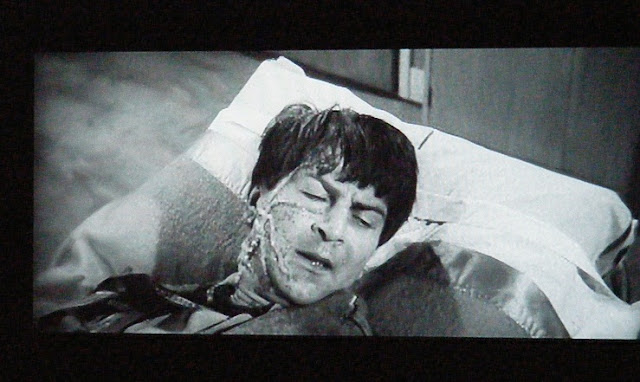
The Lou Rusoff Screenplay:
The screenplay starts with the title card:

Followed by stock images of Atomic Bombs exploding in Nuclear War, supposedly, on "The Day the World Ended". Switch to the bottom of a box canyon, and the home of former Navy Commander "Jim Maddison". He lives there with his daughter 'Louise", survivors, if for the moment, of the Nuclear War. "Louise's" fiancé, there is a picture at him bedside her bed, portrayed by Roger Corman, had left the house, after the war ended, to investigate, and never returned.
It is implied that "Commander Maddison" was one of the Naval officers involved with the "Castle Bravo H-Bomb Tests" on the Bikini Atoll, and he was known for speculating on what a nuclear war might look like.
As a result of what he saw, his home is stockpiled with food and other items for the planned three, his daughter, her fiancé, and himself.
However, things do not go as he planned!
To begin with, geologist "Rick", found his way to the house. As the story progresses, "Rick" and "Jim" become close, and "Louise" is falling in love with him, but she is still coping with her missing fiancé. "Commander "Maddison" has a ham radio set and has been attempting to locate other survivors.
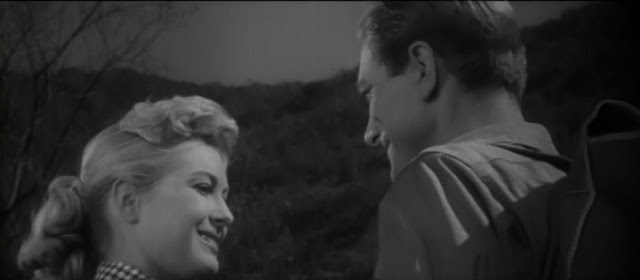
"Jim's" primary concern is over the strong levels of deadly radiation. Which start three quarters of the way up the box canyon's wall, trapping the three survivors below it. A secondary concern is that there has been no rain since the nuclear war ended. Although, there is a fresh water lake near the house, if it should rain. His fear is that even the house would become contaminated from the lingering fall-out, and shortly, thereafter, the three of them would die from radiation poisoning.
Next, two more people, "Ruby" and "Tony Lamont" make their way to the house. "Jim" wants to send them away, because their food supply would be cut short by the increase of two more people and "Tony" appears to be a wannabe mobster.
Then, a third person shows up, an old prospector named "Pete" with his mule, and as with the other two unexpected "Guests", he is decontaminated.
Tension is created between "Rick" and "Tony", because the two-bit gangster wants to run the place and even with the goodhearted "Ruby", he is thinking of exchanging her for "Louise".
Adding to her father's problems, are the dreams "Louise" is having about something watching her.
Now, "Radek" arrives, and by his facial features, and his graving for raw meat. It becomes obvious to "Jim", that "Radek" is physically mutating from exposure to the radiation above the safe zone of the box canyon.
As a result of this last arrival, "Jim" now shows "Rick" some drawings he made of the test animals used in the "Castle Bravo" H-bomb test, that he illegally retrieved. The animals were mutating, and the monkey had developed a third eye in its forehead, and two finger like protrusions on both shoulders.

"Louise" and "Ruby" go for a swim, but cut it short, when something seems to be watching them.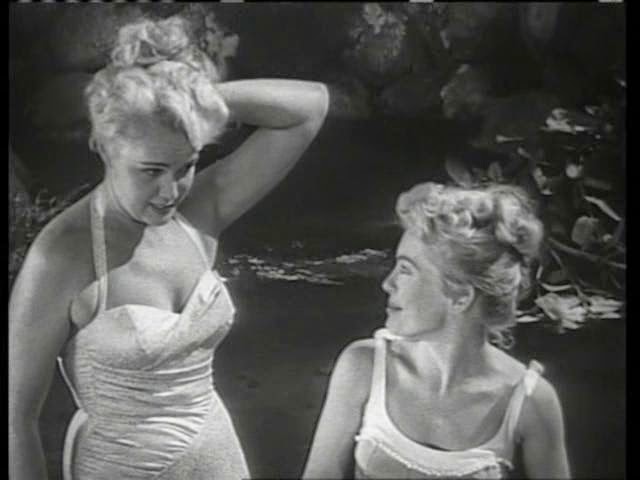
The mutant, Paul Blaisdell, that they do not see, is a danger, and will kill any food source contaminated by the radioactive fallout. It can't eat anything that isn't contaminated, and has to stay away from the fresh water swimming pool that would kill it.
"Pete's" mule disappears with "Radek", and "Pete" goes after it and is killed. While the mutant now kills "Radek".
Next, the mutant kidnaps "Louise", but while "Jim" and "Rick" hunt for them. The creature takes "Louise" to the fresh water lake and puts her down and starts to leave. It becomes clear that the mutation is really her missing fiancé. 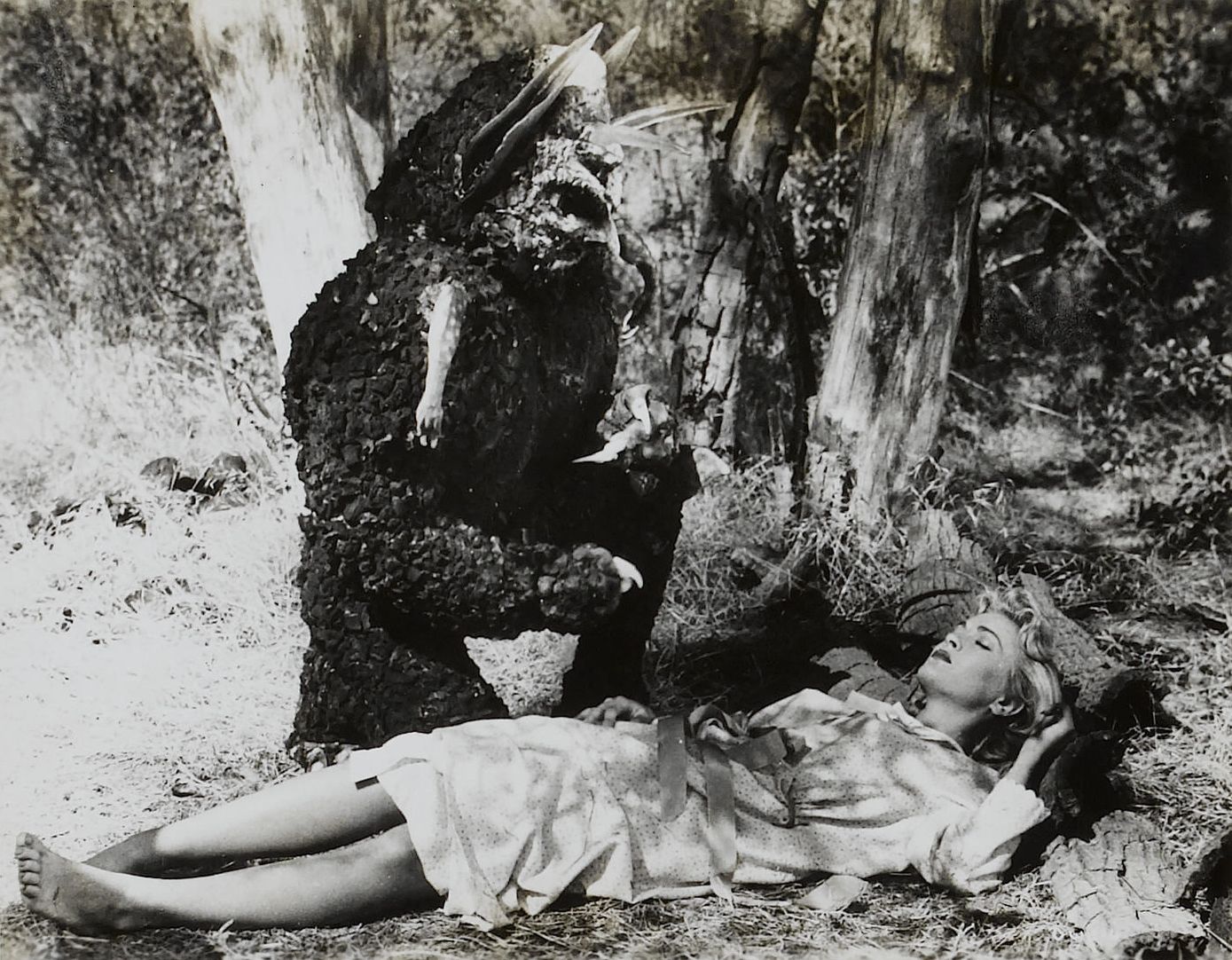
While the mutant walks away, "Jim" and "Rick" bring "Louise" back to the house. There, "Tony" stabs "Ruby" to death, and confronts "Jim" over "Louise". "Jim", who is slowly dying from radiation poisoning, he did not reveal to anyone including his daughter, can't walk very well. "Tony" now steals "Jim's" pistol and awaits to ambush "Rick".
However, the weaken "Jim" produces a second pistol and kills "Tony". It starts to rain and "Jim" runs some tests and realizes it's uncontaminated. As the mutant dies from the fresh rain, "Jim" tells "Louise" and "Rick" that he will be dead within a few days, and for the two to go out of the canyon into the now cleanse world, and start their own life.
The film ends with "Louise" and "Rick" walking up the hill and the words appearing on screen:
The Beginning
1956 had 2-Science Fiction movies related to President Eisenhower's Fear of ATOMIC WARFARE. HOWEVER, there was one additional motion picture that preceded both of these that same year. A film, that over time, would awaken medical professionals, and the "Hollywood Fan Base", to the REALITY OF ATOMIC FALLOUT!
This was NOT the Science Fiction of the Previous Motion Picture's I have been mentioning, or the ones that would follow it during the decade.
In 1954, Howard Robards Hughes, Jr. had sold "RKO Pictures". His last produced film, had been in production between May and August 1954. It was a non-Science Fiction motion picture that he believed would be an epic biography.
It was not!
My article is "HOWARD ROBARDS HUGHES, JR: The Motion Pictures" to read at:
https://www.bewaretheblog.com/2018/08/howard-robard-hughes-jr-motion-pictures.html
That Howard Hughes's motion picture has been described as a Mongolian, 1930's style, "B" Western. The good guys, without their "White Hat's", are the Mongols, led by "Temujin". Who by the film's end, will have his better known name of the "Genghis Khan". The bad guys, without their "Black Hat's", are the Tartars. "Temujin" steals a Tartar woman, named "Bortai", to get even with the evil, Tartar Lord, "Targutai". Who wants "Bortai" for his own. However, as events unfold, both "Bortai" and "Temujin", will slowly fall in love and she will be his wife by film's end. Until then, it's the good guy, Mongol's, against the bad guy Tartar's, and the evil treachery of the evil warlord,"Wang Khan", and his Shaman. Who are playing the two against each other, to enrich the "Khan's" land holding's and money.
Howard Robard Hughes's motion picture was:
THE CONQUEROR premiering in London, on February 2, 1956

Hughes's director was Singer/Actor/Director Dick Powell. His films include the 1934 musical, "Flirtation Walk", 1944's "Murder My Sweet", portraying Raymond Chandler's "Philip Marlowe", and 1952's "The Bad and the Beautiful". The decision to hire Powell, as a director, was based upon the 1953 feature "Split Second". That Film Noir was about escaped convicts lead by Stephen McNally. Who while on the run pick up several hostages including co-star Alexis Smith. They then take them to a deserted ghost town. The tension and suspense in the film was captured by Powell. Along with a twist in Irving Wallace's screenplay. Unbeknownst to McNally and the other convicts, is that the ghost town is actually an Atom Bomb Test Site. The title refers to how much time is left at the picture's climax, before the Atomic Bomb goes off.
Below, Dick Powell, center, on the studio set for "The Conqueror".
John Wayne seemed a weird choice for portraying "Temujin/Genghis Khan". The role of "Temujin" was one of four roles that the actor took in an attempt to break from his "Cowboy" image. None of them worked, and he followed this motion picture with director John Ford's, 1956, "The Searchers". My article is "JOHN WAYNE: Four Gutsy Role Choices" at:


Portraying "Temujin's" mother "Hulun" was Agnes Moorehead. The actress had four Academy Award Nominations, six Emmy Nominations and won two Golden Globe's. She appeared in two major films by Orson Welles, "Citizen Kane" and "The Magnificent Ambersons" and the Bette Davis, Joan Crawford horror film "Hush...Hush....Sweet Charlotte", but she is best remembered as "Endora", on the 1964 through 1972 television series "Bewitched".

Portraying "Temujun's" older brother, "Januga", was Pedro Armendariz. The excellent Mexican actor appeared twice with Wayne in 1948. The films were both by John Ford, "Fort Apache" and the "3 Godfathers". His last performance was in the second "James Bond" picture, 1963's, "From Russia With Love".


The role of the John Wayne's third brother "Chepei" went to actor Lee Van Cleef. Steel eyed Van Cleef, had started as one of the gunmen after Gary Cooper, in 1952's, "High Noon", brought an alien to Earth, in Roger Corman's, 1956, "It Conquered the World", was seen with Wayne, again, in John Ford's classic 1962 Western "The Man Who Shot Liberty Valance", and went on to appear in two Sergio Leon Spaghetti Westerns, 1965's, "For A Few Dollars More", and 1966's, "The Good, the Bad and the Ugly". My article is "LEE VAN CLEEF: A Mixture of 'B' and 'Spaghetti' Westerns with a Side of Science Fiction and Just a Taste of Drama", found at:


Not only did the actor's and crew of "The Conqueror", stay in St. George's motels and eat at the cities restaurants, but Howard Hughes had truck loads of sand from the nearby Escalante Desert moved to the Hollywood Sound Stage. So, that those sets would look as close to the actual Utah location as possible.
Pedro Armendariz was diagnosed with kidney cancer in 1960 and killed himself in June 1963, because he could deal with the pain anymore.
With these numbers, this case could qualify as an epidemic. The connection between fallout radiation and cancer in individual cases has been practically impossible to prove conclusively. But in a group this size you'd expect only 30-some cancers to develop. With 91 cancer cases, I think the tie-in to their exposure on the set of The Conqueror would hold up in a court of law." Several cast and crew members, as well as relatives of those who died, considered suing the government for negligence, claiming it knew more about the hazards in the area than it let on.
Howard Robard Hughes, Jr. had been taken aback by what was happening over "The Conqueror". He spent 12 million dollars, buying up every known copy, and putting them into a vault. The movie was out of circulation for years, until "Universal Studios" purchased the film from the Hughes estate in 1979.
Returning to the two actual science fiction motion pictures from 1956. The first looked at mankind's future, after President Eisenhower's FEAR, of ATOMIC WARFARE, that 1952's, "1000 Years from Now", first attempted.
WORLD WITHOUT END released March 25, 1956

This motion picture received a threat from the "Estate of H.G. Wells", for alleged similarities to his 1895 novel, "The Time Machine", but other than the threat, nothing else materialized. In fact, in 1960, Australian born actor, Rod Taylor, who co-starred in this picture, starred as Wells's, "Time Traveler", in producer George Pal's classic motion picture version of the novel. My article is
This intelligent and logical screenplay was written by the motion picture's director, Edward Bernds. He also directed and was an uncredited writer on both 1958's, "Space Master X-7", and "Queen of Outer Space". Bernds also directed 1959's, "Return of the Fly", and both 1962's, "The Three Stooges Meet Hercules", and "The Three Stooges in Orbit".


Someone on this production was thinking out of the box when it came to the films release date and a line of dialogue in Edward Bernds screenplay. As I mentioned above, the motion picture was released in March 1956. While the story opens exactly one-year later in March 1957. The "MRX", the world's first space ship, is on a mission to Mars.


On Earth the spacecraft disappears from radar and contact of any type.

The "MRX" is presumed lost and "Mrs. Jaffe" is informed as a televised report goes out to the world.

While on-board the "MRX", the unconscious crew crashes on a snow-covered mountain in what will turn out to be a valley. The crew regains consciousness, they know that whatever planet they're on, it is not Mars. While checking their instruments, the radiation level is very slight, and surprisingly, this unknown planet has Earth like gravity, and Earth like oxygen levels.

The crew checks the outside of the ship, and confirms that the "MRX" cannot be repaired by them. The obvious choice is made, explore this strange planet, taking supplies, and the small arms they have, the four men leave.

After several hours of walking and having left the snow-capped mountain range. The four Earth explorers find what turns out to be an old graveyard and are shocked to realize they're back on Earth. Based upon the dates on the grave markers, the last year they can find is 2188. "Hank Jaffe" goes into a depression over the obvious loss of his family and what they must have felt with his disappearance. "Eldon Galbraithe", believes that they went through a\


The spiders are killed, but staying in the cave is out of the question. The four set-up a camp in a clearing, but are unaware they are being observed by a group of mutated human-like creatures who attack them. The four use their pistols to kill some of the mutates and the others run off in fright of the small arms.


Those creatures that attacked the four are what has become the human race according to "Eldon". However, "Eldon" is wrong, as the four are backed up against a mountain wall, when a hidden door slides open, and the four men enter as the door way slides close. Next, they find themselves in a futuristic looking tunnel and a non-mutate human man appears and motions to them to follow.


It is at this point that Edward Bernds's screenplay gives a ray of hope to the future apocalyptic Earth.
There are three groups of humans on Earth. One group has lived underground so long that they are a dying race, because the men are infertile. Enter four males from 1957 to perhaps help repopulate the Earth. with the fertile women.


The one problem within the underground humans is "Mories", portrayed by Booth Colman, the man who met the men from 1957 at the tunnel's entrance. "Mories" spy's on the men and sees them as causing problems for his plan to rule and marry "Garnet", "Timmek's" daughter. He knows the radioactivity has long passed and it is safe to go outside, but isn't ready to push for that. The four men from the past had been required to turn over their weapons, as they are not needed in this underground world. Now, "Mories" starts to get them, is spotted by another man, and to protect himself, kills him with one of the pistols. The crew of the "MRX" now find themselves on trial for murder.


The men from 1957 manufacture a bazooka, and back up "John Bordon", who, with "Deena's" help, speaks to the mutants, challenges "Naga" for leadership. In the end, "John" wins and he has "Deena" tell the very few remaining mutants to leave forever.


The future of mankind is re-established, the underground humans return to the surface and children are being born. "Hank" finds relief from his depression by becoming a teacher to all the mutant's normal children and those of the once underground humans All four-time traveler's help restore the human race in this "World Without End".

During 1956, three countries tested Nuclear Weapons. These were:

The screenplay came from three writers, the first was John Mather. Mather actually was born in Lowell, Massachusetts, and this was his only screenplay. He was an actor with only three films, but the middle one had Mather portraying "Rao", in the Korda Brother's, 1942 production of, Rudyard Kipling's, "The Jungle Book", starring Sabu.
Kieron Moore portrayed the space craft's designer and builder, "Commander Michael Hayden (Spelled "Haydon" in some reviews)". Later, in 1959, Moore portrayed Sean Connery's competition for Janet Munro, in Walt Disney's, "Darby O'Gill and the Little People". The following year he joined American actor Aldo Ray, and the unknown, Peter O'Toole, in "The Day They Robbed the Bank of England". In 1961, Kieron Moore was "Dr. Peter Blood" in the Horror entry, "Dr. Blood's Coffin". While, in 1963, he was in the cast of "Invasion of the Triffids" aka: "The Day of the Triffids". Kieron Moore was, also, the scientist whose theories were correct, before Dana Andrews didn't listen to him, and created 1965's, "Crack in the World".
Lois Maxwell portrayed science reporter and stowaway, "Kim Hamilton". Maxwell had first appeared on-screen in an uncredited role in the David Niven and Kim Hunter, Second World War fantasy, 1946's, "A Matter of Life and Death". In 1947, she had 4th-billing in the controversial Shirley Temple drama, "The Hagen Girl", also starring Ronald Reagan and Rory Calhoun. In 1959, Lois Maxwell had 9th-billing in the Cameron Mitchell and James Whitmore drama, "Face of Fire". However, it was the role of "Miss Moneypenny" in 1960's, "Dr. No", that made her an internationally recognized actress in an internationally liked "James Bond" character. My article is "LOIS MAXWELL: Not Only 'James Bond's Miss Moneypenny" fighting "Spectre" and "Smersh" at:


SINCE "KING KONG"and definitely not:
A MIGHTY MOTION PICTUREbut a fun one.
I had only turned 11 years old, 9 days earlier, when I went to see this Bert I. Gordon entry. I can't tell you the name of the movie theater I saw it at, but I remember it was on a double bill with "The Girl in the Kremlin", starring Lex Barker and Zsa Zsa Gabor. I remember it, because the film was that good and played upon the politics and conspiracy rumors revolving around Stalin's death. There had been a belief that the body the world saw of the dead Joseph Stalin, wasn't his. It was a volunteer (?) whose appearance was changed to responsible the leader of the Soviet Communist Party, and the real Stalin was alive and well, also looking different, still running the "USSR".
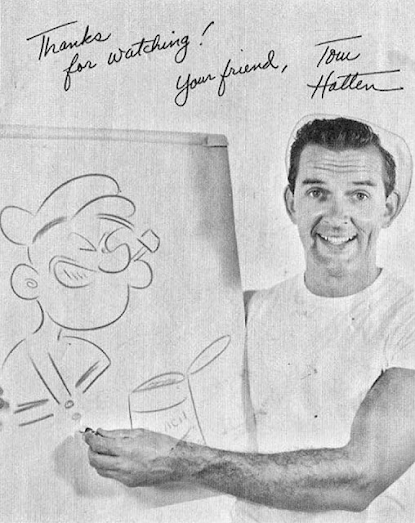
As a means of drumming up interested for "The Amazing Colossal Man". Across the country, in major television markets, a representative of "American International Pictures" was a guest on local children's television programs. In Los Angeles he was on "Popeye and Friends" hosted by Tom Hatten on KTLA, Channel 5.
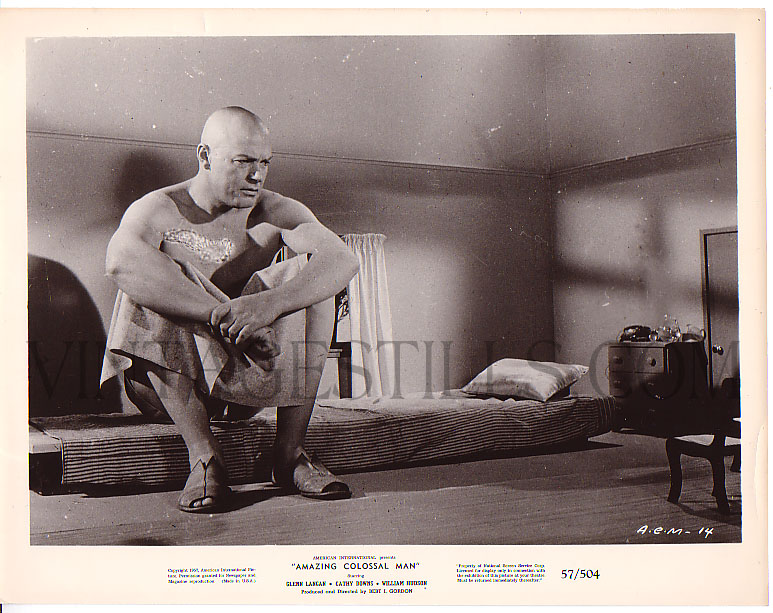
This time the film played off of not even a Hydrogen Bomb, but one made of Plutonium. Actor Glenn Langan, with his first name spelled Glen, portrayed "Lieutenant Colonel Glenn Manning". An original first name for the character. Langan had been acting since 1939 and appeared in several major "20th Century Fox" movies including the World War 2 films "A Wing and a Prayer", "A Bell for Adano", and the musical, "Something for the Boys". He was third billed behind actress Gene Tierney and actor Vincent Price in 1946's Dragonwyck", had fifth billing behind Linda Darnell, Cornel Wilde, Richard Greene and George Sanders in director, Otto Preminger's, 1947, "Forever Amber" and was also fifth billed in Olivia de Havilland's, 1948, "The Snake Pit" among other roles.

The story opens with a count down for the testing of the Plutonium Bomb. When a small airplane crashes in the test area and it can be seen that somebody is alive in it. "Lieutenant Colonel Glenn Manning" rushes out to save that person when the bomb goes off.

.jpg)
What happens to him, afterwards, is not shown at this point. His fiancee "Carol Forest",portrayed by Cathy Downs, goes to the military to find out why she's had no contact with him. Downs had been acting since 1945. In 1946 she was "Clementine Carter" in John Ford's retelling of the "Gun Fight at the OK Corral" with Henry Fonda as "Wyatt Earp" in "My Darling Clementine". After this picture, in 1958, Cathy Downs appeared in a revised remake of 1953's, 3-D, "Cat-Women of the Moon", on an even lower budget, entitled "Missile to the Moon". In 1956, she had third billing, in the original "The She Creature" starring 1930's/1940's, actor Chester Morris, and a Val Lewton stalwart Tom Conway. My article is "CATHY DOWNS the Hollywood Rabbit Hole into 1950's Low-Budget Science Fiction" at:
Below Cathy Downs as "Carol Forest'" in one of "Glenn Manning's" dream sequences.

"Carol" is finely told the truth and meets with "Glenn". Then she is informed that although "Glenn's" outer body is growing too gigantic proportions. That his heart and other organs remain the size of a normal man and will eventually not function.

Meanwhile "Glenn" is going insane and wants out of his confinement.

The Military Doctors think they have found a way to reduce "Glenn's" body back to normal. They show "Carol" what they have accomplished by shrinking a camel and elephant to doll size.
It appears that all that remains is to inject "Glenn Manning" with the serum and he should return to his normal size, but "Manning" escapes and heads for Las Vegas. This is the sequence all that pre-release publicity has the audience waiting to see, Even if we could literally see right through him in several shots.

"Carol" and the Military Doctors head first for Las Vegas and then hear "The Amazing Colossal Man" is going toward Hoover Dam. Which becomes the site of the film's climax.


"Carol" and the doctors attempt to explain to the now mostly insane "Lieutenant Colonel Glenn Manning" about the serum in the syringe. They run at him and inject it into his foot. "Manning" in a rage pulls it out and throws it at one of the men killing him.
.

.jpg)
"Manning" then continues toward Hoover Dam followed by army troops. For a moment he has "Carol" in his hands, but lets her go and the troops open fire. "The Amazing Colossal Man" then falls over the dam wall to his death.


Footnote: Bert I. Gordon made a sequel to "The Amazing Colossal Man", but it doesn't come under this article's title. The sequel was 1958's, "War of the Colossal Beast". "The Beast" was actually "Army Colonel Glenn Manning", now portrayed by Duncan "Dean" Parking, with his sister portrayed by Sally Fraser, Gordon's, 1958, "The Earth vs the Spider", searching for him.
1958's, "Operation Hardtack", took place at the "Pacific Proving Grounds", aka: the Marshall Island's. In that one year, alone, 35-Nuclear-Weapons, were detonated.
In fact, the United States detonated/tested, in the decade of the 1950's, a total of 64-NUCLEAR-WEAPONS aka: Atomic Bombs.
Once again I cross the Pacific Ocean to Japan and a motion picture with three familiar name's, Tomoyuki Tanaka, Ishiro Honda, and Eiji Tsuburaya. Their motion picture has two versions, the one they made and released in Japan by "Toho Studios", and the English language dub released by "Columbia Picture".
The original Japanese version from "Toho Studios", ran 87-minutes and was entitled:
美女と液体人間, Bijo to Ekitai-ningen ('Beauty and the Liquid People') released on June 24, 1958


The original story was written by actor Jiro Ogawa, using his pen name of Hideo Unagami, but credited by "Columbia Pictures", as Hideo Kaijo. His story was the only one Ogawa wrote, but he did appear, as an actor, both 1956's, "Sora no daikaiju Radon (Rodan)", and "Byaku fujin no yoren (Madame White Snake)", and 1957's, "Chikyu Boeigun (The Mysterians)".
The original screenplay was written by Takeshi Kimura. Among his other screenplays were 1956's, "Sora no daikaiju Radon (Rodan)", 1957's, "Chikyu Boeigun (The Mysterians)", 1960's, "Gasu ningen dai 1 go (The Human Vapor)", 1962's, "Yosei Gorasu (Gorath)" and 1963's, "Matango".
The motion picture was directed by Ishirô Honda. He had just directed a lighthearted comedy about three sisters, 1958's, "Hanayoma sanjuso", and followed this feature with 1958's, "Daikaiju Baran". Which would be re-edited with added American footage into 1962's, "Varan, the Unbelievable".
Starting in 1950, Japanese film makers turned American gangster films into a popular genre that lasted into the 1970's, "The Yakuza" film. In fact, in 1974, American actor Robert Mitchum came to Japan to film a co-production with "Toei Company", "The Yakuza". Mitchum had just been seen in the American crime feature, 1973's, "The Friends of Eddie Coyle", and followed "The Yakuza", by portraying Raymond Chandler's, "Philip Marlowe", in the 1975 version of "Farewell My Lovely".
The Ogawa and Kimura screenplay has a strong "Yakuza" crime story, mixed with a horror tale going back to the "Lucky Dragon #5" incident. It would be most of the "Yakuza" story that would be deleted by "Columbia Pictures", as not needed for American audiences, but leaves many holes in what is seen in their English language version.
Which returns me to Hydrogen Bomb Testing. As I have written, 1954's, "Gojira" owes its creation to two incidents. The March 1, 1954, "Castle Bravo H-Bomb Test", and the related "Daigo Fukuryū Maru, Lucky Dragon #5". However, the United States, the United Kingdom, and the Soviet Union were still conducting H-Bomb testing up to and after the release of "美女と液体人間, Bijo to Ekitai-ningen". One-year after the release of the English language "The H-Man", France tested their first Atomic Bomb.
Both versions start with two members of a Yakuza gang emerging from a sewer. One fully emerges, but the second Yakuza, suddenly starts to moan in pain. His partner gets away, but the moaning man has completely disappeared behind a parked car, leaving only his clothing, as if a body were still in them. Also left by the disappearing man is a large quantity of drugs.
Next, the audience meets "First Inspector Tominaga", portrayed by Akihiko Hirata, 1954's "Gojira", of the "Tokyo Metropolitan Police", who has traced the missing Yakuza to a man named "Misaki", portrayed Hisaya Ito. "Tominaga" believes "Misaski" was set up a major drug smuggling operation. The "First Inspector" now interviews "Misaki's" mistress (Not made clear in the "Columbia" version), "Chikako Arai", portrayed by Yumi Shirakawa, 1957's "Chikyu Boeigun (The Mysterians)", a singer at the "Cabaret Homura". She is being followed by a mysterious man, who now reveals himself as "Dr. Masada", portrayed by Keni Sahara, 1957's "Chikyu Boeigun (The Mysterians)", an "Associate Professor of Biochemistry" at "Jyoto University".

Above left to right, Keni Sahara, Yumi Shirakawa, and Akihiko Hirata
"Dr. Masada" believes that "Misaki" may have been exposed to a large amount of radioactive material and transformed into one of the "Liquid People" of the Japanese title.
It is at this point that "Columbia Pictures" dropped the majority of the Yakuza story, attempting to turn the picture into a typical 1950's American Science Fiction movie.
However, both versions now connect the origin of either the "Liquid People", or "The H-Man" to the "Daigo Fukuryū Maru, Lucky Dragon #5".
As I've noted above, the United States, the United Kingdom, and the Soviet Union were in an arms race over their creation of Nuclear Weapons that could be used in what President Eisenhower feared, ATOMIC WARFAFR!

In both versions, "Dr. Masada" presents to "First Inspector Tominaga" eye witness accounts of the creation of the "Liquid People/H-Men" in a flashback sequence.
A group of six fisherman come upon a derelict fishing vessel, the "Ryujin=Maru II".

Below, the actual "Lucky Dragon #5".

The six fishing men board the "Ryujin-Maru II", which, according to "Dr. Masada", was fishing in a safe area from an American H-Bomb Test.
On board the six men encounter the first of the "Liquid People" seen in the story, one of the original crew members that was irradiated by the Fallout from the H-Bomb.

Of the six fishermen who boarded the "Ryujin-Maru II", only two made it back to Tokyo to tell their story. After going through decontamination procedures.
There was no questioning by the audiences in Japan as to what this sequence was about.
The dual Yakuza story continues to run through the original film. As "First Inspector Tominaga" must deal with stopping the drug trafficking and assisting "Dr. Masada" and his love interest "Chikako Arai". Whom "Misaki's" partner, "Uchida", portrayed by Makoto Sato, is after. Believing she knows where the main stash of drugs are hidden within Tokyo's sewer system.
Everything comes together in a sequence right out of 1954's, "THEM!". "Dr. Masada" and his mentor, "Professor Maki", portrayed by Koreya Senda, have discovered that the "Liquid People" can be destroyed by fire. Their plan is to corner the "Liquid People" in the sewers and pour gasoline in and set it on fire. However, it is discovered as their plan goes into effect, that "Uchida" has kidnapped"Chikako" and their in the sewer with the fire spreading.
In the end, love triumph's.
Speaking of love, and director Rodger Corman was:
TEENAGE CAVE MEN released in July 1958

The story was by R. Wright Campbell, he had just written 1958's, "Machine Gun Kelly", starring Charles Bronson, and directed by Rodger Corman. Campbell wrote Rodger Corman's, 1955 Western, "Five Guns West", and the director's 1964, "The Masque of the Red Death", and was one of the writers on "Universal Picture's", 1957, "Man of a Thousand Faces", starring James Cagney.
Director Rodger Corman had just directed "Machine Gun Kelly", and followed this feature with 1958's, "She Gods of Shark Reef".
The Cast and Note the Ages of the Real Age of the "TEENAGERS":
Robert Vaughn portrayed "The Symbol Maker's Teenage Son". Vaughn was 28-years-old, this was his 19th on-screen appearance. but only his third motion picture. His second motion picture was the "B" Western, 1957's, "Hell's Crossroads", co-starring with Stephen McNally and Peggie Castle. His first, don't try and find him, had Vaughn portraying two characters, "A Spearman", and a "Hebrew", in director Cecil B. DeMille's, 1956, "The Ten Commandments". In 1960, Robert Vaughn broke into audience recognition as one of director John Sturges's, "The Magnificent Seven", but it wouldn't be for another 4-years until he was "Napoleon Solo", on 1964's television's, "The Man from U.N.C.L.E.".

Darah Marshall portrayed "The Blonde Maiden". This was her 2nd, of her total 7-roles, 6 on television. She was a 25-years-old teenager.

Lesley Bradley portrayed "The Symbol Maker". Bradley started on-screen acting in 1934, and was a solid supporting actor. He was the villain, "Baron Jose Gruda", in Burt Lancaster's, fun pirate spoof, 1952's, "The Crimson Pirate". He was another villain, "Targutai", in the John Wayne and Susan Hayward, 1956, "The Conqueror", and was appearing on television programs at the time of this motion picture.

Frank DeKova portrayed "The Black-Bearded One". DeKova's face, if not his name, is recognizable as a gangster, and hit-man, in many films and television crime shows. He was "Harry", in Rodger Corman's, 1958, "Machine Gun Kelly", he was in the 1959 pilot for televisions "The Untouchables", and had roles in both 1960's, "The Rise and Fall of Legs Diamond", and 1961's, "Portrait of a Gangster". Frank DeKova, additionally, was the evil astrologer in producer George Pal's, 1961's, "Atlantis the Lost Continent", among his total 156-roles.

.jpg)
Above left of Robert Vaughn is 29-years-old, Jonathan Haze, portraying the "Curly haired teenage boy". To Vaughn's right, is 34-years-old, Charles Beach Dickerson, portraying one of his 4-roles, as the "Fair Haired Teenage Boy". His other three in this picture, are the "Man from the Burning Hills", the "Tom-Tom-Drumer" at his teenage character's funeral, and even the "Bear" that attacked the teenagers.
Robert Shayne portrayed "The Fire Maker". Besides Roger Corman's "War of the Satellites", Shayne, co-starred with John Carradine in the 1946 horror movie, "Face of Marble". Among his other science fiction roles are as "Inspector Henderson", from 1952 through 1958, on television's "The Adventures of Superman", the title role of 1953's, "The Neanderthal Man". Along with being in Lon Chaney's, 1956, "Indestructible Man", and both 1957's, "Kronos" and "The Giant Claw". Not to forget non-credited roles in 1953's, "Invaders from Mars", 1954's, "Tobor the Great", and 3-episodes of televisions "Space Patrol", portraying "Groata".

Ed Nelson portrayed the "Blonde Tribe Member", 6-years before he had women swooning over him, as "Dr. Michale Rossi", on televisions "Peyton Place", from 1964 through 1969. This picture was the 30-years-old actor's 5th Rodger Corman's motion picture, and his first as a teenager. He started out as a "Police Sergeant", in 1956's, "Swamp Women".
.jpg)
The Simple Screenplay:
The story opens within a semi-caveman tribe, who are following ancient laws that were passed down forgotten generations ago. One such law, is that members of the tribe cannot cross the river to the other side, which is clearly visible to them. Why? No one living knows, but it is the law!
The main antagonist is the teenage "Son of the Symbol Maker", who is expected to replace his father upon his death. However, he is an inquisitive teen and wonders what lies across the river? His father tells him he is not to question the law, and to continue his studies to take over his father's position within the tribe.
.jpg)
Meanwhile, the young man has discovered a young woman, and each has feelings for the other.
.jpg)
However, an older, black-bearded man, also wants the young woman for his mate, and this leads to a short fight between both men.

Moving forward, through this, "Caveman James Dean, Rebel Without a Cause", plot with his father and mother. The "Son of the Symbol Maker" convinces some other teen cavemen to cross the river with him. When it's discovered they're gone, the adults, including his father, and the black-bearded man, follow to bring them back.
One of the teens drowns as they're crossing through a swamp area attached to "The River of No Return".
.jpg)
.jpg)

.jpg)
The "Son of the Symbol Maker" attempts to approach his God in peace, but from a tree the black-bearded man drops a heavy boulder on the creature.
.jpg)
The teen reacts, letting go of an arrow from his bow, killing the man who dared kill their God. However, their God's head comes off, revealing an extremely old man's head and this is what connects the story to this article.

The "Son of the Symbol Maker" finds a photo album around the old man's neck, and as he looks at the photo's, a voice over tells the story.
.jpg)
The ancient looking man, was a scientist from generations long past and forgotten. There was a Nuclear War, and his radiation suit, made to protected him from residual radiation, did more than that. It kept him alive until this very moment to bring generations of lost questions and answers to an end.
.jpg)
.jpg)
.jpg)
The scientist discovered he was affected by the radioactivity and his life span had been lengthen beyond his imagination. Over the years, his suit took on the shape of a hideous monster, as he witnessed the survival of a small group of humans beyond the radiations reach. The voice over ends with the scientist asking the question:
Will this new human race make the same mistakes of the past human race?

Besides "The Purple Cloud", the screenplay would be also based upon the short story, "End of the World", by Ferdinand Reyher. He was a 1930's screenplay writer, novelist and reporter for the "Boston Globe" and "Boston Post". During the 1940's his close friends included playwright Bertolt Brecht, director-actor John Huston, and actor Paul Henreid.
The screenplay was written by the motion picture's director, Ranald MacDougall. His screenplays included 1945's, "Objective Burma", the same year's "Mildred Pierce", 1950's, "Bright Leaf", 1954's, "The Naked Jungle", the same year's "Secret of the Incas", and 1955's, "We're No Angels".

Second, "Sarah Crandall", portrayed by Inger Stevens, is a twenty-something White woman, who was living in New York City, and was able to somehow survive exposure to the isotopes in her apartments high rise building.


The two men now move through the city armed, watching out for the other.


In the climax, "Ralph" passes the United Nations headquarter's building, climbs the steps of "Ralph Bunche Park" and reads the inscription from the "Book of Isaiah", and a little religious morality enters the screenplay.

They shall beat their swords into plowshares. And their spears into pruning hooks. Nation shall not lift up sword against nation. Neither shall they learn war any more
Which turns into an unbelievable ending:
"Ralph" throws down his rifle and goes to "Benson" unarmed. "Benson" finds he cannot shoot the other. The two men stop fighting, and with "Sarah" in the middle:
All three hold hands and walk down a main street to a better future.
To many, Japan's "Toei Company" is known for strictly for their animation, but they also made live action features and one of these was:


Dai Sanji Sekai Taisen: Yonju-Ichi Jikan No Kyofu (Third World War: 41 Hours of Horror) aka The Final War; When World War III Breaks Out; Jikan No Kyofu
Toei Company
This is not the same film as 'Sekai Daisenso', also known as 'The Final War'.
The USA accidentally detonates a nuclear device over South Korea. The North/South Korea retaliations escalate, with the USA and USSR drawn into the conflict on a global scale, ending with most of the world being wiped out - only Argentina is left. The final scenes are shot in heavy rain as a memorial service is held for most of mankind.It is the English language title that helps to confuse when this film was released. The reference to another motion picture, the above mentioned "Sekai Daisensō (The Great World War') with the English titles of either "The Final War" and "The Last War". Had a similar themed Third World War motion picture made by Japanese studio "Toho" and released in Japan on October 8, 1961, and in Honolulu, Hawaii in English, on January 3, 1962.

ON THE BEACH released on December 17, 1959

The screenplay was based upon the best-selling novel "On the Beach", by British author Nevile Shute. The audience sees that the story takes place in 1964, only 5-Years later than this movie's release year. In 1959, the Soviet Union and the United States had agreed to a voluntary joint suspension of Nuclear Testing. What became known as the "Kitchen Debate", in Moscow, between Khrushchev and Nixon took place. While Fidel Castro came into power in Cuba, 90-miles from Florida. These real events and others made the tension very high for an audience watching a story taking place after the 3rd World War between the United States and the Soviet Union. The desired shock effect, producer and director, Stanley Kramer, wanted from his audience.

As I just mentioned, the Third World War has taken place in Earth's Northern Hemisphere, and most of the cities of the world lay in waste from "Nuclear Devastation". The resulting Fallout Cloud has been slowly working its way south, leaving cities as they were built, but with every living thing dead within them. Apparently, the only living humans are in Australia, but the Cloud is coming.
The story is about the final days of a group of people living in Australia, living as if nothing ever happened, but knowing what will eventually arrive. Arriving in Sydney Harbor is the American nuclear submarine, the "Sawfish", that survived by staying underwater and surfacing only before the Cloud had reached their position.
"United States Navy Commander Dwight Lionel Towers", portrayed by Gregory Peck, has his submarine placed under the command of the Australian Navy. While awaiting his orders, "Towers" meets Australian socialite "Moria Davidson", portrayed by Ava Gardner,, and the two start an affair.

"Towers" also comes in contact with Australian scientist, "Julian Osborn", a serious role portrayed by Fred Astaire. "Julian" is rebuilding a race car to enter in the "Australian Grand Prix", another sign that life in Australia continues as if nothing happened.

Assigned to "Commander Towers" is "Royal Australian Navy Lieutenant Commander Peter Holmes", portrayed by Anthony Perkins, as his liaison. "Holmes" has a wife, "Mary", portrayed by Donna Anderson, and a baby.

An incomprehensible signal is coming from the West Coast of the United States in morse code, but it could be a sign of survivors. A scientific theory is that radiation levels are lower in the Arctic Ocean and could indicate that the radiation may be gone by the time the cloud was to have reached Australia. The "Sawfish" is ordered north to find the source of the signal and confirmed the lower radiation levels. "Julian" will accompany the crew as will "Lt. Commander Holmes".
The "Sawfish" reaches Point Barrow, Alaska, and runs tests on the radiation levels, but finds that they are inexplicably intensifying instead of lowering. The radiation cloud may even be stronger by the time it reaches Australia.

Next, the "Sawfish" arrives in San Francisco Bay and through the periscope, the crew sees a deserted city. Crewman, "Ralph Swain", portrayed by John Meillon, deserts the submarine and goes to find his family. The next morning, through the periscope, "Towers" sees "Swain calmly fishing. "Commander Towers" is warned by "Julian" not to take "Swain" on-board, as he is now a danger to the entire crew, because of his exposure to radiation.
The "Sawfish" leaves San Francisco and heads for San Diego and the morse code signal. "Communication Officer Lieutenant Sunderstrom", portrayed by Harp McGuire, is given protective gear and is sent ashore to find the signal and who's sending it.

What "Sunderstrom" finds is an empty Coke bottle, hanging by a string from a window shade over the telegraph key. He cuts it off and returns to the "Sawfish".
Back in Australia, "Dwight Towers", and "Moria Davidson", join "Julian Osborn" at the race track and watch him win the race.


As the cloud comes closer, religious fever starts to take hold.

At the climax, "Julian" seals his garage, gets into his race car, and turns the engine on. "Lieutenant Holmes" gives his wife and baby a pill that will let them die in peace and not face radiation poisoning and takes one himself. The crew of the "Sawfish" wants to go back the the United States to die, and "Moria" watches it sail out to sea.

Next, producer Stanley Kramer shows the audience a deserted Sydney, Australia.....

.... and the movie fades to black
And so will I - - -


No comments:
Post a Comment