When one looks at the great and not so great motion picture's released during the
1930's, 1940's, and
1950's, 119 of those
belonged to
Gary Cooper. Those 119-films, varied in their genre, and were not just in his
"Cowboy Persona".Frank James Cooper was born in Helena, Montana, on May 7, 1901, to a couple who immigrated to the United States from England and settled in Montana. His mother was Alice Brazier Cooper, from Gillingham, in Kent. His father was Charles Henry Cooper, from Houghton Regis, Bedfordshire. Charles Cooper became a prominent lawyer, the owner of the 600-acre, "Seven-Bar-Nine" cattle ranch, and a member of the "Montana State Supreme Court". Frank also had an older brother, Arthur, who was six-years his senior. Below, a 1903 picture, of Frank James Cooper, age 2:
Alice wanted her boys to have a formal education and, in 1909, the brothers found themselves at the "Dunstable Grammar School", in Dunstable, Bedfordshire, England.
Alice and her sons returned to the ranch in August, 1912, and Frank continued his schooling at the "Johnson Grammar School", in Helena. In 1916, he entered "Helena High School".
According to his biographer, Larry Swindell, in his 1980 work, "The Last Hero: A Biography of Gary Cooper". When he was 15-years-old, Frank was in a car accident, that after surgery, left Cooper with his "Characteristic stiff, off-balance walk and slightly angled horse riding". While still in high school, in 1920, Frank had developed an interest in art, and enrolled in three art courses at the then, "Montana Agriculture College (today the Montana State University)".
Finishing his high school education at, "Gallatin County High School", in Bozeman, Montana. Frank Cooper became interested in the works of Western artist's, Charles Marion Russell, and Frederick Remington. According to several biographies of the actor, his favorite work was Russell's, "Lewis and Clarke Meeting Indians at Ross Hole", below. It was at "Gallatin", that he met his first mentor, English teacher, Ida Davis. Who encouraged him to stay with academics and introduced her student to dramatic acting in the high school's plays.
In
1922, Frank enrolled in
Grinnell College, in
Grinnell, Iowa, to continue his education, He was now doing his own painting and, apparently, his paintings were appearing all over campus. However, the teaching staff did not think he was a good actor, and
Frank was not accepted into the drama club.

It would be the Autumn of 1924, that his direction in life was to start changing. It began with his father going to Los Angeles to take care of some legal business for his relatives and officially leaving his bench on the "Montana Supreme Court". Charles next moved his wife from Montana, to establish a home in Los Angeles. At his father's request, in November, Frank came to live with them and started looking for any kind of work. Back in Montana, on their ranch, he had been a cowboy working the stock. Now, what could a cowboy do in the wilds of Los Angeles?
Fate, if such a thing really exits, stepped in. Frank James Cooper, after going nowhere in the jobs he found, met two friends from Montana. Both were working in silent "B" Westerns for "Poverty Row" movie studios. "Poverty Row" was actually on Gower Street, located between Hollywood Boulevard and Sunset Boulevard. These "Studios" had no physical location, and just rented office space in the building's on both sides of Gower. I look at these studios and the founding of "Hollywood" in my article, "HOLLYWOOD: Segregated Housing, Motion Picture Studios and Movies Palaces" at:
https://www.bewaretheblog.com/2019/04/hollywood-segregated-housing-motion.html
Several large studio's owned their own "Movie Ranch's" to shoot mainly Westerns and chase sequences in other feature films. The main studio owned ranches belonged to "20th Century Fox", "Paramount Picture's", and "RKO". Whose ranch would become the Los Angeles suburb of Encino and the Sepulveda Basin area of the San Fernando Valley". While, "Walt Disney" owned most of "Placerita Canyon" in the Santa Clarita Valley, and "Monogram Picture's, Monogram Ranch", would become Gene Autry's, "Melody Ranch".
While, "Poverty Row" studios, had to rent space from Independent movie ranches, to film their outdoor sequences. These movie ranch's included the"Iverson Movie Ranch", in the Santana Susana mountains and "Corriganville", owned by "B" Cowboy Ray "Crash" Corrigan, in Simi Valley.
Probably the most infamous movie ranch, is the "Spahn Movie Ranch". Where teenage Lloyd would ride horses boarded by two of his Uncle's, but is remembered for Charlie Manson and his followers, living on it. That story is found in my article "The Spahn Movie Ranch, Sharon Tate, the LaBianca's, and Helter Skelter" at:
https://www.bewaretheblog.com/2020/03/the-spahn-movie-ranch-sharon-tate.html
Another filming location used by both "Poverty Row" and the large studio's was "Vasquez Rocks", located between Newall, California, where I live, and the small community of Aqua Dulce. My reader might be surprised how familiar looking the rocks may be to them. My article is "VASQUEZ ROCKS: The Most Important Pile of Rocks in Motion Picture History" at:
https://www.bewaretheblog.com/2018/08/vasquez-rocks-most-important-pile-of.html
Returning to Frank's journey into acting, his two Montana friends, introduced the young cowboy to a third Montana Cowboy, and rodeo champion, Jay "Slim" Talbot. Talbot, who later would become Gary Cooper's personal stunt-man, took the young Cooper to see a casting director. He now became a $5 a day actor, and a $10 stunt rider. In the year of this writing, that $5 a day actor, would be making the equivalent to $94.77.
Frank was listed as an "Unconfirmed Extra", in the 1923, crime drama, "The Last Hour". I could not locate any work for 1924, which may indicates why he's unconfirmed forthe year before.
However, there was 1925, during that year, casting director Nan Collins suggested a name change, because of the number of actors named Frank Cooper. When asked for a suggestion, Collins suggested the name of her hometown, Gary, Indiana, eventually Nan Collins became GARY COOPER'S agent.
In 1925, Cooper appeared in 13 motion pictures. Which of these is the title where Frank became Gary, I have not been able to confirm. Because, every filmography of the actor I have read, lists his name as Gary Cooper.
Of interest is the website for the "Montana Cowboy Hall of Fame", at:
https://montanacowboyfame.org/inductees/2016/8/frank-james-gary-cooper
On that website the linked page if for "Frank James 'Gary' Cooper".
Before I move out of the silent films era. I want to look at some of the uncredited extra's in the silent classic version of New Mexico Governor and Union Civil War General Lew Wallace's novel, "Ben-Hur: A Tale of the Christ". Which premiered in New York City on December 30, 1925, and was the actor's last motion picture for that year.
Gary Cooper is listed as a "Roman Guard", and found himself with some potential major acting company.
Uncredited actors and actresses for the Chariot Race sequence included:
John and Lionel Barrymore, Joan Crawford, actress and mistress of William Randolph Hearst-Marian Davies, Douglas Fairbanks, Sr., Clark Gable, Janet Gaynor, Dorthy and Lillian Gish, Samuel Goldwyn, Sid Grauman, Noble Johnson the future "King of Skull Island", Harold Lloyd, and Mary Pickford.
Three uncredited Slave Girls were portrayed in the picture by:
Carole Lombard, Myrna Loy, and Fay Wray.
Gary Cooper, was no longer Frank Cooper, and he finally had a fully credited role, maybe not in a feature length motion picture, but in:
"LIGHTNIN WINS"released on October 4, 1926, a 20-minute short subject
The short starred "Lightnin the Dog - The Super Dog", in his 4th of 8-shorts.
Above, 2nd-billed Gary Cooper, and 3rd-billed Ellen Sedgwick.
THE WINNING OF BARBARA WORTH released on October 14, 1926
This Western motion picture was produced by Samuel Goldwyn, the above poster identifies him as the "Presenter", not the "Producer". A substitute billing used for producers, that carried into the 1930's.
The poster tells the audience this was a Henry King "Production". There is no mention of King as the feature's director, on the above poster. Again, normal for the silent years.
There are two identified actors on the poster:
British actor, Ronald Coleman portrayed "Willard Holmes". He had just starred in the 1926 production of author, Percival Christopher Wren's, classic novel of the French Foreign Legion, "Beau Geste". Colman followed this motion picture with 1927's, "The Night of Love", co-starring Vilma Bánky.

Vilma Banky portrayed "Barbara Worth". She had just appeared in 1926's, "Son of the Sheik", co-starring with Rudolph Valentino. Banky followed this motion picture with 1927's, "The Night of Love".
Gary Cooper portrayed "Abe Lee". He would be back to an uncredited role as a "Seaman", in 1926's, "Old Ironsides", starring Charles Farrell and Wallace Beery.
The story is about a Western desert irrigation system builder, "Willard Holmes". Who while building the irrigation system meets a local rancher's daughter, "Barbara Worth", and falls in love. However, there is a local cowboy, "Abe Lee", who also wants her affections, and the two vie for "Barbara"
From co-starring in a major silent motion picture, Gary Cooper was back to uncredited small roles for his next 4-films. Then came third billing in a 1927 silent film, starring actress, Clara Bow, "Children of Divorce", and first billing in the 1927 Western, "Arizona Bound".
WINGS premiered in San Antonio, Texas, on May 19, 1927
This was the First Motion Picture to win the "Academy of Motion Pictures Arts and Science's", "Best Picture" Oscar. Award at the First "Academy Award Ceremony", on May 16, 1929, but at the time, called "Best Picture, Production". The feature was directed by William "Wild Bill" Wellman. The following comes from my article "WILLIAM A. 'WILD BILL' WELLMAN: '3' with JOHN WAYNE: 'Island in the Sky', 'The High and the Mighty' and 'Blood Alley", to read at:
https://www.bewaretheblog.com/2017/07/william-wild-bill-wellman-3-with-john.html
Moving forward to the First World War, before America finally entered it on April 6, 1917. Found 19 year old William Augustus Wellman, in 1915, joining the Norton-Harjes Ambulance Corps with other American's wanting to help defeat Germany. He didn't stay an Ambulance Driver long and later in 1915, become one of the first American's to join the French Foreign Legion as a combat pilot. He was part of the Lafayette Flying Corps. A general name for American pilots serving in the French Air Force and not the sub group "The Lafayette Escadrille".
Wellman was a "Second Unit Director" that the executives of "Parmount Famous Lasky Productions", with his military flying background, thought was the perfect choice to direct "Wings".
The motion picture's three stars were Clara Bow portraying "Ambulance driver, Mary Preston", Charles "Buddy" Rodgers, billed as Charles Rodgers, portraying "Army Air Corps pilot, Jack Powell", and Richard Arlen portraying "Army Air Corps pilot, David Armstrong".
Above left to right, Richard Arlen, Clara Bow, Charles "Buddy" Rodgers
However, the stars aside, one actor in a very small role became the talk of the "Hollywood Reviews". His name was Gary Cooper, in the 7th, fully credited role of, "Army Air Corps, Cade White". Cooper followed "Wings" with the leading role of "Sheriff Buddy Hale", in the 1927 Western, "The Last Outlaw", billed as "Garry" Cooper.
The scene in "Wings" with Gary Cooper doesn't last 2 and a half minutes, but its impact on audiences, especially women, created a major interest in the actor.
He is first seen asleep on a coat in a tent and wakes ups.

Next, "Cadet White" introduces himself to his two tent buddies, "Jack" and "David", and looks forward to being with them. "White" offers a chocolate bar of candy to the other two. Next, the scene gets serious, as the three start to discuss pilot's carrying "Lucky Charms" to survive their missions.
"White" tells the other two that the doesn't believe in "Lucky Charms". He finishes putting on his flying suit as he is going out on a mission. As he starts to leave, "White" stops, turns around and tells "Jack" and "David" that:
When it's your time, no lucky charm will save you.
He HAPPILY leaves the tent and the audience finds out he was killed by a German pilot.
On August 6, 1926, "Warner Brothers" released a motion picture with "Synchronized Musical Sound", but "Don Juan", starring John Barrymore, had no sound dialogue. Then on October 6, 1927, "Warner Brothers" released "The Jazz Singer", and before he sang one song, the sound recoding caught Al Jolson speaking:
Folks,You An't Seen Nothing Yet!
And motion picture's containing spoken dialogue were born.
Gary Cooper had co-starred in 3-sound pictures, but they actually were silent films with synchronize music. Then came director Richard Wallace's, "Part Silent-Part Talkie":
THE SHOPWORN ANGEL released December 29, 1928
The motion picture starred Nancy Carroll, who started her career in Broadway Musicals, portraying "Daisy Heath", a Broadway Actress. In the sound version, you hear Carroll sing "A Precious Little Thing Called Love", of course the song is not heard in the all-silent release. The majority of independent movie theater owners did not have the money to install sound equipment for the "Gimmick" of dialogue. So, there was always a completely silent and shorter version of a picture being released.
Gary Cooper portrayed "Army Private William Tyler". The First World War is starting and for morale busting, Broadway actress "Daisy" agrees to a publicity gimmick of courting Texas born, "Private Tyler". However, the two actually fall in love and at the end of the sound version, the audience hears both Cooper and Carroll say the words, "I Do", in the closing scene of their wedding.
Above, Paul Lukas as "Daisy's, wealthy benefactor", "Bailey", Gary Cooper, and Nancy Carroll
Then came a classic early sound Western and the birth of Gary Cooper's classic response.
THE VIRGINIAN released on November 9, 1929
If "Wings" was the motion picture that brought attention to Gary Cooper. Then, "The Virginian" made a star out of the Montana Cowboy.
The motion picture was directed by Victor Fleming. Who, ten-years later, would have his name as the only director of 1939's, "Gone with the Wind". Between this feature and that feature, among Fleming's work is 1934's, "Treasure Island" starring Wallace Beery and Jackie Cooper, 1937's, "Captains Courageous" starring Spencer Tracy and Freddie Bartholomew, and 1939's, "The Wizard of Oz" starring Judy Garland.
The second unit director was Henry Hathaway, who held the same position on "The Shopworn Angel", more about him, shortly.
The screenplay was based upon author Owen Wister's, 1902, Western novel. However, there was another filmed version of the novel, 1914's, "The Virginian", produced and directed by Cecil B. DeMille. Which was a version of the 1903 play by Kirk La Shelle. Both that film and novel were adapted into this screenplay by two other writers. The first was Grover Jones, who was an uncredited writer on Cecil B. DeMille's, 1936, "The Plainsman", more later, and DeMille's, 1938, "The Buccaneer". The second adaptor was Keene Thompson, who between 1920 and 1925, wrote 28-shorts. Just before this picture, he co-wrote the Gary Cooper and Lupe Velez, 1929, "Wolf Song".
Howard Estabrook wrote the actual screenplay. He was one of the co-writers on 1928, "The Shopworn Angel", and the Richard Arlen, Fay Wray, 1929, "The Four Feathers", the Howard Hughes, James Whale, 1930, "Hell's Angels", and Barbara Stanwyck's, 1954, "Cattle Queen of Montana".
Gary Cooper portrayed the cowboy only known as "The Virginian". He would follow this feature film with the First World War drama, 1930's, "Seven Days Leave". Which was based upon author J. M. Barrie's, the playwright author of the 1902 play "Peter Pan", other play, "The Old Lady Shows Her Medals". Gary Cooper's character is a Canadian soldier in England, that the "Old Lady" tells people is her son. He goes along with her belief, ending up, dying in the war, and the medals he won being given to the "Old Lady" in her son's name.
Walter Huston portrayed "Trampas". Huston would follow this feature film with the title role of 1930's, "Abraham Lincoln". In 1932, he co-starred with Joan Crawford, in author William Somerset Maugham's, "Rain". In 1936, he had the title role in Sinclar Lewis's, "Dodsworth", directed by William Wyler, and in 1941, Walter Huston had the uncredited role of "Captain Jacoby", in son's John Huston's, "The Maltese Falcon".
Richard Arlen portrayed "Steve". He had starred in producer Merian C. Cooper's, 1929, "The Four Feathers", co-starring Fay Wray. Arlen would next, co-star in the race car movie, 1930's, "Burning Up", with Mary Brian.
Mary Brian portrayed "Molly Stark Wood". Brian had portrayed "Wendy Moria Angela Darling", in the 1924 film version of J. M. Barrie's "Peter Pan". Brian followed this feature film with 1929's, "The Marriage Playground", co-starring with Fredric March.
The Basic Classic Western:
A man known only as "The Virginian", is the foreman of the "Box H Ranch", near Medicine Bow, Wyoming. In an opening sequence, he vies for the attention of a barmaid, but has competition is the known cattle rustler, "Trampas".
The dialogue given to Gary Cooper, became famous and stuck with him throughout his career. When Huston's, "Trampas", insults Cooper's,"The Virginian", in the barmaid sequence. Gary Cooper pulls out his pistol and says the classic line:
If you wanna call me that - smile
Because of the problems with switching to sound, dialogue was kept sparse, which fit the title character. Which somewhat became part of his Western Cowboy persona, and even showed up in "Warner Brother's" cartoon's. When an animated character of him appeared in them, or a marionette, circa 1930's, below.
To the town of "Medicine Bow" comes "Molly", a new school teacher from Vermont. Both "The Virginian" and a drifter named "Steve" now complete for her.
"Steve" was a childhood friend of "The Virginian", who gives him a job at the "Box H Ranch". "Molly" is not interested in "The Virginian", because of his violent nature. Next, things switch, as "Steve" joins "Trampas's" gang, even after being warned by "The Virginian" of what "Trampas" really is like.
"Trampas" is very clever, and plans to steal cattle from the "Box H", but smartly lets everyone else in his gang, including "Steve", do the stealing. They are caught, and this forces "The Virginian" to hang everyone including "Steve", and now it's revenge that's on the mind of the "Box H" foreman.
"Molly" is even more disgusted with "The Virginian's" seemingly callous nature to what he did to "Steve" and the others. However, "Trampas" comes back to town and shoots the ranch foreman in the back. "Molly" realizes her mistake, and starts to nurse "The Virginian" back to health, as the two fall in love. On their wedding day, "Trampas" returns, and "Molly" attempts to stop the man she loves from seeking revenge, but it is the other way around.
"Trampas" challenges "The Virginian" to a shoot-out, they meet, but "The Virginian's" holster carries "Steve's" pistol, and "Trampas" lies dead.
The feature ends with "Molly" and "The Virginian's" wedding.
Among the 18-feature films, that followed the previously mentioned 1930, "Seven Days Leave", were, immediately, 3-more Westerns. Along with 1930's, "Morocco", with Gary Cooper as a member of the French Foreign Legion in love with Marlene Dietrich, and the 1931 crime film-noir, "City Streets", directed by Rouben Mamoulian, with "Coop", as he started to be known, in love with Sylvia Sydney. Then there was his meeting with "The First Lady of American Theatre", Helen Hayes, in the 1932 version of Ernest Hemmingway's, "A Farewell to Arms".
Her name was Veronica Balfe, she was a debutante, with the nickname of "Rocky". That was given to a young Veronica by her family. She had made 7-on-screen appearances as "Sandra Shaw". Below, "Sandra Shaw" looks out of a window, and screams, as 1933's, "King Kong" climbs her building. The official cast listing describes actress Sandra Shaw as:
Woman Who Screams From Hotel Window (uncredited)
HOWEVER, on December 15, 1933, she married actor Gary Cooper. Below, on the left is "Paramount Pictures" head, Aldoph Zukor, man on right is unidentified.
The following is modified and expanded with Gary Cooper photos, from my article "Charlotte Henry: 1933's, 'Alice in Wonderland' and 1934's, 'Babes in Toyland" to relive your childhood at:
https://www.bewaretheblog.com/2021/06/charlotte-henry-1933s-alice-in.html
ALICE IN WONDERLAND premiered in London, on December 18, 1933
You do not need to take the time to read all the names on the above poster, because they appear beside the roles each played, in "Alice in Wonderland", on the following closing credit list. Which includes Gary Cooper, W.C. Fields, and Cary Grant. Every name listed was under contract to "Paramount Pictures". Which meant an actor, or actress, had to do whatever role the Executives wanted them to play without objection.
The screenplay was based upon both works by British author, Lewis Carroll, leaning more heavily on the second. These are, "Alice's Adventures in Wonderland", and "Through the Looking Glass".The screenplay was by two interesting writers:Over his career, Joseph L. Mankiewicz, was nominated for Ten Academy Awards and won four of them for two motion pictures. In each case, one Oscar was for his Directing, and the other for his Screenplay writing. The movies were 1949's, "A Letter to Three Wives", starring Jeanne Crain, Linda Darnell, and Ann Sothern, and 1950's, "All About Eve", starring Bette Davis, Anne Baxter, George Sanders and Celeste Holm. Two other Mankiewicz's screenplays are the 1955 musical, "Guys and Dolls", starring Marlon Brando, Frank Sinatra and Jean Simmons, and 1963's, "Cleopatra", starring Elizabeth Taylor, Richard Burton and Rex Harrison.Although, this is the only screenplay by William Cameron Menzies. He was one of the uncredited Director's on 1939's, "Gone with the Wind". Victor Fleming, and other "MGM" director's refused to film the burning of Atlanta sequence. Which was made by actually burning hundreds of old and not used sets on the lot. So, Menzies stepped up. However, he is known to science fiction fans for two motion pictures he Directed. These are, 1936's, "Things to Come", from one of only two screenplays written by British author H.G. Wells, and, 1953's, "Invaders from Mars".
William Cameron Menzies was also the Art Designer for "Alice in Wonderland". As he was for 1936's, "Things to Come", and 1953's, "Invaders from Mars". My article is "William Cameron Menzies: Art Director, Production Designer and Motion Picture Director" to be amazed at his work at:
https://www.bewaretheblog.com/2022/09/william-cameron-menzies-art-director.html The make-up and masks were by Wally Westmore, one of the six Westmore brothers. Among his work was the Frederick March, Oscar winning make-up, for 1931's, "Dr. Jekyll and Mr. Hyde", and the Charles Laughton and Bela Lugosi, 1932, "Island of Lost Souls. Which was based upon H.G. Wells's, the "Island of Dr. Moreau", There were three Directors on this feature film. The live action was Directed by Norman Z. McLeod. McLeod Directed the Marx Brothers, Groucho, Chico, Harpo and Zeppo, in 1931's, "Monkey Business", and 1932's, "Horse Feathers", prior to this feature.The animation sequences were from the team of Hugh Harmon and Rudolf Isling. They did this animation between the two working for Walt Disney and switching to Warner Brothers.
Below Some of the Inhabitants of Wonderland as Envisioned by William Cameron Menzies and Wally Westmore:
Above,
Charlotte Henry's "Alice" realizes there's a
"Looking Glass Room". That is the opposite of her own room, or is it really vice-versa as
Lewis Carroll wrote it?
Above, William Austin as "The Gryphon", is speaking to Charlotte Henry, and Cary Grant as "The Mock Turtle". Below, Roscoe Karns and Jack Oakie are "Tweedledee and Tweedledum"
Above, a rare color enhanced photo, the picture is in black and white, with Richard "Skeets" Gallagher as the "Rabbit". Below, Ned Sparks as the "Caterpillar".
Above, May Hobson as "The Queen of Hearts", and Alison Skipworth as "The Duchess". Below, Edward Everett Horton as "The Mad Hatter" and Charlie Ruggles as "The March Hair".
Above,
Richard Arlen as
"The Cheshire Cat" and below,
Gary Cooper as
"The White Knight".
Last, but not least,
W.C. Fields as
"Humpty Dumpty".
The motion picture was a box office flop for "Paramount Pictures". One of the reasons given was that the audience came to see their favorite stars, but could not figure out who was who under the make-ups. Another factor was the studio kept the finished feature to only 77-minutes. The Joseph L. Mankiewicz and William Cameron Menzie's screenplay was attempting to do most of both novels and was filmed longer than released. The two writers were keeping Lewis Carroll's prose in place. A tall mountain to climb!
Three more stills of Gary Cooper:
From being "Alice's, White Knight", Gary Cooper found himself in a stirring adventure film that would inspire others as a result, such as 1936's, "The Charge of the Light Brigade", starring Errol Flynn and Olivia de Havilland, and 1939's, "Gunga Din", starring Cary Grant, Victor McLaughlin, and Douglas Fairbanks, Jr.
THE LIVES OF A BENGAL LANCER premiered in New York City on January 11, 1935
The director on this feature was the previously mentioned Henry Hathaway. Hathaway started being a full director with a series of Randolph Scott Westerns, beginning with 1932's, "Heritage of the Desert". He would follow this feature film with Anglo-French author, George L. Du Maurier's, 1935, "Peter Ibbetson", co-starring Gary Cooper and actress Ann Harding. Among Hathaway's work is the Tyrone Power, 1940, "Johnny Apollo, the James Cagney, 1947, "13 Rue Madeleine", the Orson Welles, 1950, "The Black Rose", James Mason's, 1951, "The Desert Fox: The Story of Rommel", the Marilyn Monroe, 1953, "Niagara", and the John Wayne and Sophia Loren, 1957, "Legend of the Lost".
The screenplay was based upon the 1930 autobiography by Francis Yeats-Brown, who also contributed to the screenplay. Yet, this story has very little in common with the Yeats-Brown book.
The two main writers were Waldemar Young, both director Todd Browning's, 1927, "The Unknown", and "London After Midnight", and both Cecil B. DeMille's, 1932, "The Sign of the Cross", and 1934's, "Cleopatra".
John L. Balderston, co-wrote 1931's, "Dracula" and "Frankenstein", along with having been at the actual opening of "King Tut's Tomb", came up with 1932's, "The Mummy". My article is "John L. Balderston: Writing Classic Fantasy, Horror, and Science Fiction Screenplays" at:
Gary Cooper portrayed "Lieutenant Alan McGregor". Cooper had just seen in the 1934 crime drama, "Now and Forever", co-starring Carole Lombard and Shirley Temple, attempting to break away from her little girl image. Gary Cooper would followthis feature with director King Vidor's, 1935 drama, "The Wedding Night".
Franchot Tone portrayed "Lieutenant John Forsythe". He was four films away from 3rd-billing, after Charles Laughton and Clark Gable, in 1935's, "Mutiny on the Bounty".
Above, Franchot Tone and Gary Cooper
Richard Cromwell portrayed "Lieutenant Donald Stone". He was a 1930's-1940's "Heartthrob", Cromwell was married, for 9-months, to 19-years-old, Angela Lansbury, he was 35 at the time. His last movie was 1948's, "Bungalow 13", a crime film-noir, he co-starred with Tom Conway (1942's "Cat People"), and Margaret Hamilton (the "Wicked Witch" of 1939's "Wizard of Oz)".
Above left to right, Franchot Tone, Richard Cromwell, and Gary Cooper
Sir Guy Standing portrayed "Colonel Tom Stone". During the First World War he served in the "Royal Navy Volunteer Reserve", Guy Standing reached the rank of "Commander", and was transferred to "MI-6", and in 1919 was raised to the rank of "Knight Commander (KBE)". His motion picture career started in 1914.
C. Aubrey Smith portrayed "Major Tom Hamilton", below on the left, and on the right is Guy Standing.
Kathlyn Burke portrayed "Tania Volkanskya". Burke only had 22-film-roles, she had just been seen with 5th-billing in the Randolph Scott Western, 1935's, "Rocky Mountain Mystery".
Above left to right, Gary Cooper, Kathryn Burke, Franchot Tone, and Richard Cromwell
The screenplay is set in the northwest frontier of India, during the British Raj (British rule of India from 1858 through 1947). The story has Scottish-Canadian, "Lieutenant Alan McGregor" welcoming two new officers to the "41st Bengal Lancers". They are "Lieutenant John Forsythe", and a newly commissioned officer, "A Cub", "Lieutenant Donald Stone". "Stone" is the son of their unit's commander, "Colonel Tom Stone". This forms part of the storyline, as "Donald" believed his father asked for him to be part of the unit. The reality is "Colonel Stone", did not request his son and will treat him like he treats all officer's. Adding to young "Stone's" confusion, is that he hadn't seen his father since he was a boy, and hoped to spend some real time with him.
"Lieutenant Barrett", portrayed by Colin Tapley, returns, he was disguised as a rebel, and was undercover to spy on "Mohammed Khan", portrayed by Douglass Dumbrille, billed as Douglas Dumbrille. "Barrett" reports that "Mohammed Khan" is planning a major uprising against the British.
Learning that the British know of his plan, "Khan" orders Russian agent, "Tania Volkanskya", to seduce "Colonel Stone's" son, "Donald", and kidnap him. "Mohammad Khan" has knowledge of a large British ammunition train and believes "Lieutenant Stone" can reveal vital information for his planned highjacking.
Appalled by "Colonel Stone's" lack of concern for his son, "Lieutenant's McGregor" and "Forsythe", that night, leave the British army camp to rescue their friend. Next, the two disguise themselves as native merchants to enter "Mohammad Khan's" fortress. Unfortunately, "Tania" is there, recognizes the pair, and they're taken prisoner.
Neither "McGregor", or "Forsythe" reveal anything under the "Khan's" torture, but the demoralized "Stone" tells all and the ammunition train is captured. After hearing about the loss of the needed ammunition, "Colonel Stone" takes the "41st Lancer's" to attack "Mohammed Khan's" fortress. From their cell, the three Lancer's watch the battle.
With the attack causing confusion, the three manage to escape, and their heroics begin by blowing up the ammunition tower. Next, "Lieutenant McGregor" takes over one of the "Khan's" machine guns and turns it on the other's men.
During the battle, "Lieutenant Alan McGregor" heroically dies fighting the "Khan's" followers.
In the end, "Lieutenant Donald Stone", using a dagger, kills "Mohammed Khan", and his followers surrender. Father and son finally come together, both "Lieutenant Forsythe" and "Lieutenant Stone" are awarded the "Distinguished Service Order". While, posthumously, "Lieutenant Alan McGregor" is awarded the "Victoria Cross".
Henry Hathaway was nominated for the "Academy of Motion Pictures Arts and Sciences, Best Director Oscar". The screenplay was also nominated for an "Oscar", unfortunately "The Lives of a Bengal Lancer" was up against the previously mentioned "Mutiny on the Bounty".
Among this director's feature films at this point in his career, were 1931's, "Dirigible", co-starring Jack Holt and Fay Wray. The 1931, screwball comedy, "Platinum Blonde", starring "THE Platinum Blonde", herself, Jean Harrow, and 1934's, screwball comedy, "It Happened One Night", starring Clark Gable, and Claudette Colbert. The director was Frank Capra and it was now Gary Cooper's turn to show off his comic talents.
MR DEEDS GOES TO TOWN premiered in Memphis, Tennessee, on April 8, 1936
Director Frank Capra's latest release was the comedy drama, 1934's, "Broadway Bill", co-starring Warner Baxter and Myrna Loy. He would follow this motion picture with the classic fantasy adventure, 1937's, "Lost Horizon", starring Ronald Colman, Jane Wyatt, and Sam Jaffe.
The source was writer Clarence Budington Kelland's, 1935, short story "The Opera Hat", published in "American Magazine".
That screenplay was written by Robert Riskin. He was either the sole screenplay writer, or co-writer for Frank Capra's, 1931's, "Platinum Blonde", 1934's, "It Happened One Night", 1934's, "Broadway Bill", and 1937's, "Lost Horizon", among other films.
Gary Cooper portrayed "Longfellow Deeds". Cooper had just been seen in 1936's, "Desire", co-starring Marlene Dietrich. He followed this feature film with director Lewis Milestone's, 1936, "The General Died at Dawn", co-starring with Madeline Carroll and Akim Tamiroff.
Jean Arthur portrayed "Louise 'Babe' Bennett". Arthur had just co-starred with Herbert Marshall and Leo Carrillo, in the 1935 comedy, "If You Could Only Cook". The actress followed this feature with the screwball comedy, 1936's, "The Ex-Mrs. Bradford", co-starring with William Powell and James Gleason.
George Bancroft portrayed "MacWade". Bancroft had just co-starred with Ann Sothern and Victor Jory in 1936's, "Hell-Ship Morgan". In 1939, he would portray "Marshall Curley Wilcox". in director John Ford's, "Stagecoach".
Lionel Stander portrayed "Cornelius Cobb". Stander followed this feature portraying "Archie Goodwin", in the 1936 "Nero Wolf" mystery, "Meet Nero Wolf". For those of my readers into Spaghetti Westerns, he was "The Barman", in Sergio Leon's, 1968, "Once Upon a Time in the West", and television mystery fans, should know him as "Max", in "Hart to Hart", starring Robert Wagner and Stephanie Powers.
Above left to right, Lionel Standler, Gary Cooper, Emma Dunn portraying "Mrs. Meredith", and
Douglas Dumbrille portrayed "John Cedar".
The Basic Depression Era Frank Capra Comedy Screenplay:
It is the "Great Depression" and the audience meets "Longfellow Deeds", co-owner of a tallow works. "Deed's is a part-time greeting card poet, and a tuba playing resident of Mandrake Falls, Vermont. "Longfellow's" uncle, "Martin Semple passed away and he inherits $20 Million Dollars (Equal to at the time of this writing to $467 Million, 338 Thousand, and 129 dollars). "Longfellow's" Uncle's attorney is scheming "John Cedar', who wants to control the money. "Cedar" sends ex-newspaper reporter
"Cornelius Cobb" to Mandrake Falls, to bring "Deeds" back to New York City and keep other reporters away from the new multi-millionaire.
Enter newspaper editor "MacWade" who wants a major story about the "Hick Turned Millionaire". He assigns star reporter, "Babe" Bennett, to get that story. She finds out that "Longfellow" has a romantic fantasy of rescuing "a Damsel in Distress", and decides she will bring his fantasy to life. "Babe" now becomes poor factory worker, "Mary Dawson". Who finds "Deeds" outside of where he's staying in New York, and "Faints from Exhaustion" in front of him, to start worming her way into his confidence.
This leads to "Babe" writing a series of articles about the "Madcap Yokel", who has suddenly inherited riches. She gives "Longfellow Deeds" the nickname of the "Cinderella Man". Before the articles are completed, "Deeds" now owns a New York mansion complete with a butler and housekeeper.
Crooked lawyer "Cedar" wants "Longfellow" to sign a "Power of Attorney" to him. The Attorney has many "misdeeds" and owes money all over and plans to use the "POA" to pay them off and spend more of it. However, "Longfellow Deeds" is far from "Babe's" Madcap Yokel", and sizes up "John Cedar" for what he is, while falling in love with "Mary Dawson". Also, "Cobb" stops working for "Cedar" and becomes a good friend of "Longfellow Deeds".
"Babe" has a problem, she has been lying to "Longfellow", has fallen in love with him, and decides to tell him the truth about who she is,
However, before she can do this, "Cobb" discovers her plan, and tells "Deeds". A heartbroken "Longfellow Deeds" decides to return to "Mandrake Falls". Just before the now packed "Deeds" is about leave, a displaced farmer breaks into his mansion and threatens him with a gun. He expresses his concern that a man from Mandrake Falls, who feeds donuts to horses, has lost his senses since becoming rich. However, after the man calms down, "Longfellow Deeds" realizes he can help farmer's that have lost their family farms as a result of the "Great Depression". He will provide 2,000, 10-acre farm's free to farmer's, on condition, they will work them for three-years.
Attorney "John Cedar" joins forces with the only other relative of "Longfellow", another "Semple", portrayed by Jameson Thomas, who has a shrewish wife, portrayed by Mayo Methot. The plan is to prove "Longfellow Deeds" is mentally incompetent. A sanity hearing is held, but "Longfellow" refuses to speak on his behalf. As "Cedar" calls an expert who speaks on manic depression and tells "Judge May", portrayed by H. B. Warner, that "Longfellow" is a classic case. Further stating, he is basing his diagnosis upon what was reported in the articles by "Louise Bennett". "Babe" has had it, and asks the "Judge" to speak, and takes the blame for the situation "Deeds" is in.
As she speaks, "Longfellow Deeds", realizes that "Louise 'Babe' Bennett", truly loves him and he starts to speak in his own defense. "Deed's" starts punching holes in "John Cedar's" stated case for having him declared "mentally unstable". He finishes his statement, by walking over to the other, and punching "Cedar" in the face, by punctuating his speech.
"Judge May" pronounces the verdict, that"Longfellow Deed's" is:
the sanest man who ever walked into this courtroom.
After things come down, "Longfellow" kisses "Louise, ", sweeps her up in his arms, and carries her out of the court room.
His name was Cecil B. DeMille, and he was a partner in "Paramount Pictures". Like many studios, they were running afoul of censorship and he came up with an idea, SEX AND THE BIBLE. The movie was 1923's "The Ten Commandments" and the censors loved it. My article is "Cecil B. DeMille: December 1913 to December 1923" for your reading at:
THE PLAINSMAN released November 16, 1936
Nobody mixed real history with legend as well as producer and director Cecil B. DeMille. He had just produced and directed, 1935's, "The Crusades".
The source for the screenplay was from writer Frank J. Wilstach's, 1934, "Wild Bill Hickok, the Prince of Pistoleers". DeMille had writer Courtney Ryley Cooper adapt Wilstach's work into a continuous story line.
The actual screenplay was written by three writers. The first was the previously mentioned Waldemar Young. He had just co-written the W. C. Field's comedy, 1936's, "Poppy". The second was historian and screenplay writer, Harold Lamb. Lamb had just co-wrote DeMille's, 1935, "The Crusades", and would follow this feature, by co-writing DeMille's, 1938, "The Buccaneer". The third writer was Rollie Lynn Riggs, he had just co-written the Marlene Dietrich, and Charles Boyer, 1936, "The Garden of Allah".
DeMille's Cast:
Gary Cooper portrayed "Wild Bill Hickok". Cooper had just been seen in 1936's, "The General Died at Dawn", and followed this feature film with director Henry Hathaway's, 1937, "Souls at Sea", co-starring George Raft and Francis Dee.
Jean Arthur portrayed "Calamity Jane". Arthur had just appeared in the comedy crime drama, 1936's, "Adventure in Manhattan", co-starring Joel McCrea. She would follow this feature film with the 1936 comedy, "More Than a Secretary", co-starring with George Brent and Lionel Stander.
James Ellison portrayed "William 'Buffalo Bill' Cody". Ellison was known to "B" Cowboy fans as William Boyd's, "Hopalong Cassidy's" sidekick, "Johnny Nelson". Ellison would also co-star in two classic horror films, 1942's, "The Undying Monster", and producer Val Lewton's, 1943, "I Walked with a Zombie". His role of "Buffalo Bill" came between two of the "Cassidy" Westerns.
Charles Bickford portrayed "John Lattimer". Bickford co-starred in Cecil B. DeMille's first sound feature film, 1929's, "Dynamite. He became a solid supporting actor and over his career would be nominated three times for "Best Supporting Actor" by the "Academy of Motion Picture Arts and Sciences". Those feature films were 1943's, "The Song of Bernadette", 1947's, "The Farmer's Daughter", and 1948's, "Johnny Belinda".
Helen Burgess portrayed "Louisa Cody". Burgess was discovered by DeMille and casted in 1936's, "The Plainsman". Sadly, on April 7, 1937, the 20-years-old Burgess, died from lobar pneumonia, caught on the set of 1938's, "Night of Mystery", that had been filing outside in extreme cold.
Above left to right, Gary Cooper, Helen Burgess, and James Ellison.
The Basic Screenplay:
If you're looking for historical fact and accuracy, you're in the wrong place.
The screenplay has "President Abraham Lincoln", portrayed by Frank McGlynn, Sr., setting the stage for what follows for "Wild Bill Hickok", even though had been assassinated before this story begins.
The American Civil War has just ended, American arms manufacturers have a large unsalable inventory, but they discover Native American's as a new customer.
Just discharged from the Union Army is "Wild Bill Hickok". He takes a paddle wheel steamer, and finds on-board his friend, and one-time Army scout, "Buffalo Bill", with his bride, "Louisa". The paddle wheel steamer arrives at a town that the three need to disembark to await the stagecoach that will take them to their final destination. The stagecoach arrives, and is being driven by "Hickok's" and "Cody" mutual old friend, "Calamity Jane". Who takes them to Hays City, Kansas.
Meanwhile, the Cheyenne attacked a United States Cavalry outpost and killed half of the outpost's soldiers. The Cheyenne are being supplied by "John Lattimer", who is working for some of the unscrupulous gun manufactures. "Wild Bill" discovers more of the rifles being sold by "Lattimer" and informs "General George Armstrong Custer", portrayed by John Miljan. "Custer" sends an ammunition train out with "Buffalo Bill" as the guide.
Next, "Hickok" attempts to locate "Yellow Hand", portrayed by Paul Harvey, the leader of the Cheyenne. He wants to ask the chief why the Cheyenne have gone to war? "Calamity" is captured by the Cheyenne, and "Hickok" lets himself be captured, and is taken to "Yellow Hand" as he wanted.
"Yellow Hand" informs "Hickok" that the Cheyenne and the Sioux, are fighting, because the "White Man" is settling on land promised to the Native American's in a treaty. Also, white hunters are killing off the Buffalo, the main source of their food. "Yellow Hand" now wants the route of the ammunition train and will release "Wild Bill" and "Calamity", if they give him that information. "Wild Bill Hickok" refuses and is to be killed.
With "Hickok" about to be burned alive, "Calamity" keeps prodding him to see if he loves her. He finally says yes, and she tells "Yellow Hand" the route of the ammunition train. The Cheyenne chief keeps his word and the two are let go.
Next, the Cheyenne attack the train, "Wild Bill" sends "Calamity Jane" to get help and he joins the besieged soldiers and "Buffalo Bill" for what becomes a six-day fight on a river bank.
On the sixth-day, "General Custer" and his troops arrive. Back in town, "Wild Bill Hickok" confronts "John Lattimer" and tells him to prepare for a gunfight. Instead, "Lattimer", sends three cavalry deserters to kill "Hickok", but he kills them instead in a gunfight, and heads for the DAKOTA TERRITORY. Next, "General Custer" orders "Buffalo Bill" to go after "Hickok" and bring him back for killing three Union Soldiers. "Calamity" has to leave town, after the townspeople turn on her, and she heads for "DEADWOOD, SOUTH DAKOTA.
After "Buffalo Bill" and "Wild Bill Hickok" meet in the woods. They capture a Cheyenne Brave, who tells them about "General Custer" and the "Little Big Horn".
Above left to right, Gary Cooper, Anthony Quinn, and James Ellison
Next, the Cheyenne tells them that "John Lattimer" is going to Deadwood to deliver more rifles. Instead of arresting his friend, "Buffalo Bill" rides to warn the cavalry, and "Wild Bill" heads to DEADWOOD and His Destiny. There he kills "Lattimer", and is holding the rest of his gang for the cavalry. However, "John Lattimer's" informant, "Jack McCall", portrayed by Porter Hall, shoots "Wild Bill Hickok" in the back, killing him.
Back in 1926, Gary Cooper had portrayed an American in the French Foreign Legion in the Ronald Colman silent feature film version of "Beau Geste". Now, the actor from Helena, Montana, was stepping into the shoes of the actor from Richmond, Surrey, England, in the same story's title role, as:
BEAU GESTE premiering July 24, 1939
Gary Cooper was back with director William A. "Wild Bill"Wellman, but this time with sound. Wellman had just directed Fred MacMurray and Ray Milland in 1938's, "Men with Wings". He would follow this film with Ronald Colman, Walter Huston, and Ida Lupino, in 1939's, "The Light That Failed".
As with the 1926 motion picture, this screenplay was based upon, Percival Christopher Wren's, classic novel of the French Foreign Legion. For this version, and not the last film version that would ve made, the screenplay was written by Robert Carson. He had been one of three writers on the original 1937, "A Star Is Born", that William Wellman was one of three director's on that motion picture. His next screenplay was 1939's, "The Light That Failed".
This picture had a very interesting cast:
Gary Cooper portrayed "Beau Geste". Cooper had just co-starred in the Western Comedy, 1938's, "The Cowboy and the Lady", co-starring India born, British actress, Merle Oberon. He followed this motion picture with director Henry Hathaway's, 1939, "The Real Glory", co-starring David Niven, about American soldiers in the Philippines during 1906, fighting Muslim radicals.
Ray Milland portrayed "John Geste". Milland had just co-starred with the forgotten, "Italian Dietrich", Isa Miranda, but who was very popular in Europes on stage and screen. With the outbreak of the Second World War, she returned to Italy and made films for Mussolini's fascist film industry.
In 1954, Ray Milland co-starred with Grace Kelly in director Alfred Hitchcock's only 3-D motion picture, "Dial M for Murder", and in 1962, he starred in producer and director Rodger Corman's, only entry in his Edgar Allan Poe series without Vincent Price, "The Premature Burial".
Above left, movie brother RayMilland, with Gary Cooper
Robert Preston portrayed "Digby Geste". Preston had just been seen in Cecil B. DeMille's, 1939, "Union Pacific", that starred Barbara Stanwyck and Joel McCrea. The following year, he was 5th-billed in Cecil B. DeMille's, 1940, "North West Mounted Police", starry Gary Cooper and Madeleine Carroll. In 1957, Robert Preston, the actor who played several musical instruments faultlessly, and sang, created the role of "Professor Harold Hill" on Broadway, in "The Music Man". He would recreated the role of "Hill", in the 1962 movie version co-starring Shirley Jones. Fans of cult science fiction, know the actor as "Centauri", in 1984's, "The Last Starfighter".
Brian Donlevy portrayed "Sergeant Markoff". He had just been the bad guy in both director Henry King's, 1939, "Jesse James", starring Tyrone Power and Henry Fonda, and Cecil B. DeMille's, 1939, "Union Pacific". In the first half of the 1950's, Brian Donlevy was "Professor Bernard Quatermass" in two British science fiction films based on a popular BBC series. My article is "Brian Donlevy: Atomic Bombs, Space Aliens, Insects and Daikaiju" at:
Susan Hayward portrayed"Isobel Rivers". This was only her 2nd-credited-role. The first was with 9th-billing, in the Ronald Reagan starring, his 11th-film-role, 1938's, "Girls on Probation".
Above front row left to right, Robert Preston, Susan Hayward, Ray Milland, and standing Gary Cooper.
J. Carrol Naish portrayed the Russian, "Rasinoff". Naish was born in New York City, but his ability to change his voice to sound like various nationalities, made him one of the major character actor actors of stage and screen. Among his films are portraying "The Grand Vizier" in 1935's, "The Lives of a Bengal Lancer", "Cahusac" in 1935's, "Captain Blood", Japanese evil scientist, "Dr. Daka" in the 1943, "Batman" serial, the hunchback, "Daniel", in 1944's, "House of Frankenstein", Italian detective "Louis Lorellli", in 1950's, "The Black Hand", and "Chief Sitting Bull", in the 1950 musical, "Annie Get Your Gun".
Above left to right, Robert Preston, J. Carrol Naish, and Gary Cooper
Albert Dekker portrayed "Schwartz". Dekker, was just seen portraying "King Louis XIII" in director James Whale's, 1939, version of Alexander Dumas's, "The Man in the Iron Mask", starring Louis Hayward and Joan Bennett. Among his other films was the title role of 1940's, "Dr, Cyclops", the Brian Donlevy, and Robert Preston, Second World War, 1942, "Wake Island", co-starring in the 1942 Western, with John Wayne and Binnie Barnes, "In Old California", and director Robert Siodmak's, film-noir classic, 1948's, "The Killers", based upon an Ernest Hemingway story that introduced Burt Lancaster.
Broderick Crawford portrayed "Hank Miller". Crawford followed this motion picture with 5th-billing in the 1939 crime drama, "Island of Lost Men". That starred the great Chinese-American actress, Anna May Wong, J. Carrol Naish and featured Anthony Quinn portraying "Chang Tai". In 1949, Broderick Crawford won the "Academy of Motion Pictures Arts and Sciences, Best Actor" award of "All the Kings Men". My generation remembers the actor for the role of "Dan Mathews" on television's "Highway Patrol", from 1955 through 1959, for 159-episodes.
Above left to right, Robert Preston, Gary Cooper, Ray Milland, Broderick Crawford, J. Carrol Naish, and Charles Barton
As the story starts with the "Geste Brothers" as children, these three actors were important.
Should my reader be familiar with the classic 1952 musical, "Singin' in the Rain", the "Francis the Talking Mule" motion picture series, or 1957's, "The Buster Keaton Story". You probably recognize on the left, 14-years-old, Donald O'Connor, portraying "Beau Geste".
To Donald O'Connor's immediate right is Billy Cook, portraying "John Geste". Cook's 12-film-roles included portraying "Mark Twain's, Tom Sawyer", in 1938's,'Tom Sawyer, Detective", with Donald O'Connor portraying "Huckleberry Finn".
On the far right is Martin Spellman portraying "Digby Geste". Spellman's 17-film-roles started out as the uncredited "The Kid", in 1938's, "Test Pilot", starring Clark Gable, Myrna Loy, and Spencer Tracy. He followed that feature portraying "Skinny", in 1938's, "Boy's Town", starring Spencer Tracy and Mickey Rooney.
The Motion Picture Opens with:
A French Foreign Legion relief column crossing the desert and sees an isolated legion fort from a distance. From that point the column recognizes the French Flag flying and the battlement's manned.
However, when the relief column comes to the front gate and wall, not one Legionnaire is moving, or responding to the commanding officer of the relief column. Next, a pair of shots are fired from inside the fort, and the bugler volunteers to climb the outer wall and investigate. After a while, without any contact from the bugler, the commander of the relief column scales the wall, calling out to the bugler to answer him. The bugler has vanished, the men manning the wall are all dead, but the commander finds two bodies not staged like all the others at their post's. Attached to the two bodies is a note confessing to have stolen a valuable sapphire known as "The Blue Water". The relief column's commanding officer now exits the fort and returns to his men, as suddenly, the fort starts to go up in flames.
Cut to a flashback from 15-years-earlier and the three "Geste" brothers playing "Viking's" with "Isobel Rivers", portrayed by Ann Gillis.
I am going no further with the description of this motion picture and the mystery of the "Blue Water".
The following link will take my reader to director William "Wild Bill" Wellman's excellent version of "Beau Geste" and the solving of the mystery of who stole the sapphire, and who fired the shots that the commander of the relief column and his legionnaires heard.
Four motion pictures followed the previously mentioned, 1939, "Real Glory", for Gary Cooper that included another Cecil B. DeMille production, 1940's, "North West Mounted Police", and just before the next film I want to mention, was director Frank Capra's, political satire comedy drama, 1941's, "Meet John Doe", co-starring Barbara Stanwyck.
SERGEANT YORK premiered in New York City on July 2, 1941
This motion picture was directed by Howard Hawks, who had just released 1940's, "His Girl Friday", starring Cary Grant and Rosalind Russell. Among Hawks's films is the Ernest Hemingway, 1944, "To Have and Have Not", and the Raymond Chandler, 1946, "The Big Sleep", both starring Humphrey Bogart and his wife, Lauren Bacall. However, Howard Hawks is mostly associated with John Wayne, my article, that does mention politics and Gary Cooper's, 1952, "High Noon", is "Howard Hawks' 'RIO BRAVO' Remade (?) as 'EL DORADO' and 'RIO LOBO' Starring John Wayne" to hear the duet of Dean Martin and Ricky Nelson at:
Howard Hawks also produced the cult science fiction classic, 1951's, "The Thing from Another World".
This is a true story based upon the 1928 autobiography "Sergeant York: His Own Life Story and War Diary", edited by Tom Skeyhill.
The screenplay was by four writers:
John Huston, at this time, was also writing his "The Maltese Falcon", the first motion picture he would direct. Huston had written the screenplay for director "One-Eye" Raul Walsh's, 1941, "High Sierra".
Abrem Finkel's previous screenplay was Bette Davis's, 1938, "Jezebel".
Harry Chandlee had just helped turn "Thornton Wilder's play "Our Town", into a 1940 screenplay.
The 4th screenplay writer was Howard Koch, a future president of the "Academy of Motion Picture Arts and Sciences". Koch would be one of the writer's on director Michael Curtiz's, 1942, "Casablanca", and a film that became a target of the "House Committee on Un-American Activities", 1943's, "Mission to Moscow", starring Walter Huston and Ann Harding.
The Main Cast:
Gary Cooper portrayed "Alvin York". After this motion picture, Gary Cooper would be re-teamed with Barbara Stanwyck, in Howard Hawks's, screwball political satire, 1941's, "Ball of Fire".
Above, Gary Cooper, below the real Alvin York.
Walter Brennan portrayed "Paster Rosier Pile". Brennan was a close friend of Gary Cooper going back to when both started film work. Character actor Walter Brennan was the uncredited, "Neighbor with Ax", in director James Whale's, 1935, "The Bride of Frankenstein". He co-starred with Chester Morris and Lewis Stone in the 1936 version of the Western, the "Three Godfathers", and portrayed "Judge Roy Bean", in director William Wyler's, 1940, "The Westerner", starring Gary Cooper. The actor was "The Colonel" in 1941's, "Meet John Doe", and "Sam Blake", in 1942's, "The Pride of the Yankees", that starred Cooper as "Lou Gehrig".
Above, "Coop" and Brennan
Joan Leslie portrayed "Gracie Loretta Williams". She was one of the three singing "Brodel Sisters", her birth name was Joan Agnes Theresa Brodel. Leslie started film acting in 1936, as Joan Brodel, and under her real name had an uncredited role in director Alfred Hitchcock's, 1940, "Foreign Correspondent". However, two-films later, she was 5th-billed, Joan Leslie, in director Raul Walsh's, 1941, "High Sierra", starring 1st billed, Ida Lupino, and 2nd-billed, Humphrey Bogart. Just before this feature film, Joan Leslie, co-starred with Eddie Albert, in the 1941 comedy, "Thieves Fall Out".
Ward Bond portrayed "Ike Botkin". Bond had just been seen in the film-noir comedy, 1941's, "A Man Betrayed", starring John Wayne and Francis Dee. He would follow this feature with director Henry Hathaway's, 1941, "The Shepard of the Hills", starring John Wayne and Betty Fields. My article is "Ward Bond of Director John Ford's Stock Company" found at:
Three Interesting Actors with Gary Cooper:
Above left is Dickie Moore portraying "George York". He made his first on-screen appearance at the age of 18-months in John Barrymore's, 1927, "The Beloved Rogue", but by 10-years-of-age, Dickie Moore was a very popular child actor and had appeared in 52-films. He is also remembered as giving Shirley Temple her first on-screen kiss in 1942's, "Miss Annie Rooney". Moore portrayed "Jeff" in the television series "Captain Video and His Video Rangers", starting in 1949, and portrayed "Ranger Hillary" in the spin-off series, "The Secret Files of Captain Video".
To Gary Cooper's immediate right is Margaret Wycherly portraying "Mother Mary Elizabeth York". Wycherly was mainly a British Stage Actress and an actress who appeared frequently on Broadway. Her second on-screen appearance was co-starring in director Tod Browning's, 1929, "The Thirteenth Chair".
On the far right above, is 16-years-old, June Lockhart, portraying "Rosie York", in her 4th-on-screen appearance. In 1946, she became "The She-Wolf of London". However, it was 1950's and 1960's television that the actress is best remembered for. From 1958 through 1964, June Lockhart portrayed "Ruth Martin", on television's "Lassie", for 211-episodes. Trivia, in 1945, she co-starred with Peter Lawford, in the feature film, "Son of Lassie". While, from 1965 through 1968, Lockhart portrayed "Maureen Robinson", who with her family, became "Lost in Space" for 85-episodes. Not to forget, her 46-episodes portraying "Doctor Janet Craig", on television's "Petticoat Junction", or the actresses, also, 46-episodes of the daytime soap opera, "General Hospital", 1984-1998, portraying "Mariah Ramirez".
The Basic Fictional Screenplay:
The story opens prior to the First World War in Tennessee. Where the audience meets poor farmer "Alvin York", living with his widowed mother "Mary Elizabeth York", his sister, "Rosie York", and younger brother, "George York". "Alvin" spends most of his times fighting with, and drinking with, his friends, but he has a dream of purchasing a piece of fertile "bottom land" to farm. "Alvin's" sharpshooting skills enable him to raise money to purchase the land and he gets an extension on making the purchase from "Nat Tomkins", portrayed by Erville Alderson, so he can acquire more of the purchase price. However, "Nat" reneges on the deal, feeling down, in a storm, lightning hits "Alvin" and his mule, he takes that as a sign, and returns to his church and God's words.
The war breaks out, and "Alvin", who wants to fight for his country, is torn between the duties of a soldier, and the biblical prohibition against killing. He becomes a conscientious objector in the Army, but has a sympathetic commanding officer. Who sends "Alvin" home on leave to decide between the choices troubling him. Back in Tennessee, he speaks with his paster, and sees the young woman he loves, "Gracie Loretta Williams". "Alvin" makes his decision after reading the biblical injunction:
render unto Caesar the things that are Caesar's, and unto God the things that are God's
"Alvin York" returns to the Army as a conscientious objector, until during the "Meuse-Argonne Offensive", that began on September 26, 1918, near Montfaucon-d'Argonne, France. Seeing his friends and comrades being killed by a strong German position. With some of his officers dead, and others incapacitated by the German fire against the advancing American's. "Alvin York's" views change, and the sharpshooter of Tennessee takes hold. He makes his way into the German lines, finds a position that gives him protected rifle fire over the German position and starts to shoot.
With the mounting German dead, they surrender, but next he is faced with the weird problem of finding someone to take his German prisoners. All this leads to "SERGEANT ALVIN YORK" receiving recognition and metals from both the United States Army and their allies the French.
Above from his commanding officer and below from "General John J, Pershing", portrayed by Joseph W. Girard.
Next feeling uncomfortable, "Sergeant York", goes on tours throughout Europe and the United States. He is offered commercial positions that would bring him money, but rejects them to just return home to his fiancee Gracie Williams. Returning to Tennessee, Alvin is surprised that the State of Tennessee has not only purchased, for him, excellent bottom land to farm, but built a house for the about to be newlyweds to live in.
Gary Cooper won the "Academy of Motion Picture Arts and Sciences, Best Actor" for 1941's, "Sergeant York".
The following comes from my article, "La historia de España como fue creada por Hollywood: cuatro películas (Spain's History As Created By Hollywood: Four Films)" for reading at:
His name was Ernest Miller Hemingway and in 1931, he covered the "Spanish Civil War" for the large newspaper syndicate, the "North American Newspaper Alliance".
Hemingway would turn all of his experiences into his 1940 novel, "For Whom the Bells Tolls".
FOR WHOM THE BELLS TOLLS premiered in New York City on July 14, 1943
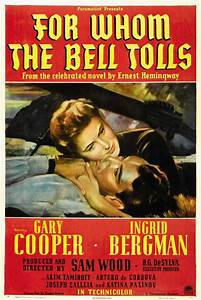
The title of the novel and motion picture comes from a quote by metaphysical poet
John Donne, published in 1624, and reads:
No man is an Iland, intire of it selfe; every man is a peece of the Continent, a part of the maine; if a Clod bee washed away by the Sea, Europe is the lesse, as well as if a Promontorie were, as well as if a Mannor of thy friends or of thine owne were; any mans deathdiminishes me, because I am involved in Mankinde; And therefore never send to know for whom the bell tolls; It tolls for thee.
The
173 minute long, not including the Intermission, Road Show motion picture was Produced and Directed by
Sam Wood for
"Paramount Pictures". Wood Directed several classic motion pictures of the
1930's and
1940's. These included the
Marx Brothers, 193, "
A Night at the Opera", and their
1937, "A Day at the Races". Wood was one of several uncredited Directors on
1939's, "Gone With the Wind". He also Directed,
1939's, "
Good-bye Mr. Chips", and the controversial
1942, "King's Row", with
Ronald Reagan and
Bob Cummings, as lovers, and the same years
"The Pride of the Yankees", with
Gary Cooper as
"Lou Gehrig".The screenplay was by
Dudley Nichols.
Nichols won the Academy award for
John Ford's classic,
1935, "The Informer". His other screenplays include producer,
Merian C. Cooper's, 1935,"SHE", and in
1939, both
John Ford's, 1939, "Stagecoach", and
George Stevens's, "Gunga Din". Nichols would receive Oscar nominations for
1940's, "The Long Voyage Home", 1943's, "Air Force", along with
1957's, "The Tin Star".The four leading roles were all nominated for Academy Awards:
"Robert Jordan" was portrayed by
Gary Cooper. "Maria"
 was portrayed by
Ingrid Bergman.
"Pablo" was portrayed by
Akim Tamiroff.
"Pilar" was portrayed by,
"Best Supporting Actress Winner",
Katina Paxinou.
The character of "Robert Jordan" is in many ways Ernest Hemingway, but instead of being a journalist and writer. "Jordan" is an American language teacher, who lived in Spain during the pre-Civil War.period. He has become a member of the "International Brigade" to fight against the "Nationalists" of Franco, but "Jordan" is now an experienced dynamiter. "Jordan" has been given an assignment to go behind enemy lines and blow up a strategic bridge. He will need the assistance of a group of anti-fascist Republican Guerrillas.
The group is led by "Pablo", but the arrival of "Robert Jordan" with his mission. Will create tension between "Pablo" and his wife "Pilar". As the story progresses, the husband and wife are in a battle of wills for control of the Republican Guerrilla Group.
Ernest Hemingway's own prose comes into play with the backstory of the quiet and somewhat reclusive
"Maria". "Robert Jordan": is attracted to her, but she seems standoffish. Yet, seems to like him at the same time, confusing the American.
"Pilar' will reveal that the Fascists,
Franco's men, executed her parents in front of the girl and then gang raped her. Which also reflects
Hemingway's views toward"The Nationalists". As it did for
Ernest Hemingway's future second wife J
ournalist Martha Gelhorn, also covering the Spanish Civil War.
As with Hemingway's original prose.
Dudley Nichols' screenplay and
Sam Wood's choice of actors, mostly unknown in the United States, bring to life the Spanish Guerrilla's of
Ernest Hemingway's novel and experiences. These people are real human beings that reflect the Spanish Republican fighters of the period. One face may be recognizable to my readers and that is Russian character actor
Vladimir Sokoloff, portraying
"Robert Jordan's" guide
"Anselmo".
In comparison it should be noted that
Hemingway used his leverage to hand pick the two leads Gary Cooper and Ingrid Bergman. because he felt they had the ability to portray
"Robert" and
"Maria" as he envisioned them without being seen, on screen, as Hollywood actors. Such as would have been,
Cary Grant and
Myrna Loy, considered by the studio,
for the two roles.
"Jordan" is a man who has lost his faith in life and lives now in a depressed state of mind. He takes on missions, like blowing up the bridge, hoping he might be killed. His meeting with
"Maria" restores his faith in life and ads another dynamic which is affecting how he views his current mission.
Another group of Guerrilla's is ambushed and murdered by the Nationalists.
"Pablo", who was worried about their mission in the first place, is now firmly against it, and thinks about what the Fascists will do to the group. While his men and
"Pilar" think otherwise.
"Pablo" will destroy all of
"Robert Jordan's" dynamiting equipment to stop the attack on the bridge and as a result is confronted by
"Pilar" for leadership. The Guerrilla's back
"Pilar" and
"Pablo" leaves.

Shortly though,
"Pablo" regrets leaving his comrades and returns to join them in the final assault. However, here
Hemingway adds a very realistic touch from his experiences during the Spanish Civil War. The Nationalists have been appraised of the coming attack on the bridge and are preparing to attack the group in force.
The idea of blowing up the bridge becomes almost meaningless, but idealistic, "Robert Jordan", will complete his mission.
"Anselmo" and
"Jordan" rig up hand grenades on wires to pull the pins out from a distance. Definitely
too close than the
safe distance of using the plunger for the original dynamite.
"Pablo", "Pilar", "Maria" and the other Republican fighters start a diversion to permit the bridge to be blown.
"Anselmo" and
"Robert"take the hand grenades to the bridge and place them around the supports. While this is happening the Fascists bring in tanks.
After the bridge is blown, the two leave on horseback, and join the others. Who are holding off the Nationalists.and the group prepares to flee the area under fire. As they ride away a tank shell lands by
"Robert Jordan's" horse and he falls injured.
"Jordan" is picked up under fire and taken to a temporarily safe location as the Nationalists reform. However,
"Robert" can't feel his legs anymore and knows his friends would be killed attempting to save him.
He bids farewell to
"Maria", who does not want to leave her love behind. To assure she and the other survivors will escape.
"Robert Jordan" takes a Lewis Machine Gun and covers the pass the Nationalists, on foot, must come through.

 "For Whom the Bells Toll"
 ends with
"Robert Jordan" firing the Lewis Machine Gun directly at the camera.
The director started in the German silent, expressionist, cinema, and brought to the world 1927's, "Metropolis", and a gold hunting expedition to the Moon, in 1929's, "Frau im Mond (Women in the Moon)". He would make Peter Lorre an International star, as the child killer known as "M". The actual, 1931, German title was "M - Eine Stadt sucht einen Moder (M-a city searches for a Murderer)".
Along with Lorre and other German Cinema production Jews, the director would flee the country with the rise of Adolph Hitler. My article is "Frtiz Lang and Leni Riefenstahl: Their Films" found at:
CLOAK AND DAGGER released September 28, 1946
Director Fritz Lang had just released 1945's, "Scarlet Street", starring Edward G. Robinson, Joan Bennett, and Dan Duryea. Lang would follow this spy thriller with the 1947 film-noir, the "Secret Beyond the Door", starring Joan Bennett, and Sir Michael Redgrave.
The screenplay's source was the non-fiction work "Cloak and Dagger: The Secret Story of the O. S. S." by Journalist Army Lieutenant Cornel Corey Ford and Army Major Alastair MacBain. For my reader who doesn't know what "O. S. S." stands for, that's "The Office of Strategic Services", that would be renamed the "Central Intelligence Agency (C. I. A.)".
The book would be turned into a story for a screenplay by Boris Ingster, 1945's, "Paris Underground", and co-writer, John Francis Larkin, 1945's, "The Dolly Sisters".
The actual screenplay was written by two writers:
Albert Maltz, would become one of the "Hollywood 10", Blacklisted, for refusing to testify before the "House Committee on Un-American Activities". About his affiliation during the Second World War with the "Communist Party USA".
Ring Lardner Jr., for the same reasons as Maltz, was Blacklisted as Branded a member of the "Hollywood 10", and forced to leave the United States. Their story is part of my article "MCCARTHYISM: LIGHTS, CAMERA, COMMUNISTS IN THE MOTION PICTURE INDUSTRY" found at:
I will return to that subject in the third film I will speak about, following this feature film's entry.
Former "O. S. S." Officer, Navy Lieutenant, Edmund Michal Burke, was the picture's technical advisor. He was still with "The Agency", after the name was switched to the "C. I. A.". Later Burke became the "General Manager" of the "Ringling Bros. and Barum and Bailey Circus", an executive at the "Columbia Broadcasting System (CBS Television)" and the "President" of the "New York Yankees", the "New York Nicks", and "Madison Square Gardens". He would pass away in February 1967.
The picture's three leads:
Gary Cooper portrayed "Professor Alvah Jesper". Cooper had just co-starred with Ingrid Bergman in the 1945 period drama, based upon the Edna Ferber novel, "Saratoga Trunk". He would follow this feature film with a cameo as himself, with 35-other "Paramount Contract Players", in 1947's, "Variety Girl", starring the forgotten Mary Hatcher and Olga San Juan, but not DeForest Kelly.
Robert Alda portrayed "Pinkie". Alda had just co-starred with Joan Leslie in the 1946, musical comedy, "Cinderella Jones". He followed this movie with the classic cult horror film from writer, Curt Siomak, 1941's "The Wolf Man" and 1943's "Frankenstein Meets the Wolf Man", with 1946's "The Beast with Five Fingers", co-starring Peter Lorre.
Lilli Palmer portrayed "Gina". Palmer had appeared in several stage productions at the Moulin Rouge in Paris. Shortly before to the German invasion of France, the motion picture company, "Gaumont Films", brought the young actress to England. In 1945, accompanying her husband, British actor Rex Harrison, they crossed the pond, and came to Hollywood. She had just co-starred with Sir Cedric Hardwicke in 1946's, "Beware of Pity", and would follow this feature film co-starring with John Garfield in 1947's, "Body and Soul".
Above, Robert Alda and Lilli Palmer
Helen Thimig portrayed "Katerin Lodor". Thimig was an Austrian stage and film actress. From 1935 until his death in 1943, she was married to Austrian stage and film producer Max Reinhardt. Who first established schools in Austria, but when they came to the United States, established a prestigious "Expressionist" acting school on Hollywood's Sunset Boulevard. The two had fled Austria under the Nazi regime, but Thimig would return to Europe after the Second World War ended.
Above, Gary Cooper and Helene Thimig
The Very Strong and Taut Story:
The year is 1944, nuclear physicist, and bachelor, "Alvah Jesper", is working on the "Manhattan Project" to develop the first atomic bomb. He is approached by the "Office of Strategic Services" to go to Switzerland and make contact with Hungarian nuclear physicist "Katerin Lodor". She had been working on Nazi Germany's own atomic bomb project, but escaped to the neutral country.
"Alvah" is flown to Switzerland, has one very brief conversation with "Katerin", before German agents show up, ending it. "Alvah" next meets an attractive young American woman, who is also a German Agent, named "Ann Dawson", portrayed by Marjorie Hoshelle.
"Alvah" now blackmails "Ann", and learns the location of where the German's are holding "Katerin" for her return to Germany. An "O. S. S." raid to rescue the Hungarian physicist fails, but during it, "Ann Dawson" is shot and killed.
During that previous brief conversation, "Katerin" was able to tell "Alvah" that the German's want her to work with an Italian nuclear physicist named "Polda", portrayed by Vladimir Sokoloff. Passing this information on to the "O. S. S.", they now move "Alvah" by British submarine to Italy. He is met by "Gina" an attractive member of the Italian resistance movement, who hides him. The leader of the resistance cell is "Pinkie", who works with "Alvah" and "Gina" to complete the American "O. S. S." agent's mission.
In another brief meeting, "Alvah" meets with "Polda", who agrees to work with the American's, but only if they free his daughter, "Maria", portrayed by Janet Shaw, held by the German's.
The "O. S. S." rescue mission is a success, but when they deliver "Polda's" daughter "Maria". He is shocked, because this is not her. The fake "Maria" is a Nazi agent that informs everyone that the house is surrounded by German troops. What follows is a gun battle, and the fake "Maria" is killed.
"Gina" and "Alvah" are able to smuggle "Polda" through a tunnel to a nearby house with an inside well that they enter the house through.
Struggling against German soldiers and Nazi Agents, "Alvah" and "Gina" are able to get "Polda" to a meeting with a British aircraft. "Polda" is placed on the plane, and "Gina" tells "Alvah" that she is not going with him, but will stay and fight. Adding, that when the war is over, their love affair will continue with his return to Italy.
My next motion picture returns Gary Cooper to a Cecil B. DeMille production. The following comes modified from my article "Boris Karloff: There Was More Than Horror Movies (January 15, 1919 to July 20, 1958)" for your reading enjoyment at:
UNCONQUERED premiered September 24, 1947
As you can miss on the above poster, the picture was both produced and directed by Cecil B. DeMille. DeMille. It had been 3-years earlier, that the last feature film directed by DeMille was released. That was the Second World War, 1944, "The Story of Dr. Wassell", based upon a true story, starring Gary Cooper and Laraine Day. DeMille would follow this motion picture with the 1949, biblical epic, "Samson and Delilah", starring Hedy Lamarr and Victor Mature.
The screenplay was based upon American author, Neil H. Swanson's, January 1947, novel, "Unconquered: A Novel of the Pontiac Conspiracy".
There were three credited and one uncredited writer on the screenplay. The first credited writer was Charles Bennett. In 1929, he turned his own play "Blackmail", into the screenplay for the first British sound movie, which was directed by the sell unknown, Alfred Hitchcock. Bennett also wrote Hitch's, 1934, "The Man Who Knew Too Much", 1935's, "The 39 Steps", and both 1936's, "Secret Agent", and "Sabotage". Along with 1940's, "Foreign Correspondent". For Cecil B. DeMille, prior to this picture, Bennett wrote, 1942's, "Reap the Wild Wind",
The second writer was Fredric M. Frank, his other films for DeMille were 1949's, "Samson and Delilah", 1952's, "The Greatest Show on Earth", and 1956's, "The Ten Commandments".
The third credited writer was Jesse Lasky, Jr., among his films was Alfred Hitchcock's, 1936, "Secret Agent", DeMille's, 1938, "The Buccaneer", 1939's, "Union Pacific", 1940, "Northwest Mounted Police", 1942, "Reap the Wild Wind", and 1949s, "Samson and Delilah", and in 1956, "The Ten Commandments".
The uncredited writer was Jeanie Macpherson, she started writing films in 1913. Among her films for Cecil B. DeMille was 1923's, "The Ten Commandments", 1927's, "King of Kings", 1935's, "The Crusades", 1936's, "The Plainsman", 1938, "The Buccaneer", 1939's, "Union Pacific", and 1942's, "Reap the Wild Wind".
Gary Cooper portrayed
"Captain Christopher Holden". He followed this feature film with
1948's, "Good Sam", co-starring
Ann Sheridan.
Paulette Goddard portrayed
"Abigail 'Abby' Hale". Like Cooper, she had a cameo in
1947's, "Variety Girl", and followed this motion picture with
Alexander Korda's, 1947, version of playwright
Oscar Wilde's, "An Ideal Husband".
Howard Da Silva portrayed
"Martin Garth". The actor had just appeared as himself in
1947's, "Variety Girl". Da Silva next appeared in
1948's, "They Live by Night", co-starring with
Cathy O'Donnell and
Farley Granger.
Boris Karloff portrayed
"Guyasuta - Chief of the Senecas (One of the few actual people in the screenplay and novel). "KARLOFF" followed this picture with
1947's, "Dick Tracy Meets Gruesome".
Cecil Kellaway portrayed
"Jeremy Love". Of course, Kellaway was himself in
1947's, "Variety Girl", and would follow this picture with
Ingrid Bergman's, 1948, "Joan of Arc". Some of his other feature films were
James Stewart's, 1950, "Harvey", co-starring with
Donald O'Connor and
"Francis the Talking Mule (voiced by
Chill Wills), in
1951's, "Francis Goes to the Races", and in
1953, stop motion animator
Ray Harryhausen's, "The Beast from 20,000 Fathoms".
Ward Bond portrayed "John Fraser". Bond had just portrayed "Virgil Earp", in director John Ford's, , 1946, "My Darling Clementine", He would portray "Bert", in director Frank Capra's, 1946, "It's a Wonderful Life". After this feature, Ward Bond portrayed "El Gringo", in director John Ford's, 1947, "The Fugitive".
The Basic Screenplay:"Abigail Hale" is put on trial for the death of a Royal Navy officer she accidently killed, while attempting to rescue her brother from a press gang. She's sentenced to death, but the judge offers her "King's Mercy", if she agrees to be transported to the British colonies in North America for a term not less than
14-years as an indentured servant, and to be sold at auction upon arrival.
Nearing Norfolk in the Virginia colonies, "Abby" incurs the anger of trader "Martin Garth", who insists that her auction take place now. A bidding war between "Garth" and "Captain Christopher Holden" follows and "Holden" wins, setting "Abby" free.
"Christopher Holden" is engaged, but when he returns to his fiancée, "Diana", portrayed by Virginia Grey, "Diana" informs him that while "Christopher" was away, she married his brother.
Meanwhile, "Garth" gets the slave dealer to believe that "Holden" was only jesting about "Abby", is handed her freedom papers and burns them.
Next, he forcibly takes her to the western frontier. "Martin Garth" has been selling guns to the Native American's during the last days of the "French and Indian War".
Holden" and "Abby's" path cross, but "Garth" is able to convince "Holden" that she came to him of her own free will. "Abby" is too frightened of "Garth" to express her love for "Holden" in the other's presence.
Later, "Garth", having made it clear that he is attracted to his slave "Abby", is now speaking to a group of likeminded men. When his Native American wife, "Hannah", daughter of the Chief of the Seneca's, "Guyasuta", portrayed by Katherine DeMille (Cecil B. DeMille's adopted daughter), arrives with a message, and after reading it. "Garth" hastily leaves everyone he has been speaking with to go to a meeting.
"Garth" is attending a meeting with
"Colonel George Washington of the Virginia Regiment", portrayed by
Richard Gaines, his subordinate, "Captain Holden", the colonial governor,
"Sir William Johnson", portrayed by
Alan Napier, and others.
At the meeting the fear is of a Native American uprising and "Captain Holden" expresses his belief that
"Obwaandi'eyaag", known as "
Chief Pontiac", of the Ottawas, portrayed by
Robert Warwick, will unite the tribes in war against the settlers. "Captain Holden" suggests that someone take "peace belts" to "Guyasuta" and "Pontiac". "Garth" suggests that "Holden" takes the belts and he accepts.
However, when "Holden" and his two companions are ambushed. "Holden" realizes he must deal with "Garth". When "Christopher" comes for "Garth", he is reunited with "Abby", and their mutual misunderstanding is cleared up, before the two now flee "Garth" and go to Fort Pitt.
"Martin Garth" now comes for "Abigail Hale", and "Christopher Holden" challenges "Garth" to a duel. However, "Garth" has the bill of sale for "Abby" and the miliary governor turns her over to him.
Before "Garth" can to do anything to "Holden", he receives a summons to "Guyasuta" and takes "Abby" along.
While, at the same time, a nearby settlement is wiped out by the tribes and the military governor prepares Fort Pitt for a siege. "Garth" leaves "Abby" with "Guyasuta" as she is to be tortured to death.
Next, "Captain Holden", unarmed, walks into "Guyasuta's camp to rescue "Abby".
Above, Gary Copper, Boris Karloff, and to his right, Robert Warwick.
"Christopher" and "Abby" manage to escape, find the settlement, go to warn Fort Pitt, but "Garth" convinces the military governor that "Holden" is an untrusty deserter and he is sentenced to death and "Abby" returned to him. "Abby" makes a deal with "Garth", she will go with him, if he arranges for "Christopher's" escape. He agrees, but plans on having "Holden" killed. "Hannah" is told by "Garth" that he is leaving her for "Abby". She goes to "Holden", tells him everything, takes his place in bed, and is killed by those hired by "Garth" thinking she's the sleeping "Christopher Holden".
There is no more food left, as Fort Pitt was under siege, the commanding officer decides to surrender and accept "Guyasuta's" false promise of letting the survivors go. While "Holden" has joined the relief column that is under attack.
Fortunately for Fort Pitt, the reinforcements appear to be arriving in time, and the tribes flee. However, when the relief column enters the fort, the commanding officer and the others realize they have been saved by dead men set up to look alive, along with some still alive drummers and bagpipers, all under the command of "Captain Christopher Holden". Afterward, "Holden" and "Garth" have a shootout, "Garth" is killed, and "Christopher" and "Abby" are now free to marry.
The following motion picture was extremely controversial, because of the views of the author and screenplay writer of the story.
THE FOUNTAINHEAD premiered in Los Angeles and San Francisco, California, on June 25, 1949
An Interesting Back Story:
The author of the 1943 novel, "The Fountainhead", was Ayn Rand, shown below in that year.
Alisa Zinovyevna Rosenbaum was born on February 2, 1905, in Saint Petersburg, Russia. Her alma mater was "Leningrad State University". She came to the United States in 1926, and was an unsuccessful author and playwright until "The Fountain Head". With her husband, in 1940, Charles Francis "Frank" O'Connor, the became politically active with the campaign of Republican Lawyer and Presidential candidate, Wendell Wilkie. He would loose to Franklin Delano Roosevelt.
Ayn Rand, Alisa's pen name, believed in "Philosophical Realism". As such, she opposed without question, anything she regarded as being supernatural, which to her was religion. Rand believed in Free Will, from her beliefs in metaphysics, she thought a person was an agent of causation. That anyone not in an event, could cause an event. She disbelieved in metaphysical determination. Where all events within the universe, or multiverse, can only happen in one way.
As a result of her views, she created her own philosophical system she named, "OBJECTIVISM". To quote Alisa Zinovyevna Rosenbaum, "Objectivism" was:
the concept of man as a heroic being, with his own happiness as the moral purpose of his life, with productive achievement as his noblest activity, and reason as his only absolute
Her work reflected this philosophy, which brings me to her novel and the screenplay she solely wrote.
In 1943, actress Barbara Stanwyck, after she read "The Fountainhead", wanted to play "Dominque Francon". With her star power, Stanwyck told Jack L. Warner to acquire the rights to the novel for her. He did, but the novel's authoress demanded two conditions, that Warner agreed too. The screenplay would be written by Ayn Rand, and the movie would be filmed WITHOUT a word being changed from her screenplay.
In October 1943, Jack L. Warner assigned Mervyn LeRoy, Ronald Colman and Greer Garson's, 1942, "Random Harvest", Greer Garson and Walter Pidgeon's, 1943, "Madame Curie", and Spencer Tracey's. 1944's, "Thirty Seconds Over Tokyo", as the director of "The Fountainhead". However, the "War Production Board" got involved and delayed the start of filming. The reason given was Ayn Rand's anti-Communist politics. Which has to seem strange, because after the Second World War, as I mentioned, the "House Committee on Un-American Activities" went after suspected Communist supporters in the motion picture industry.
In 1946, production was resumed with director King Vidor, 1946's, "Duel In the Sun", starring Jennifer Jones and Gregory Peck, and 1949's, "Beyond the Forest", starring Bette Davis and Joseph Cotton.
Vidor wanted Humphrey Bogart for the lead role of "Howard Roark". While Ayn Rand wanted Gary Cooper. Meanwhile, Barbara Stanwyck still wanted the leading women's role of "Dominque Francon". She kept pushing the producer, Henry Blanke, to cast her, but King Vidor thought she was now too old for that role. The Hollywood Trade paper's rumored that Bogart's wife, Lauren Bacall would be cast beside him. Neither prove correct, and in one case, Ayn Rand won the battle for "Howard Roark", and Gary Cooper was cast. Meanwhile, King Vidor wanted actress Patricia Neal cast in the role of "Dominque Francon".
The Three Leading Roles:
Gary Cooper, as mentioned, portrayed "Howard Roark". Cooper had just seen in the comedy romance, 1948's, "Good Sam", co-starring with Ann Sheridan. He followed this feature film with the Second World War movie, 1949's, "Task Force", co-starring with Jane Wyatt.
Patrica Neal portrayed "Dominque Francon". This was just Neal's second on-screen appearance. Her first film was 1949's, "John Loves Mary", with 9th-billing as "Mary McKinley". The movie starred Ronald Reagan portraying "John Lawrence". Two-years-later, Patricia Neal went into cult science fiction film history with 1951's, "The Day the Earth Stood Still. However, in 1950, she co-starred again with Gary Cooper, in "Bright Leaf", and the actress considered for this motion picture, Lauren Bacall.
According to the "Warner Brothers Studio's", "The Making of 'The Fountainhead". Gary Cooper made it known he didn't like Patric Neal's audition tape and called it "Bad Acting".
As for Barbara Stanwyck not getting the role that started all of this, she walked out of her "Warner Brothers" contract and left the studio. The actress had never been informed by the studio that she wasn't getting the role. Stanwyck learned about that decision in a phone call from Ayn Rand.
Raymond Massey portrayed "Gail Waynand". Massey had just been seen in the 1947, film version, of American playwright, Eugene O'Neil's, "Mourning Becomes Electra". He would follow this feature with the drama, 1949's, "Roseanna McCoy".
The above backstory is more interesting than the motion picture about an architect, "Howard Roark", who would rather struggle in obscurity than give up his principles. Ayn Rand's screenplay follows "Roark" and the people that come into his life while designing and building that title structure.
Both the critics and public panned the movie upon its release, but over time this has changed. However, upon the picture's release, it was been described both by the author and the critics as the struggle between Individualism (the central role of the individual) and Collectivism (a psychological outlook based upon people being a group).
The bottom line for the studio, according to "Warner Brother Records", was a final budget of $2.375 million dollars with a box office of only $3 million dollars worldwide.
Concerning the motion picture, in her letters published as 1997's, "Letters of Ayn Rand", edited by Michael S. Berliner, you find her stating at the time of the film's release that:
The picture is more faithful to the novel than any other adaptation of a novel that Hollywood has ever produced and It was a real triumph.
Concerning Gary Cooper's performance:
Gary Cooper's performance should have been stronger", but, I would rather see the part underplayed than overdone by some phony-looking ham.
However, in a later dated letter, Ayn Rand writes that she:
... disliked the movie from beginning to end.
At the time of the film's release, the motion picture critic for the "New York Times", Bosley Crowther, expressing the majority critical opinion of the motion picture, wrote for January 1, 1949 that the screenplay was:
wordy, involved and pretentious
While, the Communist Newspaper, "The Daily Worker" called the motion picture:
an openly fascist movie
According to the website, "Open Culture" at:
https://www.openculture.com/2017/05/slavoj-zizek-names-his-5-favorite-films.html
Slovenian-born political philosopher and cultural critic, Slavoj Žižek, considered the motion picture to be:
ultracapitalist propaganda, but it’s so ridiculous that I cannot but love it.
I leave my reader, at the time of this writing, with this link to the motion picture to decide your own view of the fate of author and screenplay writer Ayn Rand's story:
https://www.dailymotion.com/video/x9jk9b4

I now move from Gary Cooper's struggle with Individualism and Collectivism to an attack (?) on McCarthyism found in part, in my above linked article under the motion picture, "Cloak and Dagger", with slight modifications.
McCarthyism and the "House Committee on Un-American Actibities" came to the "Wild West" in a still politically controversial Western.
HIGH NOON premiered in London, England, on May 1, 1952, and in New York City on July 24, 1952
There's many ways to look at this influential Western. The different award nominations are remarkable, for directing, acting, and several technical fields across several award programs including the "Academy of Motion Picture Arts and Sciences", "The Golden Globes", "The Directors Guild of America", and the "Writers Guild of America".
The "Academy of Motion Picture Arts and Sciences" gave the theme song an "Oscar". The title was actually "Do Not Forsake Me", but is known as either "The Ballad of High Noon", or just"High Noon". It was composed by Dimitri Tiomkin with lyrics by Ned Washington and is still haunting. It's sung over the opening credits by Tex Ritter, and sets the mood that follows. As behind Ritter's singing, "Frank Miller's" gang comes together, and when formed, heads for the railway station, to await his return from prison at "HIGH NOON!"
Producer Stanley Kramer was nominated for the "Academy of Motion Picture Arts and Sciences, Best Picture, Oscar".
Director, Fred Zinnemann was nominated for the "Academy of Motion Picture Arts and Sciences, Best Director, Oscar".
Gary Cooper portrayed "Marshal Will Kane". He won the "Academy of Motion Picture Arts and Sciences, Best Actor Oscar", and the "Golden Globe Award for Best Actor in a Motion Picture - Drama".
The role was originally offered to John Wayne. In his May 1971 interview, for "Playboy Magazine", John Wayne stated he refused to play "Marshall Will Kane", because he believed Carl Foreman's screenplay was an obvious allegory against Blacklisting, which he strongly supported. In another interview, Wayne had told the interviewer that he would:
never regret having helped run Foreman out of the county.
Read on:
The motion picture has two distinct groups. I've mentioned"Frank Miller's" gang, which is first seen as the opening credits role. This group includes:
Sheb Wooley portraying "Frank's" young brother, "Ben". My article about the actor is "High Noon', 'The Purple People Eater', and 'Rawhide': A Short But Fond Memory of Sheb Wooley" pushing cattle at:
https://www.bewaretheblog.com/2017/03/high-noon-purple-people-eater-and.html
Lee Van Cleef portrayed "Jack Colby". Van Cleef started out as an alien on 1952 television's, "Space Patrol". My article is "LEE VAN CLEEF: A Mixture of 'B' and Spaghetti Westerns with a Side of Science Fiction and Just a Taste of Drama" to be read at:
https://www.bewaretheblog.com/2021/09/lee-van-cleef-mixture-of-b-and.html
Robert J. Wilke portrayed "Jack Colby". Bad Guy character actor Wilke had been first seen on-screen as an uncredited survivor in the Clark Gable, Jeanette McDonald, and Spencer Tracy, 1936, "San Francisco". In 1954, the now major character actor, portrayed the "First Mate on the Nautilus", in Walt Disney's, "20,000 Leagues Under the Sea".
Above left to right, Lee Van Cleef, Robert J. Wilke, and Sheb Wooley.
Ian MacDonald portrayed "Frank Miller". This Reverend's son was known for playing the bad guy in "B" westerns and crime dramas. After this movie, the majority of MacDonald's roles were in television westerns. He had just been seen, with 6th-billing, in the Sterling Hayden and Forrest Tucker western, 1952's, "Flaming Feather".
The Second group are the townspeople of Hadleyville, in the New Mexico Territory. Who all like, even love, their Marshall, "Will Kane". I'm going to look at the main character's in this group.
Thomas Mitchell portrayed "Mayor Jonas Henderson". Mitchell's name was the first one in the credits after Gary Cooper's. More for name recognition to the potential audience, than his screen time, which was a total of 7-minutes.
Lloyd Bridges portrayed "Deputy Marshall Harvey Pell". Two-years earlier, Bridges was in the cult Science Fiction classic warning about nuclear war, 1950's, "Rocketship X-M". My detailed look at that movie and its relationship to the period is in my article "ROCKETSHIP X-M, EXPEDITION MOON (1950): Anatomy of a Cult Science Fiction Classic" blasting off at:
https://www.bewaretheblog.com/2022/07/rocketship-x-m-expedition-moon-1950.html
Katy Jurado portrayed "Helen Ramirez", the lady with a past with "Will Kane". Maria Cristina Estela Marcela Jurado García was a Mexican actress who started in motion pictures in 1943. This was only her second American feature and she took home the "Golden Globe - Best Supporting Actress - Motion Picture" award.
Grace Kelly portrayed "Amy Fowler Kane", the "Bride" in those haunting lyrics. This was 5th-billed Kelly's 2nd motion picture, out of her first 12-roles.
Otto Kruger portrayed "Judge Percy Mettrick". Kruger started on-screen in 1915, he was "Dr. Livesey" in the 1934, "Treasure Island", "Jeffrey Garth" in 1935's, "Dracula's Daughter", and "Charles Tobin", in director Alfred Hitchcock's, 1942, "Saboteur".
Above front row left to right, Otto Kruger, Grace Kelly, and Gary Cooper.
Lon Chaney portrayed "Martin Howe, the former Marshall". My article is "LON CHANEY, JR: OF MICE AND WEREWOLVES", to be read by the full Autumn moon at:
https://www.bewaretheblog.com/2016/05/lon-chaney-jr-of-mice-and-werewolves.html
Harry Morgan billed as Henry Morgan, portrayed "Sam Fuller". Harry Bratsburg would be remembered by television audiences for three- roles, "Pete Porter", on "December Bride, 1954-1959", "Officer Bill Gannon", on "Dragnet, 1967-1970", and of course, "Colonel Sherman T. Potter" on "M.A.S.H.", 1974 - 1983".
Front row left to right, Lon Chaney, Thomas Mitchell, and Henry Morgan.
My reader must have noticed that I haven't mentioned who wrote the screenplay. That writer was Carl Foreman:
He was nominated by "The Academy of Motion Picture Arts and Sciences" for "Best Screenplay".
He was also nominated for the "Best Screenplay - Motion Picture", by the "Golden Globes".
He won the "Best Written American Drama", from the "Writers Guild of America".
The accepted source story, has Carl Foreman getting the idea for 1952's "High Noon", from a short story by Western writer John W. Cunningham. Which had appeared in a 1947 issue of "Collier's Magazine". Cunningham's original story can be found at:
http://erginguney.com/web/coursematerial/The_Tin_star.pdf
On its surface, Carl Foreman's screenplay is the usual "B" western of the period. The Marshall of Hadleyville is retiring, and the towns people, that he has known for years, were invited to attend his wedding. Which just happens to fall on the day of that retirement, one day before his replacement is to arrive.
Newly married "Amy Fowler Kane" and he husband, "Marshall Will Kane" are about to leave and receive well wishes from the townspeople he protected for years. The two are heading for a different town and a store they own and will run. As the well wishes continue, at the railroad depot three horsemen approach.
Th
e "Station Manager/Telegraph Operator", portrayed by
Ted Stanhope, recognizes the three. As he has just received a message that
"Frank Miller" was released from prison. When the three gang members are not looking, the Station Manager heads for town to tell them that "Miller" is due on the train at
"HIGH NOON!"
The word reaches the townspeople, who are sending off the still technically, "Marshall Will Kane", until the new Marshall arrives the next day. "Kane" wants to stay and confront "Miller" and the others, but everyone tells him to leave with his new "Quaker Bride, Amy". Besides, his inexperienced deputy, "Harvey Pell" will be there, and "Miller" and his gang will have no reason to cause a problem for the townspeople with "Kane" long gone.

After a short time, "Will Kane" stops his wagon, and to his wife's surprise. He turns it around to return and face "Frank Miller", his brother, "Ben", "Jack Colby", and "Jim Pierce on the streets of Hadleyville.
Was the screenplay for "HIGH NOON", a veiled (?) attack on "MCCARTHYISM"?
In the screenplay, the townspeople are very supportive of "Will Kane", UNTILL they hear of "Frank Miller" and the others. NOW FEAR kicks in and it can be argued that the four-killers are a metaphor for the average American's Fear of "Communism" destroying their lives.
However, when "Kane" returns and asks the citizens he has defended for years for help? Fear overshadows friendship, and he becomes a man alone.
Religion vs Communism is reflected in the beliefs of "Amy Kane", blinded by her religious faith of what the four-killers signify.
I could not locate the exact date that production on the motion picture started, but on September 5, 1951, filming began. Sometime between that date and October 6, 1951, when filming ended. Carl Foreman was called before the "House Committee on Un-American Activities" in Los Angeles.
The following paragraph comes from the outstanding, March 12, 2017 article, "How 'Commie' writer turned 'High Noon' into a subversive Hollywood hit", by Larry Getien, on the "New York Post" website at:
https://nypost.com/2017/03/12/commie-writer-turned-high-noon-into-subversive-hollywood-hit/
Wearing “a dark blue suit and what he called ‘a very sincere tie,’ ” Foreman faced the five-member committee. After answering basic questions about his life, his past and his profession, as well as throwing in a plug for “High Noon,” describing the film as “the story of a town that died because it lacked the moral fiber to withstand aggression” in “a backward swipe at the committee,” Foreman refused to answer whether he was a member of the Communist Party, invoking both the First and Fifth amendments. Foreman’s hour-long testimony walked a fine line.

Carl Foreman refused to "name names", of those he knew were members of the "Communist Party USA (CPUSA). Foreman went on to emphasized that he hadn't been a member of "CPUSA" for over ten-years. Which put the end of his membership just after the United States entered the Second World War.
In fact, Foreman, had been assigned to the United States Army Signal Corps, under the command of "Multiple Oscar" winning, Major Frank Capra. The writer was making training films, from 1942 through 1945, and had a honorable discharge. During this period, Carl Foreman also provided the story for the John Wayne and Vera Hruba Ralston, the wife of Herbert J. Yates, the owner of "Republic Pictures", Western, 1945's, "Dakota".
After it was revealed that Foreman was labeled an "uncooperative witness" for refusing to name names of "CPUSA" members in the motion picture industry. Producer and business partner, Stanley Kramer, was frightened he'd be called before the "HUAC", due to "guilt by association", and demanded that their partnership be dissolved. Their partnership included 1949's, the "Champion", starring Kirk Douglas, which Carl Foreman had been nominated for a "Best Adapted Screenplay, Oscar", and the still powerful, "Home of the Brave". For which he had to change antisemitism in the army to racism, and 1950's, "The Men", starring Marlon Brando.
John Wayne, as president of the "MPA (Motion Picture Alliance for the Preservation of American Ideals)", attacked Carl Foreman's loyalty. Wayne was joined by powerful motion picture gossip Columnist Hedda Hopper.
Carl Foreman was "Blacklisted" by the major studios and his career in the United States was over, at the time.
Gary Cooper was a solid Republican that supported Blackilisting. However, Cooper also respected Carl Foreman and let it be known. Strangely, although some, like John Wayne, considered "High Noon" un-American, there would be a different take in 1989, Poland. The following link takes my reader to the website for the "National Endowment for the Humanities" speaking to a poster of Gary Cooper as "Will Kane" at:
https://www.neh.gov/article/how-gary-cooper-became-face-polish-resistance
In the lead-up to the June 1989 elections, Sarnecki, then a twenty-three-year-old design student, used the imagery of High Noon to urge Poles to vote the anti-communist Solidarność (“Solidarity”) ticket. In the center of the poster, Sarnecki reproduced an image of Cooper as Kane, placing a small badge above his marshal’s star and a ballot in his right hand. At the top of the poster, he placed the bold red Solidarność logo; at bottom, in black text, he inserted the call to action: “High Noon for Poland June 4, 1989.”
Four motion picture's later, and Gary Cooper was reunited with Susan Hayward. In what is considered one of the best of the actor's Westerns.
GARDEN OF EVIL premiered at the Berlin, Germany Film Festival in June 1954
The motion picture was directed by Henry Hathaway. Hathaway has just released 1954's, "Prince Valiant", based upon the popular Sunday newspaper comic strip, starring Robert Wagner, James Mason, and Janet Leigh. The director followed this feature film with the International race car film, 1955's, "The Racers", starring Kirk Douglas.
The original story was co-created by William Tunberg, he had just co-written the Robert Stack and Joan Taylor, 1953, "War Paint". The writer next moved to television scripts.
The other co-story creator was Fred Freiberger, just before this feature, Freiberger co-wrote stop-motion-animator Ray Harryhausen's, 1953, "The Beast from 20,000 Fathoms". He followed this film with 1954's, "The Black Pirates".
The actual screenplay was written by Frank Fenton. Fenton was the main writer on 1954's, "River of No Return", starring Robert Mitchum and Marilyn Monroe. He followed this motion picture by co-writing 1955's, "Untamed", starring Tyrone Power, Susan Hayward, and Richard Egan.
Gary Cooper portrayed "Hooker". Cooper proceeded this picture with the South American adventure, 1953, "Blowing Wild", co-starring Barbara Stanwyck and Ruth Roman. He followed this motion picture with 1954's, "Vera Cruz", co-starring with Burt Lancaster.
Susan Hayward portrayed "Leah Fuller". Hayward had just been seen in the sequel to the first "Cinemascope" motion picture, the Biblical epic, 1953's, "The Robe", in the 1954, "Demetrius and the Gladiators". She would next be seen in the previously mentioned, 1955, "Untamed".
Richard Widmark portrayed "Fiske". Widmark had just been in the seldom seen atomic bomb from China motion picture, from director and writer Sam Fuller, 1954's, "Hell and High Water". He followed this feature film with 1954's, "Broken Lance", co-starring with Spencer Tracy, Robert Wagner, and Jean Peters.
Hugh Marlowe portrayed "John Fuller". Marlowe was at this time appearing on television, his next major film work were two classic 1956 science fiction, "World Without End", and Ray Harryhausen's, "Earth vs the Flying Saucers".
Cameron Mitchell portrayed "Luke Daly:. Mitchell had been in 1953's, "Robe", more correctly his voice was heard as "Jesus Christ". The actor was also in 1954's, "Hell and High Water", the same year he was seen in the crime horror movie, "Gorilla at Large", Mitchell portrayed "Napoleon's Brother" in the Marlon Brando and Jean Simons, 1954, "Desiree". In 1964, the actor was the murderer in Italian director Mario Bava's, "Blood and Black Lace".
Above left to right, Cameron Mitchell, Richard Widmark, and Gary Cooper.
Rita Moreno portrayed the "Cantina Singer". Moreno became known to many viewers, around the world, for the singing and dramatic role of "Anita" in 1961's, "West Side Story". Before that, she was "Tuptim" in the 1956 version of Rodgers and Hammerstein's, "The King and I". Prior to this feature film, Rita Moreno portrayed many Native American characters. She was seen just before this feature film in 1954's, "The Yellow Tomahawk", and followed this feature with both 1955's, "Untamed", and 1955's, "Seven Cities of Gold".
Victor Manuel Mendoza portrayed "Vicente Madariaga". Mendoza was a Mexican actor who appeared in 65-motion pictures, almost entirely within the Mexican film industry.
Above, Rita Moreno and Victor Manuel Mendoza
A Tale of Greed and Lust:
Three American adventures, who don't know each other, are stranded in the Mexican village of Puerto Miguel. This is after the ship they were on developed engine trouble and it could take days to repair, because parts need to be brought in. The three are "Hooker, an ex-lawman turned soldier of fortune", "Fiske, a money hungry gambler, and card sharp", and "Luke Daly, a bounty hunter that's good with a gun, but nothing else". The three American's are introducing themselves to each other as they watch the "Cantina singer" dance and sing. Also watching from the bar is "Vincente Madariaga", a skilled guide of the area they're going into, but also has a crude sense of humor and a mucho attitude".
Into the Cantina comes
"Leah Fueller", who approaches the three American's with extreme confidence and authority. She offers each
$2,000 to come with her to rescue her husband, trapped in a mine cave-in. The three are not sure what to make of her, or where they would be going? However, when she tosses a bag full of gold coins onto their table, their mind set changes. Before they can decide on a journey into Apache territory, "Vicente" offers "Leah" his assistance.
During the very dangerous journey to the mine, "Leah" opens up to "Hooker", that were the group is going is what's left of a Mexican boom town that was destroyed by a volcano's eruption. All that still stands are a church's steeple, a shack, and the mine.
One additional point that
"Leah" informs
"Hooker" of, is that the local
Apache's look upon the
volcano as sacred (The working title of the movie was
"Volcano", until an Italian movie of that name opened in the United States).
As the group travels toward the mine, "Vicente" keeps leaving markers so he can find his way back, but unknown to him, "Leah" removes them. She wants to be the four men's only source of how to get to, what they now think is a gold mine, and how to get back to "Puerto Miguel" and their ship.
The group arrives at the remains of the church and meets a "Resident Priest", portrayed by Arturo Soto Rangel, who refers to the ruins as the "Garden of Evil". They now go to the mine and find"John Fuller", alive, but unconscious, and decide how to get him out before the rest of the mine's ceiling collapses.
They succeed in getting "John Fuller" out of mine as the roof finally gives way. "Hooker" sets "John's" broken leg in a still standing cabin. During the ride to the gold mine and after arriving, "Fiske" has made unwanted advances toward "Leah", and his relationship with "Hooker" has deteriorated as a result. Although they will get $2,000 each for the rescue, the four men are speaking to all the gold the "Fuller's" have mined. Except for "Hooker', the other three want some of it.
Meanwhile, "John Fuller" has become suspicious of his wife's intentions, believing she is setting up with "Fiske" to take all their gold. "Leah" denies this and speaks of her love for him. However, she has developed feelings for the honest ex-lawman, "Hooker", and he for "Leah". The difference between "Fiske" and "Hooker", is that "Hooker" will not make any passes to a married woman,
What no one is thinking about are the Apache's and their sacred volcano as the group now leaves for "Puerto Miguel". "John" knows he's slowing the other's down and gets "Luke" to go with him. The two disappear with the gold and shortly, "Luke" is killed by an arrow to his back.
The remaining four arrive at a burnt out church and find "John Fuller" hanging upside down on a cross.
The four bury him and continue down the mountain.
As they continue, on-guard for the Apache's, arrows come as if from nowhere, and "Vicente" is killed. "Hooker", "Leah", and "Fiske" continue on, and reach a chokehold in the mountainside.
It is decided that the only way that "Leah" can survive, is for either "Fiske", or "Hooker" to remain behind to hold off the Apache's. To "Leah's" surprise, "Hooker" suggests that the two men draw cards and the loser stay behind.
"Leah's" second surprise comes from "Fiske", the gambler and card sharp, loses. "Leah" now rides away with "Hooker". Back at the choke hold, "Fiske" is successful in killing most of the Apache's, but is, himself, mortally wounded.
After seeing that "Leah" is now safe, "Hooker" returns to "Fiske". Who admits he cheated, so that it would be him staying behind, and "Leah" and "Hooker" could get away together. Before he dies, "Fiske" tells "Hooker" to go back to "Leah" and settle down together.
The movie ends with "Hooker" meeting up with "Leah" and the two riding into the sunset together.
I now turn to a true story:
THE COURT-MARTIAL OF BILLY MITCHELL premiered in New York City on December 22, 1955
The motion picture was directed by Otto Preminger. He had just directed Frank Sinatra, Kim Novak, and Eleanor Parker in a an excellent 1955 motion picture, that for the Eisenhower Era, dared to be honest about drug addiction, "The Man with the Golden Arm". Preminger followed this feature film with a George Bernard Shaw play, transferred to the screen by author Graham Greene, 1957's, "Saint Joan", starring Jean Seberg, Richard Widmark, and Sir Richard Todd.
The first of the two credited screenplay writers was also the motion picture's producer, Milton Sperling. Who had started to work on a story about the "Brigadier General" in 1938, 2-years after William Lendrum Mitchell had died of a coronary occlusion. Sperling's story development went right up to the start of filming. As he continued to work with the Mitchell family, on refining the story he wanted to tell.
Playwright and screenplay writer, Emmet Lavery, was the second credited screenplay writer working on the story that Milton Sperling wanted to tell. Lavery wrote the forgotten, but outstanding, 1943, "Hitler's Children", starring Tim Holt and Bonita Granville, and both the play and screenplay for 1950's, "The Magnificent Yankee", starring Louis Calhern portraying "Oliver Wendell Holmes".
However, it is the three uncredited screenplay writers, whose names are known, but their contributions unknown, even today, that I now mention. They apparently turned the Sperling and Lavery story into an actual screenplay. Which, because of the "House Committee on Un-American Activities", they were denied on-screen credit. Leading to the previous two writers being nominated by the "Academy of Motion Picture Arts and Sciences" for solely writing the screenplay and having only their names on the motion picture screen.
In April 1951, Michael Wilson's screenplay for "A Place in the Sun", starring Montgomery Clift, Elizabeth Taylor, and Shelley Winter was nominated at the "Grand Prix du Festival", in Cannes, France. Two months later, in June, Michael Wilson was called before the "House Committee on Un-American Activities". According to Joseph McBride at:
In September, Wilson wrote a friend that:
I have been "laid off," which is the studios' temporary euphemism for blacklisting me. There was a time when studios waited until a man was in contempt of Congress before blacklisting him; but today the mere announcement that I have a subpoena and that I oppose this committee's aims costs me my job... [F]reedom of speech is costly these days.
Michael Wilson was "Permitted" to accept his "Academy of Motion Pictures Arts and Sciences, Best Screenplay" award of "A Place in the Sun", at the Award's Ceremony in March 1952, BUT was unable to work in the American Motion Picture industry for the next 13-years.
Dalton Trumbo became one of the members of the "Hollywood Ten", after he was Blacklisted. He couldn't accept his "Academy Award" for the Gregory Peck and Audrey Hepburn, 1953, "Roman Holiday". His friend Ian McClellan Hunter fronted, accepted the award, and had his name initially on the movie. For the 1951, "He Ran All the Way", starring John Garfield and Shelley Winters, writer Guy Endore fronted for Trumbo. Then, shortly afterwards, Endore was also Blacklisted. Without credit, Trumbo wrote, or gave input on screenplay's from a California Prison Cell. Trumbo's Blacklisting ended in 1960. When Otto Preminger for "Exodus", and Kirk Douglas for "Spartacus", boldly placed his name across their film's opening credits and no member of Congress dared take on either producer.
Ben Hecht, was the only one of the three who could have meet with Sperling and Lavery. He was a major playwright and screenplay writer. Just some of his screenplay's include director Howard Hawks's, 1930, "Scarface", 1934's, "Viva Villa", 1935's, "Barbary Coast", 1939's, "Gunga Din", 1940's, "His Girl Friday", 1940's, "Comrade X", Alfred Hitchcock's, 1945, "Spellbound", and 1946, "Notorious", and the movie that made Richard Widmark a star, 1947's, "Kiss of Death". YET HE WAS ALSO BLACKLISTED, but not by the United States. His Blacklisting came from the UNITED KINGDOM, because Ben Hecht was a Jewish ZIONIST, supporting what England considered anti-British causes, the "State of Israel".
Gary Cooper portrayed, removed of the rank of "Brigadier General", "Colonel Billy Mitchell", seen below. Cooper had just co-starred with Burt Lancaster in 1954's, "Vera Cruz", and would follow this feature film with director William Wyler's, 1956, "Friendly Persuasion", co-starring Dorothy McGuire, and featuring, Anthony Perkins.
Above
Gary Cooper, below the real
William "Billy" Lendrum Mitchell
Charles Bickford portrayed "Major General Jimmy Guthries (a composite of Major General Charles Pelot Summerall and Major General Robert Lee Howze)". Bickford was guest appearing on television at this time.
Ralph Bellamy portrayed real life Illinois Lawyer and Congressman, "Frank R. Reid". Like Bickford, Bellamy was appearing on different television drama's at this time.
Rod Steiger portrayed real life Prosecutor, "Major Allen W. Gullion". Steiger had just been seen in Rodgers and Hammerstein, 1955, "Oklahoma", and followed this feature film with the 1956, Glen Ford Western, "Jubal".
Above to Rod Steiger's left is Fred Clark as real life Chief Prosecutor, "Colonel Sherman Moreland'.
Jack Lord portrayed "Lieutenant Commander Zachery 'Zack' Lansdowne", and Elizabeth Montgomery, in her first motion picture, portrayed "Mrs. Margaret 'Betsy' Kennedy Ross Lansdowne". The real Lansdowne, was a strong believer in the strength of air power and a firm believer in Mitchell's crusade to establish an independent air branch within the Army.
Above left to right, Jack Lord, Gary Cooper, and Elizabeth Montgomery
A little true-life background about Army Air Corps Brigadier General William "Billy" Lendrum Mitchell:
During the First World War, he lead a combined Air Force attack of nearly 1,500 American, British, French, and Italian planes in the September 1918, "Battle of Saint-Mihel". Which was one of the first co-ordinated air attacks in history.
When Mitchell returned from Europe in January 1919, it was widely expected throughout the Army and Navy air corps, that he would be made "Director of Air Service", because of his vast knowledge of the potential of air power. Instead, under the recommendation of Army General John Pershing, the promotion went to an Artillery Officer, Major General Charles T. Menoher. Who had no idea of what air power could be, but fit the Army's belief in the superiority of ground forces backed by the Navy's belief in large Dreadnought Battleships.
On July 20, 1921, the United States Navy Command, brought the German Dreadnaught, "SMS Ostfriesland", seen below, which they had purchased from Germany, to an agreed upon Army and Navy demonstration of the "Usefulness" of aircraft in battle.
There were other American Navy ships used in these tests, but to the observers from across the world. The stated idea was to prove the military advantages of air power.
However, both the Army and Navy brass actually wanted to downplay the air planes use in an actual battle situation.
Certain rules for the tests were agreed upon between the two branches, that the International observers were unaware. The bombs could not be over 1,000 pounds, and not dropped lower than 5,000 feet. A unrealistic, even that year, for combat aircraft to attack any country's Naval ships.
During these controlled tests, the "Ostfriesland" had been hit both during the testing of July 20th, and the morning of July 21st. The bomb's dropped by the Army and Navy pilots weighed between 230 and 1,100 pounds. According to the inspectors that went on board, there was no significant damage to the ship.
At which point, to prove what air power really was, Army Air Corps Brigadier General William "Billy" Lendum Mitchell changed the rules of these tests. At 12:19 P.M. dropping the Army/Navy altitude from 5,000 feet, he moved his aircraft to the more realistic combat altitude of 1,500 feet, and ordered the dropping of 2,000 pound bombs. The German Dreadnaught was blown out of existence in front of the Army and Navy officials, and more importantly the International observers.
In 1922, Mitchell traveled to Italy under the orders of Army Air Corps General Mason Mathews Patrick, to meet with Italian pro-Air Power General and Theorist, Giulio Douhet. What General Patrick had not expected, was that after that meeting, Mitchell stirred things up within both the Army and Navy air corps. When English language translations of pages of Douhet's, "The Command of the Air", started circulating within both branches of service.
To, hopefully, put an end to Michell's popularity within the two service's air corp's, and the press. General Patrick sent him on a 1924 inspection tour that included the Hawaiian Islands and Japan. When he returned, William Lendrum Mitchell turned in a 324-page, "Inspection Report", in which Billy Mitchell not only warned General Patrick, but the higher up's of the Army and Navy Command structures. That there was a major build-up of air power in Japan. Adding, and clearly outlining, what he believed was a forthcoming direct Japanese air attack on Pearl Harbor. The only difference in the reality of December 7, 1941, was that Mitchell, who didn't believe in aircraft carriers, stated the attack would come from Japanese controlled Pacific islands, such as in the Philippines. While the military brass thought his work fiction, in 1925, it was released in book form as "Winged Defense"! "Winged Defense" sold 4,500 copies between August 1925 and January 1926, the months surrounding "THE COURT-MARTIAL OF BILLY MITCHELL".
A Basic Overview of the Motion Picture Screenplay:
Brigadier General William "Billy" Mitchell, wants to prove that the Army Air Corps should be an independent branch of the military. He has run up against a brick wall from the historically old line believers in the strength of ground troops and that air planes are only good for sending messages between troop encampments, if at all.
The Army and Navy agree to a test of the viability of air power in war conditions. What he does not know is that the two services are against such an idea and set conditions that will only lead to failure and keep the status quo that the unimaginative top brass believe in. Mitchell is told that the conditions agreed to are no plane can be lower than 5,000 feet, and no bomb can weigh more than 1,000 pounds. Billy Mitchell changes those conditions, his planes will fly at 1,500 feet, and drop 2,000 pound bombs as if in actual combat.
Billy Michell's actions sink the World War One German Dreadnaught, the "SMS Ostfriesland", considered "Unsinkable" by both the Army and Navy brass. Their action is to demote him from Brigadier General to Colonel, for disobeying their orders and reassign the air officer to a ground unit in Texas.
Next, two events take place:
1. A high-profile air disaster, the "USS Shenandoah (ZB-1"), actually seen below, crashes killing Lieutenant Commander Zachery 'Zack' Lansdowne.
2. Six aircraft crash while flying from a California West Coast Base to Fort Huachuca in Arizona. All six are determined to have crashed due to poor maintenance, because of lack of funding to support the Army and Navy Air Corps.
Colonel Mitchell calls a press conference and accuses both the Army and the Navy of criminal negligence. He comes very close to accusing both branches of treasonable disregard of the Air Service's. He now faces a court-martial.
Now the screenplay becomes very factual:
Colonel William "Billy" Lendrum Mitchell would be defended by his close friend, Illinois Congressman, Frank R. Reid. However, there were the Army officers that made up his judges.
Of the thirteen judges, (Charles Pelot Summerall, William S. Graves, Robert L, Howze, Douglas MacArthur, Benjamin A. Poore, Fred W. Sladen, Ewing E. Booth, Albert J. Bowley, George Irwin, Edward K. King, Frank R. McCoy, Edwin B. Winans, and Blanton Winship), none had aviation experience and three (Summerall, who was the president of the court, Sladen, and Bowley) were removed by defense challenges for bias.
Frank R. Reid requests that witnesses supporting Mitchell's position on Air Power be called, and is denied,
Reid asks to know who brought charges against Mitchell, and never is given a clear answer.
Without any answers about who brought the charges against Colonel Mitchell. Reid now requests the appearance of President of the United States Calvin Coolidge, portrayed by Ian Wolfe, the court adjourns to consider Congressman Reid's request.
Billy Mitchell refuses to sign a paper, presented to him by Reid, withdrawing his criticisms of the Army and Navy, as a means of saving his own military career.
However, now the court permits witnesses for the defense. The President refuses to appear, but among the witnesses who do, are "Margaret 'Betsy' Kennedy Ross Lansdowne", "Eddie Rickenbacker" portrayed by Tom McKee. future Second World War Air Corps "General Carl Spatz", portrayed by Steve Roberts, the future "Chief of the Army Air Corps General Henry Harley 'Hap' Arnold", portrayed by Robert Brubaker, and future "New York City Mayor Fiorello LaGuardia", portrayed by Phil Arnold.
Now, William "Billy" Lendrum Mitchell takes the stand and is cross-examine by Major Allen W. Gullion, a prosecutor especially brought in by the Army brass.
Factually seen:
Major Gullion ridicules Colonel Mitchell's claims and the ridiculous idea that Japan would attack the United States at Pearl Harbor, Hawaii.
The court finds Colonel William "Billy" Lendrum Mitchell, guilty as charged. As he leaves the court, members of the Army Air Corps salute him. The motion picture closes with Billy Mitchell looking skyward and seeing a group of bi-planes flying and turning into the jets of the modern 1955, Air Force.
On March 15, 1916, one of the future judges of Colonel Billy Mitchell, John J. Pershing, was given an assignment. He was to enter Mexico and capture Pancho Villa. As one story goes, because the United States Army's uniforms were basically "Green", the derogatory term of "Gringo" was born.
THEY CAME TO CORDURA first released in Japan on August 20, 1959
The director and co-screenplay writer was Robert Rossen. Rossen started out writing screenplays, became a director, and then a producer. Among his work in all three fields are the multiple "Oscar" winning, 1949, "All the King's Men", 1956's, "Alexander the Great", and 1961's, "The Hustler".
The screenplay was based upon the novel, "They Came to Cordura", by Glendon Swarthout. Another of his novels was "The Shootist", that was turned into the 1976 film starring John Wayne.
Robert Rossen's co-screenplay writer was Ivan Moffat. Moffat, among his work, co-wrote the screenplay for 1956's, "Giant", 1957's, "Boy on the Dolphin", and 1957's, "The Wayward Bus".
The Four Leads:
Gary Cooper portrayed "Major Thomas Thorn". Cooper was just seen in the Western, 1959's, "The Hanging Tree", and was one of the cameo Western actors in the 1959, Bob Hope, comedy, "Alias Jesse James".
Rita Hayworth portrayed "Adelaide Geary". Hayward had just co-starred with Deborah Kerr, David Niven, Wendy Hiller, and Burt Lancaster, in the 1958, drama, "Separate Tables". My article about her start in films is "Rita Hayworth aka: Margarita Carmen Cansino" to dance to at:
Van Heflin portrayed "Army Sergeant John Chawk". Van Heflin had just been seen in the 1958, Italian film, "La tempesta (Tempest)" co-starring with Sylvana Magano and Vivieca Landfors. He would follow this motion picture with an American-Italian co-production, director Martin Ritt's, 1960, "5 Branded Women", again staring Sylvana Magano, along with French actress, Jeanne Moreau.
Tab Hunter portrayed "Army Lieutenant William Fowler". Hunter had just co-starred with "Sophia Loren", in 1959's, "That Kind of Woman", and followed this film with the first episode of his one-season television comedy, "The Tab Hunter Show".
Above left to right, Gary Cooper, Tab Hunter, and Van Heflin
The Basic Screenplay"
This is an excellent character study of individuals coming together and the question posed, what is courage?
The year is 1916, the American Army is in Mexico chasing bandit/hero/politician/guerrilla leader, Pancho Villa. The audience meets the men of "Colonel Rodgers", portrayed by Robert Keith, regiment. "Rodgers" is 63-years-old, about to reach forced retirement age, and dreams about being promoted a "General.
"Major Thomas Thorn" has been assigned, by "Rodgers", as a battlefield observer to decide which men deserve recognition for their extreme heroism. It is Colonel's hope, that having assigned "Thorn" to the non-combat duty post, he will recommend him for promotion to general.
As with the Army Officer's of "The Court-Martial of Billy Mitchell", "Colonel Rodger's", has no imagination and follows "Proper Army Protocol". This leads his mounted regiment in a Cavalry charge that goes back to the Civil War for its execution.
That charge was against Pancho Villa's men held up at a villa, "Ojos Azules", owned by the widowed, "Adelaide Geary". After finding out that "Major Thorn" won't recommend him for a citation in battle, "Colonel Rodgers" is furious with him. "Thorn's" reasoning, the charge was "In the Line of Duty" and not out of his normal responsibilities. "Colonel Rodgers" reminds "Thorn", that he protected him from charges of cowardice, out of respect for the Major's father. "Major Thomas Thorn" isn't swayed by this veiled threat.
However, he has identified for heroism, "Lieutenant Fowler", "Sergeant Chawk", "Corporal Milo Trubee", portrayed by Richard Conte, and "Private Renziehausen", portrayed by Dick York. They will accompany him back to headquarters, where he plans to recommend each for the "Congressional Medal of Honor".
Before the group leaves, "Colonel Rodgers" orders "Major Thorn" to take "Adelaide Geary", charged with giving aide to the enemy, with him. One additional member rides with this group, he is "Private Andrew Hetherington", portrayed by Michael Callan, who was recommended for a medal by "Major Thorn" from an earlier battle.
Their destination is the Texas town of Cordura, but before they arrive there. "Major Thomas Thorn" will learn some truths about each man's heroism, and his own.
As the men squabble among themselves and show hostility toward the Major. Different events, besides these childish, for soldier's, squabbles take place effecting the group. As they journey to Cordura, the heroism that "Major Thorn" thought in saw in each man. Is in actually, among others revealed, reacting to the terror of the battle field, the chance of dying for something they were ordered to do, but don't believe is right, interaction with "Mrs. Geary" and Villa's men, and that same ambition shown by "Colonel Rodger's" without concern for anyone else.
In the end it is the personal courage, not the physical courage, of "Major Thomas Thorn" that inspires each man. As the major discovers his own inner strength as a true leader.
On September 30, 1960, the last motion picture of Gary Cooper's film career started to be filmed. It wouldn't be released until after the actor's death, on May 13, 1961, from prostrate cancer.
THE NAKED EDGE fittingly, the motion picture premiered in Helena, Montana, on June 28, 1961
Look at the above poster;
The First Tag Line Reads:
Only The Man Who Wrote PSYCHO Could Jolt You Like This!
That is slightly misleading. This screenplay was by television writer, Joseph Stefano. He had written the screenplay for Alfred Hitchcock's, 1960's, "Psycho". However, the 1959 novel, "Psycho", that Stefano based his screenplay upon, was written by author Robert Boch.
For this motion picture, Joseph Stefano turned the 1955 novel, "First Train to Babylon", by Max Ehrlich, into a screenplay.
However, keeping with the apparent publicity campaign working off of Alfred Hitchcock's "Psycho!".
The Second Tag Line Reads:
NO ONE - ABSOLUTELY NO ONE - SEATED DURING THE LAST 13 MINUTES!
Take a look the following 1960 poster for "Psycho!" as a comparison.
The British-American motion picture was directed by Michael Anderson. Among his films was 1959's, "The Wreck of the Mary Deare", starring Gary Cooper and Charlton Heston. Just before this feature was 1960's, "All the Fine Young Cannibals", starring Robert Wagner and Natalie Wood. In 1956, Michael Anderson directed Michael Todd's first "Todd A-O" feature film, the movie that invented the term "Cameo Appearance", Jules Verne's "Around the World in 80-Days". He also directed that years version of British author, George Orwell's, "1984".
Gary Cooper portrayed "George Radcliffe". Cooper had last been seen in 1959's, "The Wreck of the Mary Deare".
Deborah Kerr portrayed "Martha Radcliffe". Kerr had just starred with Cary Grant and Robert Mitchum in the screwball comedy, 1960's, "The Grass is Greener". She followed this feature film with the great psychological horror film, 1961's, "The Innocents".
Eric Portman portrayed "Jeremy Clay". The Halifax, West Riding of Yorkshire, born actor still has people debating, if he was either German, or Austrian, because of the majority of roles he portrayed.
Portman had just appeared in an episode of the television program the "Shirley Temple Storybook".
Ever Try to Turn a Straight Forward Murder Mystery, the wife believes her husband is the real murderer from five-years ago. Into a Pseudo Alfred Hitchcock "Psycho"? Welcome to "The Naked Edge".
The screenplay opens with a gloved, face not seen in a very dark office, killer stabbing to death "Jason Roote", portrayed by Martin Baddey, as the opening credit's role.
"Roote" cries out, and another employee in the office, London based American business man "George Radcliffe", discovers the body, calls the police, and sees "Donald Heath", portrayed by Ray McAlly, seemingly running away from the murder scene. The police arrive and search the office building and locate "Heath" in the boiler room. "Heath" claims he went there to drink and knows nothing about the murder.
This opening cuts into an on-going trial with the only known witness to the murder of "Jason Roote", is "George Radcliffe". Who is being questioned by "Evan Wick", portrayed by Peter Cushing. "George's" testimony will lead to the conviction of "Donald Heath", as only the three men, "Roote", "Radcliffe", and "Heath" were in the building. To the prosecution this is an open and shut case with "George Radcliffe's" testimony about"Health's" character.
The unanswered question is, because the prosecution and the police didn't know it existed:
What happened to the bag full of money?
Cut to five-years-later and a very happily married couple, "George" and "Martha Radcliffe". They are a model couple deeply in love with each other.
THEN!
A lost mailbag from the time of the trial is found and an innocent letter is forwarded to "George" and "Martha Radcliffe". He is not home, but she reads the 5-years-old letter, from a "Jeremy Clay". "Clay" is threatening her husband by claiming "George" was the murderer of "Jason Roote".
"Martha" shows the letter to "George", who claims he has no idea who "Clay" is, and that he testified truthfully at "Donald Heath's" trial.
The letter starts to worry "Martha" and it also starts her thinking of inconsistencies, in her mind, to what her husband has told her.
She knows that "George" started a new business immediately after that trial, but where did he suddenly get all the money he needed? According to "George", he made the money playing the stock market, but again, where did the money to play the market come from?
Then there's her husband's mysterious Business Partner, a "Morris Brooke", portrayed by Michael Wilding. Yet, all these years "George" never introduced her to him. Why?
So, starts her confusion over what is the truth, and what is not.
"Martha" finds "Clay", and he tells her that he witnessed the murder, and the murderer was her husband, but - - -? While, "George" keeps saying there was only three people in the office, the murder victim, "Donald Heath", and himself. Has "George" been lying to her, and if so, what other lies has he told?
Find out the answer in Gary Cooper's final movie, at the time of this writing, to be viewed at:


No comments:
Post a Comment